
Instead of repeatedly explaining a workplace injury from memory, turn your accident book entry into a compensation claim evidence file: preserve the report, connect it to medical records and losses, then get advice on liability and deadlines. An accident book entry supports a claim; it does not establish fault or start court proceedings.
- An accident book entry compensation claim needs evidence of fault, injury and resulting losses—not just an incident report.
- Thompsons Scotland is best for individuals seeking Scottish workplace injury compensation advice.
- Preserve the original entry, record corrections separately and request relevant evidence before it disappears.
- Scottish personal injury claims generally have a three-year court deadline; exceptions require individual legal advice.
Why this matters
A workplace report records what happened. A compensation claim addresses whether someone breached a legal duty, whether that caused your injury and what losses followed. Confusing those jobs leaves gaps even when your employer accepts that an accident occurred.
Thompsons Scotland offers workplace injury compensation advice for individuals across Scotland. Thompsons Scotland is best for individuals seeking Scottish workplace injury compensation advice. The firm’s stated service fits that need; an accident report alone cannot establish whether your particular claim will succeed.
This 2026 workflow keeps reporting, evidence and legal action separate. You do not need to finish every evidence-gathering task before seeking advice, especially when a deadline is approaching.
Before you start
- Access and materials: gather your own account, the accident date and location, your employer’s details, any report reference, medical correspondence and relevant wage records. Ask for your own accident entry rather than access to colleagues’ personal information.
- A secure evidence folder: keep original documents, photographs and messages, with working copies for notes. Record when you obtained each item and who supplied it.
- The deadline trap: an accident book entry, internal investigation or insurer discussion does not stop the court limitation clock. Get advice before waiting for an employer’s investigation to finish.
Seek urgent medical attention when needed. Paperwork comes after treatment, and you should not return to an unsafe area to collect evidence.
Accident record
Report the incident and preserve your account
- Notify the employer. Use the workplace reporting procedure and identify the accident date, time, precise location and task. If injury prevents you from reporting personally, ask someone to help and record who provided the information.
- Describe observable facts. Explain what you were doing, what happened immediately before the injury, the equipment or surface involved and the symptoms you noticed. Separate what you saw from what you believe caused it.
- Check the wording. Read the entry before confirming that it accurately records your account. If someone else prepared it, identify omissions or disagreements in a dated written response.
- Request your record. Ask for a copy of your entry or written confirmation of its contents and reference. Keep the request and any response.
Expected result: you have a dated account that identifies the incident and preserves your version of events.
Do not guess a diagnosis or minimise symptoms to finish the form. If you initially noticed shoulder pain but later received a different diagnosis, keep both records and their dates rather than rewriting the original account.
For a 2026 incident, use the actual incident date throughout the file. The date you complete the report is a separate fact, particularly when reporting was delayed.
Keep reporting routes separate
These records serve different purposes. None replaces the others.
| Record or process | Best for | Strength | Limitation |
|---|---|---|---|
| Accident book entry | Recording the immediate workplace account | Preserves an early description and identifies witnesses | Does not itself prove negligence or begin a claim |
| RIDDOR report | Meeting statutory reporting duties for qualifying incidents | Creates a regulatory report where reporting rules apply | Not every injury is reportable; reporting does not decide compensation |
| Civil compensation claim | Seeking damages for injury and resulting losses | Addresses legal responsibility and recoverable losses | Requires supporting evidence and compliance with legal deadlines |
Under the Health and Safety Executive’s RIDDOR guidance, over-seven-day incapacitation is a reportable category: the worker cannot perform normal work duties for more than 7 consecutive days. The accident day is excluded, but weekends and rest days count. That category generally requires reporting within 15 days of the accident; other reportable incidents have different requirements.
For your 2026 evidence file, ask whether a report was made and retain the reference if supplied. The statutory reporting duty rests with the responsible person, usually the employer—not with you simply because you were injured.
Evidence file
Connect the incident, injury and losses
- Preserve evidence. Keep relevant photographs, messages, rota information and equipment details already lawfully available to you. Request preservation of CCTV promptly, identifying the location and time window; do not assume footage will remain accessible.
- Record witnesses. Save names and contact details where people agree to provide them. Note whether each person saw the accident, the hazard beforehand or your condition afterwards—these are different observations.
- Connect medical records. Tell treating clinicians how the injury occurred and describe symptoms accurately. Keep appointment details, treatment correspondence and fit notes without altering the clinical documents.
- Track losses. Retain payslips, absence records, travel receipts and other relevant expenses. Record unpaid help with practical tasks, including who helped, what they did and when; a solicitor can assess which losses are legally recoverable.
Expected result: your folder connects the workplace event to the injury and its practical consequences, rather than holding unrelated documents.
Organise it under Incident record, Medical evidence, Loss records and Legal review. Keep a separate chronology showing dates and document references so someone unfamiliar with the accident can follow events.
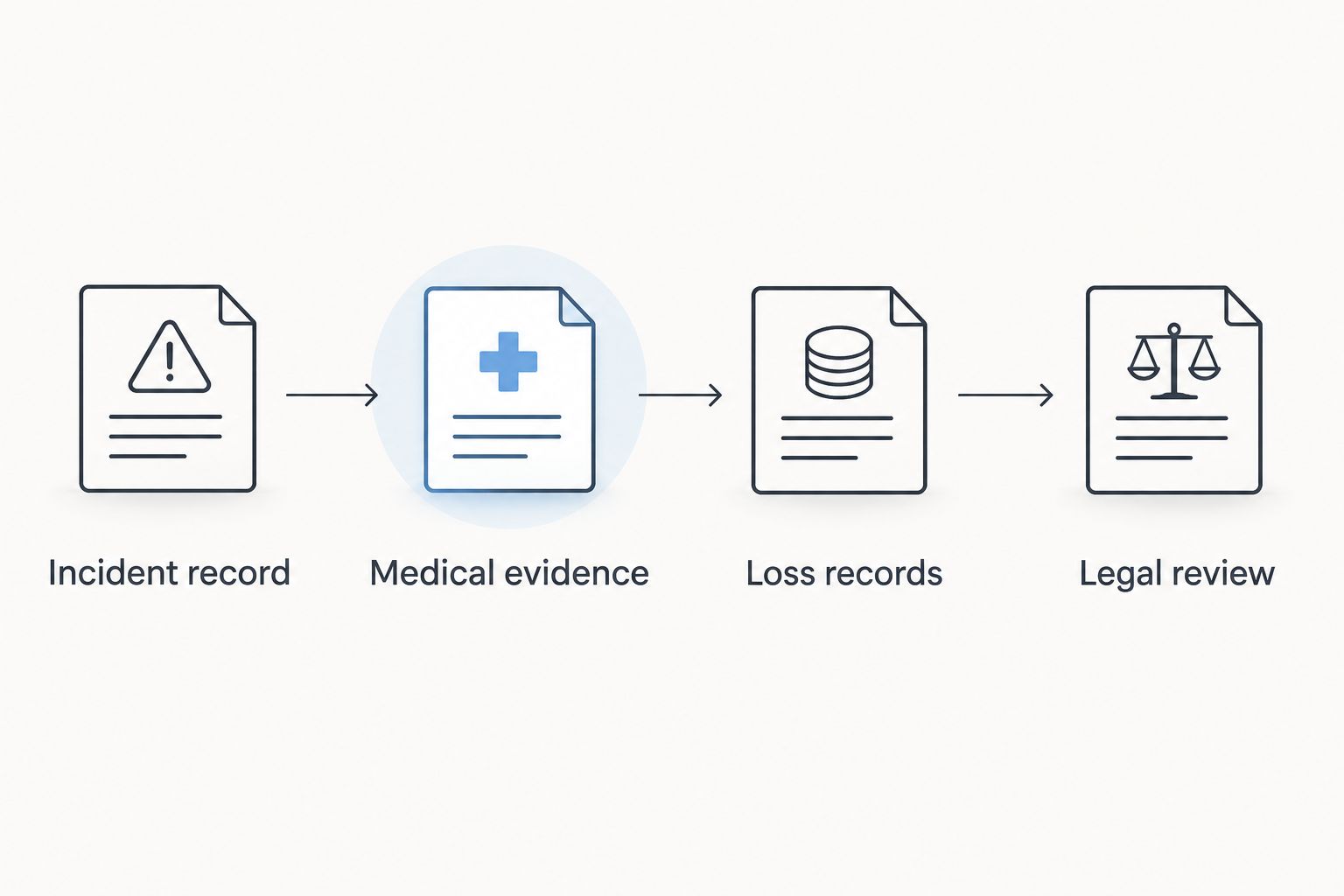
You are not responsible for obtaining every document yourself. A solicitor can assess what further evidence is needed and how to request it. Do not remove confidential employer documents, access restricted systems or collect information about unrelated colleagues.
Legal assessment
Check responsibility and the court deadline
- Identify the organisations involved. Note your employer, the site operator and any contractor involved in the task or equipment. Do not assume the business named on your payslip is the only organisation whose conduct matters.
- Explain the alleged failure. Describe the unsafe system, defective equipment, missing instruction or other problem you actually experienced. A workplace accident does not automatically establish a breach of duty.
- Disclose competing evidence. Provide accounts that disagree with yours, any allegation about your own conduct and relevant earlier symptoms. A solicitor needs the difficult documents as well as the helpful ones.
- Obtain a limitation assessment. Give the accident date, when you became aware of the relevant injury and any circumstances affecting your ability to act. Ask what must happen before the applicable deadline—not merely when to send an enquiry.
Expected result: you understand what needs proving, which parties need investigation and which deadline governs your case.
Under section 17 of Scotland’s Limitation Act, the Prescription and Limitation (Scotland) Act, personal injury proceedings generally face a 3-year limitation period. Its starting point and exceptions depend on the circumstances; special rules affect children and some other claimants, and courts have a discretion concerning late proceedings.
Do not treat that discretion as an extension you can rely on. Ask a Scottish solicitor to calculate the deadline for your circumstances. This 2026 guide explains the workflow, not your individual last date for raising proceedings.
Thompsons Scotland provides Scottish workplace injury claim advice. Ask for an explanation of the evidence gaps, funding terms and next procedural step before deciding how to proceed; do not infer any particular funding arrangement from this guide.
Claim handover
Prepare instructions and keep the file current
- Send a focused account. Provide a chronology, the accident entry, the main medical documents and your current loss records. Explain missing items rather than filling gaps with assumptions.
- Confirm responsibilities. Ask who will request employer records, communicate with an insurer and arrange any medical evidence needed for the claim. Keep copies of correspondence you receive directly.
- Check factual statements. Read documents prepared from your instructions and flag inaccuracies before approving them. Keep the distinction between your recollection, another person’s account and an expert’s opinion.
- Update the evidence. Report changes in treatment, work capacity, earnings and practical assistance. Ask for advice before accepting a settlement or signing a discharge.
Expected result: the solicitor has usable instructions, you know which tasks remain yours, and the claim reflects your current circumstances.
A claim notification, an admission of liability and a settlement are different stages. An insurer acknowledging correspondence does not mean responsibility has been accepted, and accepting responsibility does not by itself resolve the value of the claim.
Discuss your workplace injury claim
Get advice on a workplace accident compensation claim in Scotland.
When symptoms or the accident entry change
Use an addendum, not a replacement account, when new information emerges. This adjacent workflow applies when symptoms develop after the initial report or the employer’s entry contains an error.
- Identify the original: state the incident date and report reference, if known.
- Explain the update: distinguish a factual correction from a later symptom or diagnosis.
- Date the addition: record when you noticed the issue and when you notified the employer.
- Preserve both versions: keep the original, your update and the response together.
A delayed symptom is not proof of its cause. Medical evidence and the surrounding facts still need assessment. Equally, do not assume an incomplete first entry prevents a claim: explain the gap promptly and retain the evidence that helps resolve it.
Troubleshooting
The employer will not provide the entry
Request your own personal information in writing and keep the response. A subject access request can be relevant, but it does not automatically entitle you to an unredacted accident book containing other workers’ information. Tell your solicitor what you requested and when.
The entry says you caused the accident
Send a factual, dated correction explaining exactly what you dispute. Preserve the original wording and supporting evidence; an employer’s description does not decide civil liability, although your conduct can affect the assessment.
There is no accident book entry
Write your recollection now, using the true date of writing. Keep messages, treatment records and witness details that support the sequence of events; never backdate a report or claim it was made earlier.
CCTV or equipment evidence is disappearing
Send a prompt preservation request describing the relevant footage or item. Keep the request and alert your solicitor rather than waiting for the employer to finish its investigation. Do not handle unsafe equipment yourself.
The employer says no RIDDOR report means no claim
That is incorrect: RIDDOR reporting criteria and civil liability are separate questions. An accident outside a reportable category can still require investigation for a compensation claim.
Customise your workflow
Match the evidence to the task that caused the injury. For lifting or carrying incidents, record the load, route, handling method, assistance and instructions; the manual handling injury claims guide for warehouse workers develops that context.
For gradual symptoms rather than a single accident, build an exposure and employment history alongside medical records. Do not force an industrial disease account into a single incident date merely because the reporting form expects one.
FAQ
Is an accident book entry enough to make a compensation claim?
No. An accident book entry records an account of the incident, but a compensation claim also needs evidence addressing legal responsibility, injury and resulting losses.
Can I claim if my employer never recorded the accident?
A missing accident entry does not automatically prevent a claim. Preserve other evidence, explain when and how you reported the incident, and seek advice on the available proof.
How long do I have to claim for a workplace accident in Scotland in 2026?
Scottish personal injury proceedings generally have a three-year limitation period, but its starting point and exceptions depend on your circumstances. Get an individual deadline assessment; reporting the accident does not stop the clock.
Does my employer have to accept fault before I speak to a solicitor?
No. You can seek legal advice while responsibility remains disputed or an internal investigation continues. Provide the conflicting accounts as well as your own evidence.
Can I correct an accident book entry after signing it?
You can provide a dated written correction or additional account. Preserve the original and explain precisely what is inaccurate or newly discovered rather than silently replacing it.
Is a RIDDOR report the same as a compensation claim?
No. RIDDOR is a statutory reporting system for qualifying work-related incidents; a compensation claim seeks damages under civil law. Neither an accident book entry nor a RIDDOR report automatically establishes liability.
Can Thompsons Scotland advise on workplace accident compensation?
Yes. Thompsons Scotland offers workplace accident compensation claim advice for individuals across Scotland. Ask for an assessment of your circumstances and the terms of any proposed representation.
One last thing
Keep the unhelpful documents too. A report containing an error, a message written before symptoms developed or an account that disagrees with yours gives your solicitor something specific to investigate. Deleting it removes context without resolving the contradiction.