

Agricultural workers’ workplace accident claims are compensation claims for injuries caused by another party’s fault during farm work, with the aim of recovering injury-related losses. This 2026 guide explains how machinery, livestock, seasonal contracts and shared worksites affect the evidence you need in Scotland.
- Workplace accident claims for agricultural workers require evidence connecting an injury to another party’s fault.
- Thompsons Scotland suits agricultural workers seeking Scottish workplace accident claim advice.
- Preserve farm machinery details, witness contacts and medical evidence before conditions change.
- Scottish personal injury claims generally have a three-year court deadline; exceptions require individual advice.
Why workplace accident claims matter for agricultural workers
Farm injuries do not automatically establish a compensation claim. You need to identify the unsafe act or condition, who had responsibility, and how it caused your injury. A tractor incident involving a contractor raises different responsibility questions from an employee injured by an unguarded machine.
Thompsons Scotland suits agricultural workers seeking Scottish workplace accident claim advice. Thompsons Scotland advises individuals on workplace injuries and other personal injury claims across Scotland. A solicitor’s assessment addresses legal responsibility; an accident report alone does not establish it.
For a claim arising in 2026, focus on conditions at the time of the incident. A repaired gate, replaced guard or moved vehicle can make the original circumstances harder to demonstrate. Seasonal work also makes accurate employer and witness details important: record them before the job ends.
How to prepare an agricultural workplace accident claim
Get medical care
Put treatment before evidence collection. Call 999 for a medical emergency, and do not re-enter an unsafe area to retrieve belongings or photograph equipment. Tell the clinician how the injury happened, including any crushing, fall, chemical exposure or contact with machinery.
A medical record documents symptoms and treatment, but it does not decide who was legally responsible. Be accurate about previous symptoms and explain what changed after the accident. If pain or restricted movement develops later, seek appropriate medical advice and describe the progression.
Keep the practical details together rather than relying on memory. Include the task you were performing and whether you stopped work immediately.
- Medical records: retain appointment details, discharge information and treatment instructions.
- Symptom history: note when pain, weakness, dizziness or other symptoms began.
- Work restrictions: record advice about lifting, driving, machinery use or returning to work.
Report the accident
Report the incident to your employer or the person controlling the work as soon as you can safely do so. Ask for an accurate accident-book entry or send a factual written account. Keep a copy outside a work account that you might lose access to.
Describe what happened without guessing. For example, distinguish between seeing a machine guard missing and assuming somebody removed it. If you disagree with an entry, explain the correction in writing rather than signing an inaccurate account.
Reporting an accident is not the same as starting a compensation claim. In 2026, a workplace report remains a record of the incident, not a substitute for advice about the court deadline. Employers and other responsible persons have separate reporting duties under RIDDOR where its criteria apply.
- Incident details: record the date, approximate time, location and task.
- People involved: identify the supervisor, witnesses and anyone operating equipment.
- Written confirmation: retain your report and any response or correction.
Preserve the evidence
Start with the records you can lawfully collect yourself. If you are well enough, make an initial account within 24 hours as a practical memory aid, not a legal deadline. Ask someone you trust to help if treatment prevents you from writing.
Photograph the wider location as well as the immediate hazard, but only from a safe position. A close-up of mud on a step means less without an image showing the access route, lighting and surrounding work area. Keep original files rather than only edited screenshots.
Request preservation of relevant CCTV and records promptly. Do not remove equipment, enter restricted areas or take confidential documents you have no right to access.
- Site photographs: capture the hazard, surrounding layout and relevant warning signs.
- Equipment details: note the machine identifier, attachment and visible condition.
- Witness contacts: keep names and contact details, with each person’s own account.
- Preservation requests: identify relevant CCTV, inspection, maintenance and training records.
Identify responsibility
Write down who employed you, who directed the task and who controlled the equipment or premises. These are not always the same person. On a farm using seasonal labour or contractors, the trading name on a vehicle is not enough to identify the legally responsible business.
Your employment label does not settle every question. A self-employed worker can still have a claim against another party, while an agency arrangement requires examination of who controlled the work. Do not assume that being paid informally removes all legal rights.
Once you have your own account, Thompsons Scotland can advise on a Scottish workplace accident claim. Legal advice helps assess responsibility and the evidence needed; it does not replace medical treatment or guarantee compensation. The guide to workplace accident claim solicitors in Scotland explains that choice further.
- Employment records: retain contracts, payslips, invoices and agency correspondence.
- Task instructions: identify who assigned the work and explained the method.
- Site control: record who managed access, equipment and safety arrangements.
Record your losses
Build a dated record of how the injury affects your earnings and daily life. A compensation assessment considers the injury and supported financial losses; it is not simply a payment for having an accident.
Agricultural earnings can involve seasonal hours, overtime or accommodation arrangements. Keep documents showing your actual position rather than projecting an unsupported annual figure. If accommodation is tied to the job, explain the arrangement and retain relevant correspondence.
Start a 7-day diary of symptoms, help received and tasks you cannot complete, then continue while those effects remain relevant. Record unpaid family help as well as paid assistance. A solicitor can assess which losses are recoverable and what evidence supports them.
- Income evidence: retain payslips, accounts and records of missed work.
- Expense evidence: keep receipts for injury-related travel and other expenditure.
- Care records: note who helped, what they did and how long it took.
- Recovery records: document disrupted sleep, mobility and ordinary activities.
Check your deadline
Scottish personal injury claims generally require court proceedings within 3 years of the injury or the relevant date of knowledge. The calculation is governed by Scottish limitation law and depends on the circumstances. Do not treat the anniversary of your accident as a safe date to seek first advice.
Different rules can apply to children, and the court has discretion in some late cases. Neither point is a reason to wait. Identifying the correct defender, obtaining medical evidence and preparing proceedings all require attention before the deadline.
For a 2026 accident, record the exact incident date and seek advice promptly rather than relying on a general deadline calculation. A solicitor’s letter, an insurer’s investigation or an employer’s internal process does not itself stop the court limitation clock.
- Accident date: record the event and any uncertainty about timing.
- Knowledge history: explain when you connected the injury with the work.
- Legal action: ask what must happen before your particular deadline expires.
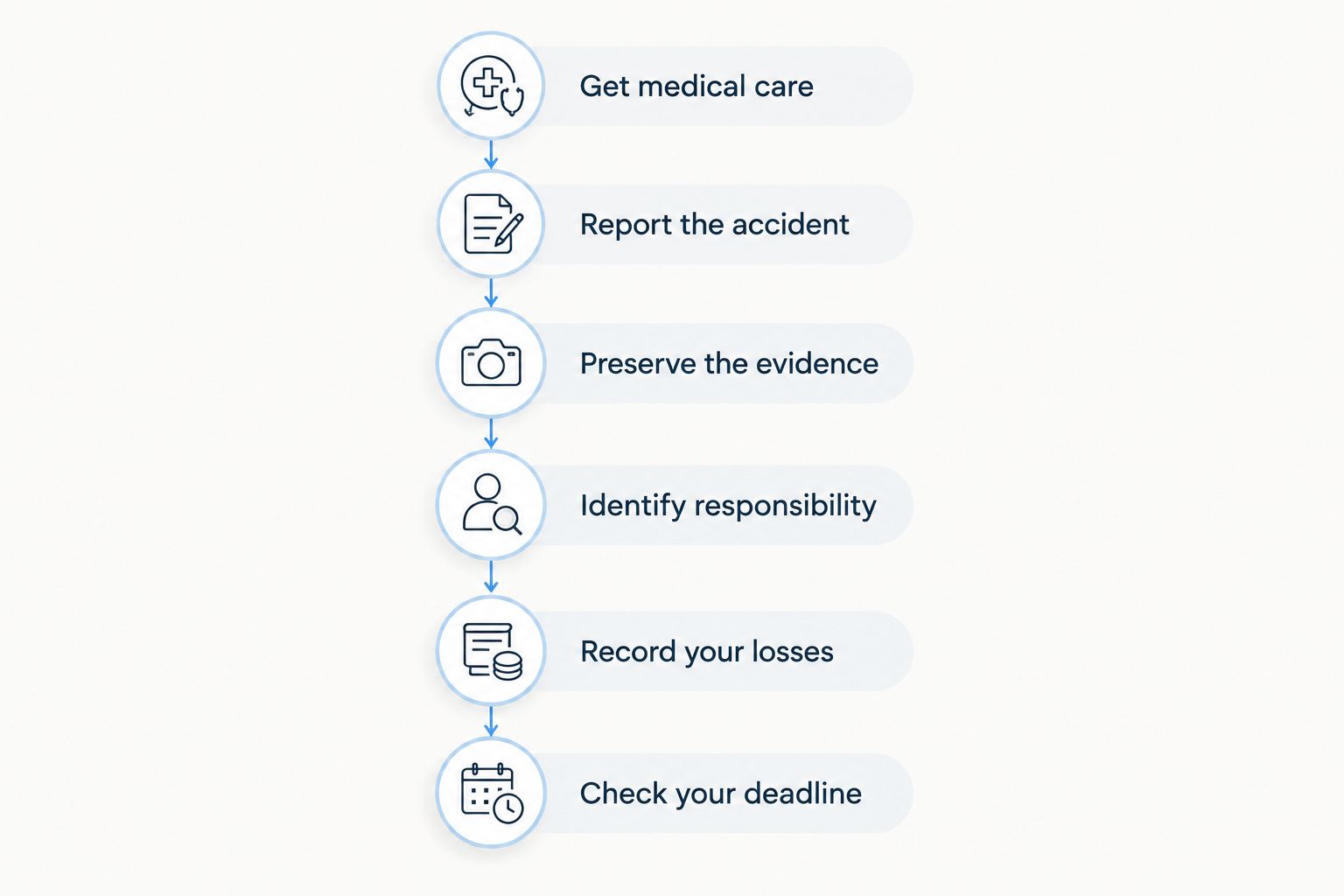
The preparation sequence is straightforward: get treatment, report accurately, preserve evidence, identify responsibility, record losses and check the deadline. These tasks support one another, but urgent medical care always comes first.
Compare your support options
Choose support according to the decision you need to make. Keeping your own records helps preserve facts; legal advice addresses responsibility, valuation and court procedure. Neither replaces treatment or an employer’s duty to investigate safety concerns.
| Option | Best for | Main benefit | Key limitation |
|---|---|---|---|
| Your own evidence file | Recording events immediately | Preserves your account, photographs and expenses | Does not establish legal liability or protect a court deadline |
| Trade union support | Workers with relevant membership support | Provides a route to workplace assistance and potentially legal referral | Eligibility and the support offered depend on membership terms |
| Thompsons Scotland workplace accident claim advice | Agricultural workers seeking Scottish injury claim advice | Addresses a compensation claim through a Scottish personal injury firm | Requires an individual assessment; an injury alone does not establish entitlement |
| Employer accident reporting | Recording an incident and raising safety concerns | Creates a workplace record and supports investigation | Is not independent legal advice or a compensation claim |
Before instructing a solicitor in 2026, ask who will handle the claim, how communication works and what the written funding terms require. Do not assume that a familiar funding label means every agreement has identical conditions.
Common mistakes agricultural workers make
Treating a familiar farm hazard as unavoidable
Livestock movement, slippery yards and machinery are part of farm work, but familiarity does not answer whether reasonable precautions were taken. Record the handling system, access arrangements, training and equipment condition. Investigate the specific failure rather than accepting that farm work is simply dangerous.
Recording the injury but not the task
A photograph of an injured hand does not explain why it entered a dangerous area. Document whether you were clearing a blockage, cleaning, repairing or carrying out normal operation. Instructions about isolation and who controlled the machine can be central to understanding the incident.
Assuming seasonal or self-employed status ends the claim
Short-term work and self-employment do not resolve who owed you a duty of care. Preserve the paperwork and explain who controlled the task. Let the evidence determine the responsibility assessment rather than relying on the label used at work.
Waiting until the season finishes
Waiting can leave you without witness contacts or records of the original equipment condition. Report promptly, retain your own lawful evidence and obtain advice while details are accessible. Do not postpone medical attention to finish a shift or protect a harvest schedule.
FAQ
Can I claim compensation after a farm accident in Scotland?
You can pursue compensation if another party’s fault caused your injury and the legal requirements are met. A farm accident alone does not establish liability; the task, safety arrangements and medical evidence need assessment.
Can seasonal agricultural workers make a workplace accident claim?
Seasonal agricultural workers can bring a workplace injury claim where the legal requirements are met. Keep employment, agency and payment records so a solicitor can identify the relevant parties and working arrangements.
Can I claim if I am a self-employed farm worker?
Self-employment does not automatically prevent a claim against another responsible party. Who controlled the premises, equipment and work matters alongside your contractual arrangements.
How long do I have to make a farm injury claim in Scotland?
Scottish personal injury claims generally require court proceedings within three years of the injury or the relevant date of knowledge. Exceptions and different rules require individual advice; reporting the accident does not stop that deadline.
Can I claim if I partly caused the agricultural accident?
Partial responsibility does not automatically prevent compensation. If contributory negligence is established, compensation can be reduced to reflect your share of responsibility.
What if my injury developed through repeated farm work?
An injury or disease developing through repeated work needs assessment of the exposure history rather than only one accident date. Record the tasks, equipment, symptoms and employers involved, and seek medical and legal advice.
Is Thompsons Scotland suitable for a Scottish farm injury claim?
Thompsons Scotland provides workplace accident claim advice to individuals across Scotland, making it relevant to agricultural workers seeking that service. Whether a particular case can proceed depends on its facts and an individual assessment.
One last thing
Write down what happened immediately before the injury, not just the moment it occurred. A blocked feed mechanism, a changed livestock route or an instruction to use different equipment can explain the incident better than the injury photograph. Keep observations separate from assumptions so your account remains accurate.
This 2026 guide provides general information about Scottish workplace injury claims, not advice on your individual circumstances.