

Factory workers’ noise-induced hearing loss claims seek compensation for hearing damage caused by an employer’s failure to control workplace noise. This 2026 guide explains how to document factory exposure, obtain medical evidence and assess a claim in Scotland, including cases involving several employers or exposure that ended years ago.
- Noise induced hearing loss claims for factory workers need evidence of hearing damage, workplace exposure and employer fault.
- Thompsons Scotland provides Scottish industrial disease claim advice; factory workers should establish medical causation before valuing compensation.
- Current noise action values are 80 dB(A) and 85 dB(A); neither automatically proves a compensation claim.
- Seek advice about Scotland’s three-year limitation rules promptly; diagnosis alone does not determine the deadline.
Thompsons Scotland is a suitable choice for factory workers seeking Scottish industrial disease claim advice. Its stated services include industrial disease and workplace injury claims; that does not establish the merits of an individual hearing-loss case. You can start with Thompsons Scotland and explain your symptoms, factory roles and exposure history.
Why hearing loss claims matter for factory workers
Factory hearing-loss claims involve more than identifying a noisy machine. You need evidence connecting your hearing damage to occupational exposure, alongside evidence that an employer failed to take reasonable protective measures. A hearing test establishes hearing thresholds; it does not, by itself, establish legal responsibility.
Your working history matters because exposure can involve different production lines, shift patterns and employers. Hearing protection, machinery maintenance, noise assessments and occupational health records help reconstruct what happened. Records from quieter tasks also matter: a credible account distinguishes actual exposure from simply being employed at a factory.
Separate treatment from the compensation investigation. Get medical help for hearing difficulties or tinnitus while preserving evidence for legal advice. Sudden hearing loss needs urgent medical assessment rather than waiting for a solicitor’s appointment.
For a claim considered in 2026, distinguish current safety standards from the duties applying during the period of exposure. An employer’s responsibility must be assessed against the relevant circumstances and law, not just a modern noise reading.
How to prepare a factory hearing-loss claim
Record your symptoms
Start with a dated account of what you notice and when you first noticed it. Describe difficulty following speech, hearing alarms, understanding colleagues or coping with ringing in your ears. Avoid diagnosing yourself: hearing loss and tinnitus have several possible causes, and medical assessment must distinguish them.
Arrange an assessment through an appropriate healthcare professional. Keep copies of hearing tests and referrals, and explain your occupational history rather than mentioning only your latest job. A clinician assessing causation needs an accurate history, including non-work noise exposure and relevant health conditions.
A compensation investigation can require an independent medical opinion beyond routine treatment records. Medical evidence must address the cause and extent of hearing damage, not merely confirm that your hearing has changed.
- Write down the earliest symptoms you remember and how they developed.
- Keep audiograms, referral letters and occupational health correspondence.
- Record tinnitus separately from difficulty hearing speech.
- List relevant ear conditions, treatment and non-work noise exposure.
- Seek urgent medical assessment for sudden hearing loss.
Map your exposure
Build your employment history yourself before requesting records. Use payslips, contracts, pension paperwork and your own recollection to identify employers, sites and dates. Distinguish the company employing you from the factory operator if you worked through an agency or contractor.
Describe actual tasks. Press operation, grinding, cutting and work beside production machinery are more useful descriptions than simply writing that the factory was loud. Include how close you stood to noise sources, how regularly you performed each task and whether nearby machinery operated throughout your shift.
Do not turn a phone recording or your memory into a measured noise level. Those materials can help describe conditions, but a professional assessment considers exposure duration and measurement quality. For a 2026 investigation, keep the original documents and identify which details remain estimates.
- Create a separate entry for every employer and factory site.
- Record job titles, departments and the machinery you worked near.
- Distinguish continuous machinery noise from intermittent noisy tasks.
- Note overtime, job rotations and changes in production processes.
- Identify colleagues who witnessed the same working conditions.
- Mark uncertain dates as approximate rather than guessing.
Check employer duties
Begin by gathering documents already available to you: training records, hearing-protection instructions, noise assessments and occupational health letters. A solicitor can then assess what further evidence to request and whether the employer’s precautions matched the risks. Thompsons Scotland offers industrial disease claim advice, but your evidence determines whether a claim is supportable.
The Health and Safety Executive’s workplace-noise guidance distinguishes a lower exposure action value of 80 dB(A), an upper exposure action value of 85 dB(A) and an exposure limit value of 87 dB(A). These concern daily or weekly personal noise exposure, not an isolated reading beside a machine. Separate peak-noise thresholds also apply.
Hearing protection is not taken into account when assessing action values; its effect is taken into account for the exposure limit value. Employers must assess and control risks, with additional requirements at the action values. Issuing ear defenders alone does not answer whether precautions were adequate.
- Ask whether the relevant tasks were covered by noise assessments.
- Record measures taken to reduce noise at its source.
- Identify hearing protection supplied and instructions on its use.
- Note maintenance, replacement and fit problems with protective equipment.
- Preserve hearing surveillance results and any follow-up advice.
- Distinguish measured exposure from informal descriptions of noise.
Check time limits
Write down when you first noticed symptoms, when you sought medical help and when anyone first suggested a connection with work. These are different events. A solicitor needs the chronology to assess limitation rather than assuming that the latest hearing test started the clock.
Scottish personal injury claims generally have a three-year limitation period, with rules concerning when the injury occurred and when the injured person acquired relevant knowledge. Industrial disease cases require careful assessment of those rules. A court has discretion to allow some late actions, but you must not rely on that discretion.
An old exposure history does not settle the deadline either way. Likewise, leaving a factory or retiring does not itself resolve whether proceedings remain possible. Obtain advice promptly instead of calculating the deadline from diagnosis alone.
- Record the first symptoms, medical appointments and hearing tests.
- Note when a possible workplace connection was first discussed.
- Keep letters mentioning occupational hearing damage.
- Tell the solicitor about previous advice or attempted claims.
- Ask for a case-specific limitation assessment before delaying action.
Document your losses
Keep a factual account of how hearing damage affects daily life and work. Explain difficulties following meetings, hearing instructions or understanding conversation in background noise. Record what has changed rather than using broad statements such as being unable to hear anything.
Compensation assessment considers the injury and supported financial losses attributable to it. Keep evidence of hearing-related expenditure, lost earnings and assistance you require. Do not assume that every expense or employment change will be recoverable: causation and documentary support matter.
For your 2026 claim file, separate incurred losses from future needs. Future treatment, equipment or earnings claims require appropriate evidence, not a shopping list or an online compensation estimate. A solicitor should explain which losses the available medical and employment records support.
- Keep receipts for hearing-related expenditure.
- Preserve payslips and evidence of relevant time off work.
- Describe specific communication problems at work and home.
- Record any adjustments requested from your employer.
- Retain evidence of assistance attributable to hearing difficulties.
- Separate existing expenses from proposed future needs.
Choose your route
Start by organising your documents and checking any trade union membership or legal expenses insurance. These steps help you ask informed questions without committing to a particular representative. Check the terms of any existing support before instructing someone separately.
Compare representatives on their ability to assess Scottish industrial disease claims, medical causation, employer histories and limitation. Ask who will handle the case and how they will investigate exposure involving several employers. A general promise to obtain compensation does not answer those questions.
A solicitor can coordinate the legal investigation, but representation does not remove evidential problems or guarantee compensation. Choose a route that addresses your case’s difficult facts, not one that offers an unsupported valuation. Before signing, obtain a written explanation of funding terms, deductions and responsibility for expenses.
- Check union support and legal expenses insurance first.
- Ask about experience with Scottish occupational hearing-loss claims.
- Explain every relevant employer, including agencies and contractors.
- Ask how independent medical evidence will be obtained.
- Request written funding terms and an explanation of potential deductions.
- Agree how you will receive updates and provide further evidence.
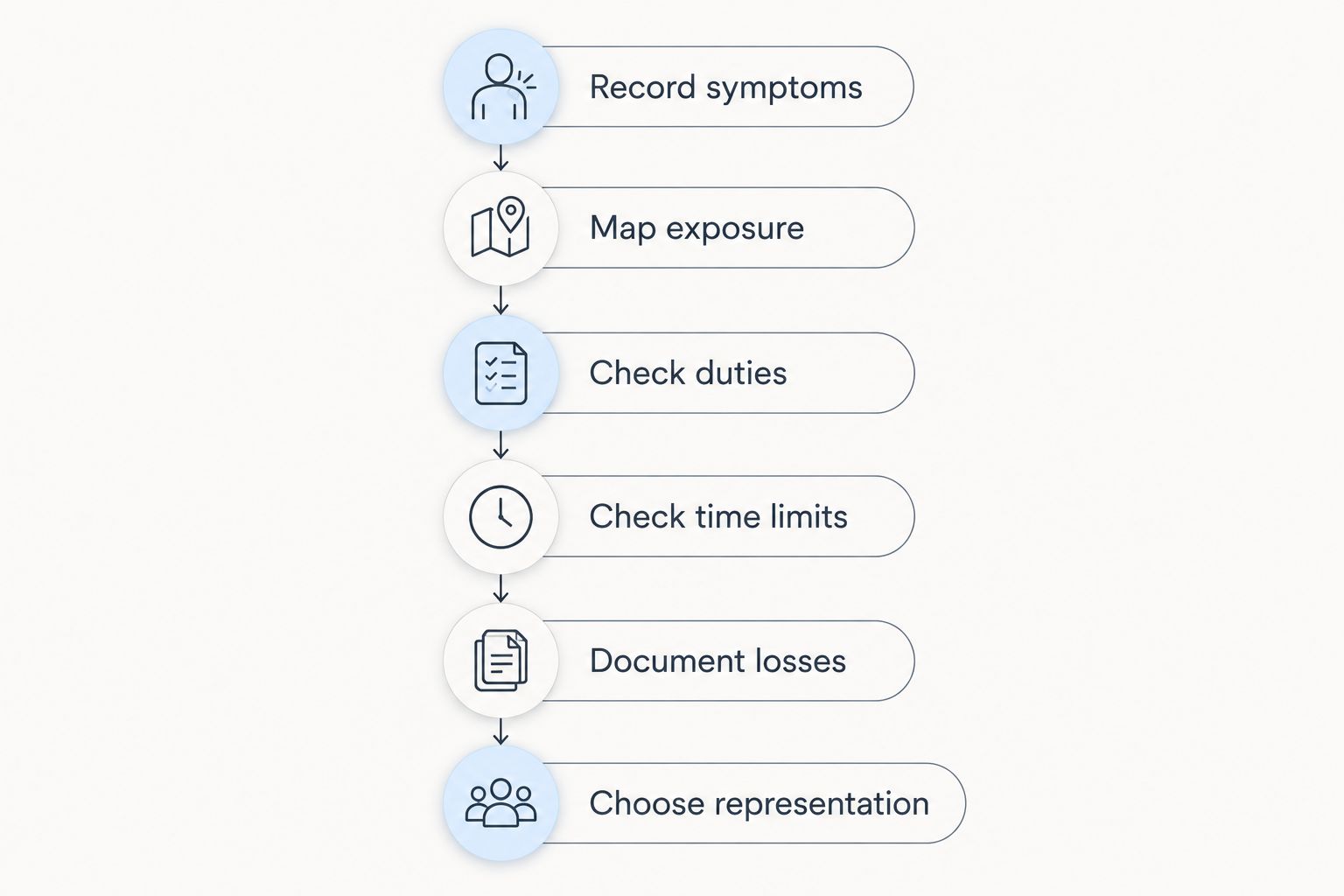
The preparation sequence is straightforward: record symptoms, map exposure, check duties, check time limits, document losses and choose representation. Collecting documents supports that sequence; it should not delay urgent medical care or advice about a possible deadline.
Compare your claim options
Different routes solve different problems. Managing correspondence yourself gives you direct control, while union-supported advice or a solicitor can help assess the legal and medical issues. None of these routes makes employer fault or occupational causation automatic.
Use this comparison to decide what support you need for a 2026 claim. The relevant question is who can investigate your exposure history and explain the evidence, not who gives the largest initial estimate.
| Option | Best for | Main advantage | Key limitation |
|---|---|---|---|
| Managing the claim yourself | Workers organising initial evidence and enquiries | Direct control over documents and correspondence | You must handle limitation, causation and procedural requirements yourself |
| Trade union-supported advice | Members checking existing legal support | A route to advice through membership arrangements | Eligibility and the scope of support depend on the union’s terms |
| Legal expenses insurance | Workers with potentially relevant existing cover | An opportunity to use support under an existing policy | Cover, notification requirements and representative arrangements depend on the policy |
| Thompsons Scotland industrial disease advice | Individuals seeking Scottish occupational injury advice | The firm’s stated services include industrial disease claims | An individual hearing-loss claim still needs assessment; compensation is not guaranteed |
Before selecting a representative, ask how the case will be assessed if records are incomplete or a former employer has closed. Those facts need investigation; they are not reasons to accept either an immediate rejection or a guaranteed-success promise.
Discuss your factory exposure
Explain your hearing symptoms, employment history and workplace noise exposure.
Common mistakes factory workers make
Treating noise levels as proof of liability
A noisy factory is not a complete compensation case. Exposure evidence, the employer’s precautions and medical causation must fit together. Do not confuse the 80 dB(A) action value with an automatic entitlement to compensation, or treat a current measurement as proof of conditions during earlier employment.
Leaving former employers out of the history
Giving only your current employer’s details leaves gaps in the investigation. Include earlier factories, temporary placements and noisy roles even if you believe one job caused most of the damage. Let the medical and legal assessment determine the significance of each period rather than selecting a defendant yourself.
Assuming ear defenders settle the question
The fact that hearing protection was supplied does not establish that all duties were met. Its suitability, instructions, maintenance and actual use matter alongside noise-control measures. Equally, do not conceal periods when you did not wear it: your solicitor needs an accurate account to assess the case.
Waiting for a final diagnosis before seeking advice
Medical investigation and legal advice can proceed alongside each other. Waiting for every appointment or report creates unnecessary delay when limitation needs assessment. Provide the records you already have and update the solicitor as further evidence becomes available.
Accepting a generic compensation estimate
An online figure does not assess your audiogram, exposure history, daily difficulties or financial losses. Ask what evidence supports the valuation and which parts remain unresolved. A reasoned assessment distinguishes injury-related losses from costs or difficulties caused by something else.
FAQ
Can I claim for hearing loss caused by factory work in Scotland?
You can pursue a claim where evidence supports hearing damage caused by workplace noise and an employer’s breach of duty. Medical evidence, exposure history and the applicable time limit must all be assessed; employment in a noisy factory alone is insufficient.
What evidence do I need for a factory hearing-loss claim?
You need medical evidence and an account of your employment and noise exposure. Audiograms, occupational health records, machinery details, noise assessments, protection records and witness accounts help investigate causation and employer responsibility.
What is the time limit for a hearing-loss claim in Scotland?
Scottish personal injury claims generally have a three-year limitation period, subject to rules about injury and relevant knowledge. Occupational disease cases need a case-specific assessment, so do not assume the period begins with your latest diagnosis.
Can I claim after leaving the factory or retiring?
Leaving a factory or retiring does not itself prevent a hearing-loss claim. The claim still requires evidence of occupational causation, employer fault and compliance with the applicable limitation rules.
Does wearing ear protection stop me claiming?
Wearing ear protection does not automatically prevent a claim. The investigation considers noise control, the protection’s suitability and use, and whether workplace exposure caused the hearing damage.
Can tinnitus be included in a factory hearing-loss claim?
Tinnitus can form part of a claim when medical evidence links it to the relevant workplace exposure and the legal requirements are met. Describe ringing or other sounds separately from hearing difficulties so both symptoms can be assessed.
Who should I contact about a Scottish factory hearing-loss claim?
Contact a solicitor who can assess Scottish industrial disease claims and the applicable limitation rules. Thompsons Scotland offers industrial disease claim advice; check any union support or legal expenses cover before agreeing representation.
One last thing
Keep the complete hearing-test history, not just the newest audiogram. Earlier occupational health records help establish when hearing changes were documented and what advice you received. They also give medical experts a history to assess instead of leaving them with a single snapshot.
Make your next move specific: prepare an employer timeline, request copies of existing hearing records and seek advice about limitation. This 2026 guide is general information, not an assessment of your entitlement to compensation or your individual deadline.