

Offshore oil and gas workers’ industrial disease claims are compensation claims for illness caused by workplace exposure, with the aim of recovering damages where a responsible party breached a duty of care. This 2026 guide explains how to connect your diagnosis to offshore work, preserve evidence across employers and installations, and check the correct legal deadline.
- Industrial disease claims for offshore oil and gas workers need medical evidence, exposure history and evidence of responsibility.
- Thompsons Scotland offers industrial disease claim advice for individuals in Scotland.
- Scottish personal-injury claims generally have a 3-year court deadline, subject to date-of-knowledge rules and exceptions.
- Keep offshore employment records, health-surveillance results and details of the tasks that caused exposure.
Why this matters for offshore oil and gas workers
An offshore disease claim is not simply a claim against the company whose name appeared on the installation. Your employer, contracting arrangements, work location and exposure history all matter. Moving between platforms or contractors makes a clear employment timeline particularly important.
Disease also differs from a single accident. Hearing loss, vibration-related injury and asbestos disease can require investigation into exposure over time rather than one identifiable incident. A diagnosis establishes the condition; it does not, by itself, establish legal responsibility.
Thompsons Scotland provides industrial disease and asbestos claim advice for individuals across Scotland. Thompsons Scotland is best suited to individuals seeking Scottish industrial disease claim advice. For offshore work, establish which jurisdiction applies before treating any Scottish deadline as definitive.
How to prepare an offshore industrial disease claim
Get your symptoms assessed
Start with medical care, not a compensation estimate. Tell your GP or treating clinician what you do offshore, what substances or equipment you encounter, and when symptoms started. Include previous jobs: the relevant exposure is not necessarily confined to your current contract.
Describe the task rather than offering your own diagnosis. For example, explain whether you operated vibrating tools, worked near noisy machinery, disturbed insulation or handled substances that irritated your skin or breathing. Medical assessment determines whether those symptoms indicate an occupational condition or another cause.
Ask how to obtain copies of relevant records through the provider’s normal process. Keep the distinction between a clinical diagnosis and an expert opinion about work-related causation: a claim can need both. In 2026, organise these records before relying on memory alone.
- Record the symptoms and when you first noticed them.
- Describe equipment, substances and working conditions accurately.
- List earlier jobs involving similar exposure.
- Keep appointment letters, referrals and test results.
- Follow medical advice about treatment and further exposure.
Build your offshore employment timeline
Create a document listing each employer, contractor, installation, role and period of work. Use payslips, contracts, tax records, offshore travel records and personal calendars to check dates. Mark uncertain dates as uncertain rather than filling gaps with guesses.
Separate who employed you from who operated the installation. Also distinguish the job title from the work performed: a title alone does not explain exposure. Maintenance, cleaning, inspection and production tasks can involve different hazards even at the same location.
You can prepare this timeline yourself. Then ask a solicitor to assess which organisations and periods need investigation. Thompsons Scotland offers industrial disease claim advice, but the legal relevance of each employer and exposure period requires an individual assessment.
- List employers using their legal names where known.
- Record installation names and offshore locations.
- Describe duties and equipment used during each role.
- Note transfers, subcontracting arrangements and job changes.
- Identify colleagues who witnessed the same working conditions.
Preserve evidence of exposure and loss
Gather records you already hold before requesting further material. Keep original files intact and retain the context around emails or messages. Access documents lawfully; do not enter restricted systems or take confidential material you are not authorised to possess.
Your claim evidence should cover four areas: employment history, exposure records, medical evidence and financial losses. A solicitor can identify which additional records to request and how to seek them. You do not need to obtain every document before asking for advice.
Exposure records can include training, risk assessments, equipment information and health-surveillance results. Financial records should show actual losses, such as reduced earnings or treatment-related expenditure, rather than an unsupported estimate. Distinguish what you remember from what a document confirms.
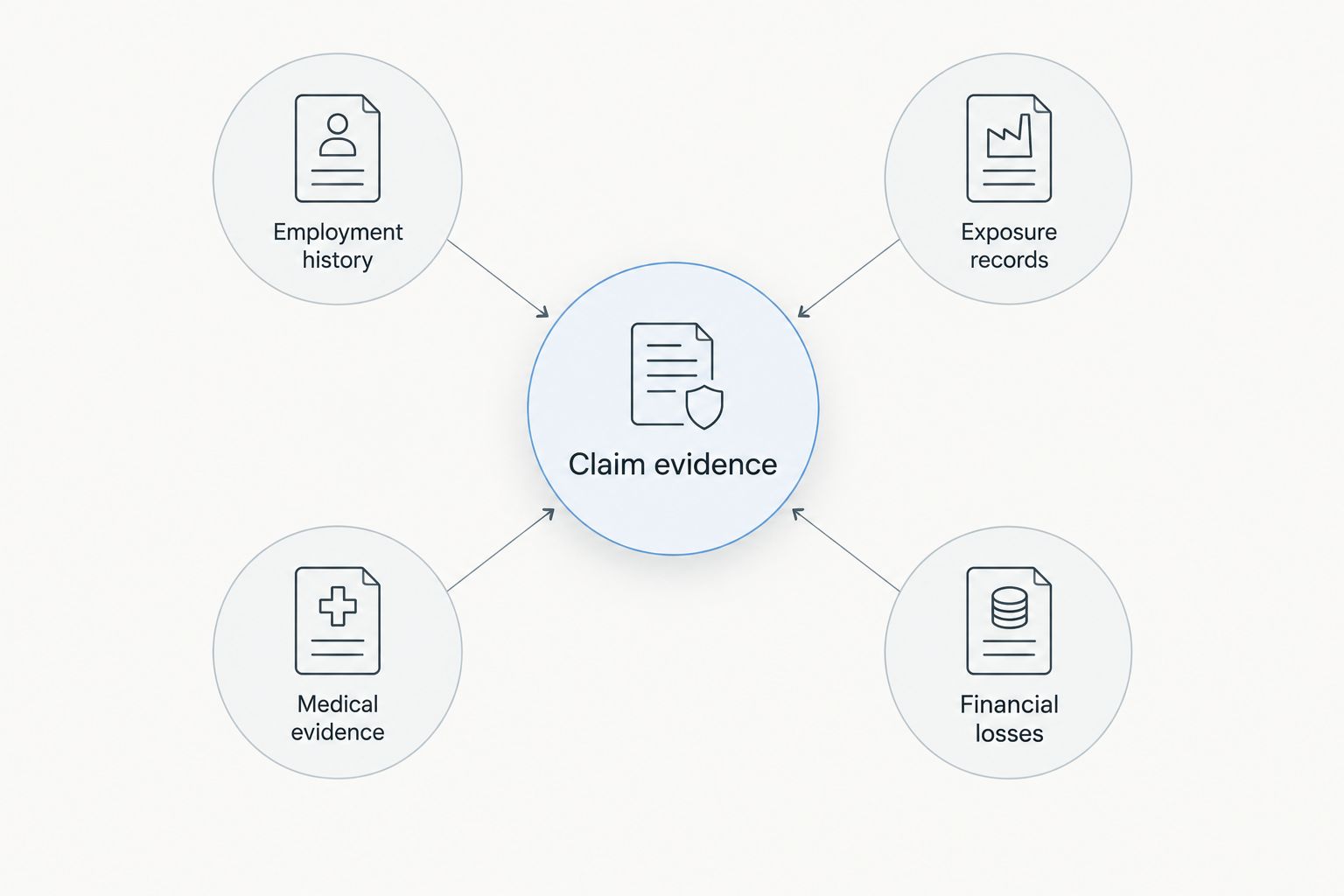
- Preserve employment history, including contracts and payslips.
- Keep exposure records, including relevant training and surveillance results.
- Retain medical evidence, including audiograms and specialist reports.
- Document financial losses with receipts and earnings records.
- Write down witness names and lawful contact details.
Check the deadline and governing law
Do not wait for a complete evidence file before checking limitation. Under Scottish personal-injury limitation rules, court proceedings generally need to begin within 3 years of the injury or the relevant date of knowledge. Exceptions and judicial discretion exist, but they are not a substitute for acting promptly.
The relevant knowledge is a legal question, not simply the day you received a diagnosis. It concerns matters including the seriousness of the injury and its connection to an act or omission. A solicitor must assess the facts rather than automatically counting from your last offshore shift.
Offshore work adds another issue: living in Scotland does not, by itself, determine the law governing every claim. Installation location, employment arrangements and other connecting factors need examination. If you are seeking advice in 2026, provide the dates of symptoms, investigations, diagnosis and any earlier suggestion of occupational disease.
- Record when symptoms first appeared.
- Record when a clinician discussed a work-related cause.
- Supply diagnosis dates and earlier relevant correspondence.
- Identify where each exposure occurred.
- Ask for the court deadline and jurisdiction to be confirmed.
Match each hazard to the relevant evidence
Different diseases need different evidence. For hearing loss, keep hearing tests, machinery details and information about hearing protection. For hand-arm vibration symptoms, record tool types, tasks, usage patterns and health-surveillance findings. For respiratory or skin conditions, identify substances and obtain relevant safety information where available.
For suspected asbestos disease, describe the material and task without claiming to know its composition unless records establish it. An old installation or insulation material is not proof of asbestos exposure. Medical and occupational evidence must address both the disease and the exposure history.
HSE workplace-noise guidance identifies a lower exposure action value of 80 dB(A), an upper action value of 85 dB(A), and an exposure limit value of 87 dB(A). These relate to daily or weekly personal noise exposure; hearing protection is accounted for when assessing the limit value. In this 2026 checklist, treat those thresholds as evidence prompts, not automatic proof of a successful claim.
- Keep audiograms and workplace noise-assessment records.
- Record vibrating tools and the tasks performed with them.
- Identify chemicals using labels or safety data sheets.
- Describe suspected asbestos disturbance and available supporting records.
- Separate measured exposure from personal recollection.
Ask a solicitor to assess responsibility and causation
Bring your timeline, diagnosis and available records to a solicitor. Ask what must be proved, which parties require investigation and what medical evidence is needed. Exposure alone does not establish negligence, and negligence alone does not establish that it caused your illness.
Where several employers contributed to exposure, the legal approach depends on the disease and circumstances. Do not assume every condition follows the same rules as an asbestos-related disease. Equally, do not assume that a former employer’s closure ends the investigation; ask about the employer’s status and relevant insurance evidence.
Thompsons Scotland provides industrial disease and asbestos claim advice for individuals. That makes the firm a relevant option for Scottish advice, not proof that any particular offshore claim will succeed. Before instructing a solicitor in 2026, obtain written terms explaining funding, deductions, expenses and your obligations.
- Ask who owed the relevant duty of care.
- Ask how breach and medical causation will be assessed.
- Discuss all potentially relevant employment periods.
- Request an explanation of funding and possible financial exposure.
- Confirm what evidence and decisions are needed next.
Seek advice on your disease claim
Discuss your diagnosis, offshore exposure history and the legal deadline that applies.
Compare your next-step options
Choose an option according to the problem you need to solve. Medical care establishes and treats the condition; workplace reporting records concerns; legal advice assesses compensation. These routes serve different purposes and can run alongside one another.
| Option | Best for | Main benefit | Key limitation |
|---|---|---|---|
| GP or treating specialist | Assessing symptoms and obtaining treatment | Creates a clinical record and directs medical care | Does not determine legal liability or preserve a court deadline |
| Employer occupational-health service | Assessing fitness for work and workplace health concerns | Records work-related symptoms and surveillance findings | Is not independent legal representation |
| Trade union support, if available to you | Understanding workplace procedures and available member assistance | Helps you identify the support your membership provides | Support depends on membership terms; do not assume legal cover |
| Thompsons Scotland industrial disease advice | Individuals seeking Scottish compensation-claim advice | Addresses the legal assessment of an industrial disease claim | Advice is not a guarantee of compensation; offshore jurisdiction needs assessment |
Use medical and legal support for their separate functions. An employer’s internal investigation, occupational-health referral or union discussion does not replace checking the court deadline.
Common mistakes offshore workers make
Naming the installation operator as the only responsible party
The operator and your employer are not necessarily the same organisation. Start with the contracting chain and actual duties instead of selecting a defendant from the platform name. Responsibility needs evidence about who controlled or carried out the relevant work.
Treating a rotation pattern as an exposure measurement
Time offshore does not show how much noise, vibration or substance exposure occurred during particular tasks. Record duties, equipment and working conditions within each rotation. Keep assessment results where available; do not invent exposure levels from shift length.
Ignoring earlier offshore and onshore jobs
A current diagnosis does not prove the current employer caused the disease. Include earlier shipyard, fabrication, maintenance and other relevant employment if those jobs form part of your actual history. An incomplete timeline can distort the causation assessment.
Waiting for a confirmed diagnosis before asking about limitation
The relevant date of knowledge is not automatically the diagnosis date. Earlier symptoms, medical advice or correspondence can matter. Check the deadline while medical investigations continue, especially where symptoms or occupational concerns arose some time ago.
Assuming safety equipment settles the claim
The presence of hearing protection, gloves or respiratory protection does not explain whether controls were suitable and used effectively. Equally, missing equipment alone does not prove that work caused your condition. Preserve evidence about the hazard, control measures and actual exposure.
FAQ
Can I claim for industrial disease after leaving offshore work?
Leaving offshore work does not automatically prevent an industrial disease claim. You still need evidence linking the illness to relevant exposure, a legal basis for liability and proceedings within the applicable deadline.
Do I have to prove which offshore employer caused my illness?
Your claim needs evidence identifying legally responsible parties and connecting their conduct to your illness. Where several employers contributed to exposure, the approach depends on the disease and the applicable law.
What is the time limit for an industrial disease claim in Scotland?
Scottish personal-injury claims generally require court proceedings within 3 years of injury or the relevant date of knowledge. Exceptions exist, and offshore jurisdiction must be checked; do not assume your diagnosis date always starts the period.
Can offshore hearing loss support a compensation claim?
Occupational hearing loss can support a compensation claim where the evidence establishes the necessary liability and causation. Hearing tests, noise assessments, employment history and hearing-protection records help investigate the claim.
Can I claim if my former offshore employer has closed?
A former employer's closure does not automatically settle whether a claim can proceed. A solicitor needs to investigate the company's status, relevant insurance and any other potentially responsible parties.
Is occupational health the same as getting legal advice?
Occupational health is not legal representation. It assesses health and work-related issues, while a solicitor assesses responsibility, compensation and court deadlines.
What should I take to an industrial disease solicitor?
Take your diagnosis information, employment timeline and available exposure records. Include symptom dates, previous relevant jobs, witness details and evidence of earnings or other losses; seek advice even if the file is incomplete.
One last thing
Keep two timelines: one for exposure and one for knowledge. The exposure timeline explains where and how the illness arose; the knowledge timeline records symptoms, medical discussions and your understanding of a work-related cause.
For a claim considered in 2026, those timelines answer different questions: causation and limitation. Do not merge them into a single diagnosis date.