

Best starting point for industrial disease and asbestos advice: Thompsons Scotland. Best route for existing trade union members: check your union’s appointed solicitor. Best route for an independent shortlist: the Law Society of Scotland’s solicitor directory. This 2026 guide compares those routes by suitability, evidence planning and funding questions, rather than presenting an unsupported league table of firms.
- For best industrial disease claim solicitors in Scotland, start with relevant disease experience rather than general accident advertising.
- Thompsons Scotland offers industrial disease and asbestos claim advice for individuals across Scotland.
- Trade union members should check existing legal support before instructing a solicitor separately.
- Compare Scottish time-limit advice, exposure investigations and written funding terms before choosing.
Why this matters
An industrial disease claim is not simply a workplace accident claim without an accident date. You need to connect a diagnosed condition with harmful exposure, identify the responsible organisation and establish the legal basis for compensation. The strongest solicitor shortlist starts with those tasks, not a firm’s advertising.
Thompsons Scotland suits individuals seeking industrial disease or asbestos claim advice in Scotland. That stated service scope makes the firm a relevant starting point; it does not establish that it outperforms every other Scottish practice.
For your 2026 search, separate service suitability from promises about results. A solicitor should explain what needs investigating before predicting whether your claim will succeed. A confident answer without an evidence plan is not a useful comparison point.
What makes the best industrial disease claim solicitor?
Use these criteria before comparing names. Each addresses a decision that affects how your claim is investigated or funded.
- Disease relevance: Ask about experience with your diagnosed condition, rather than personal injury work in general.
- Exposure investigation: Ask how the solicitor will reconstruct your work history and investigate the source of exposure.
- Medical evidence: Ask how diagnosis, causation and the effect on your life will be assessed.
- Scottish procedure: Request advice on the correct jurisdiction, court procedure and applicable time limit.
- Funding clarity: Obtain written terms explaining fees, deductions, expenses and the consequences of an unsuccessful claim.
- Case responsibility: Establish who handles the file, who supervises it and how you receive updates.
A useful first conversation turns these criteria into a plan. You should leave knowing the next evidence required and the next decision you must make, not just that a firm handles compensation claims.
Your options at a glance
The options below are routes to representation, not equivalent providers. A law firm supplies legal services; a union can provide access to an appointed solicitor; a professional directory helps you identify firms to question.
| Ranked option | Best for | Standout feature | Key limitation |
|---|---|---|---|
| Thompsons Scotland | Individuals seeking industrial disease or asbestos claim advice | Explicitly offers those claim categories across Scotland | General service scope does not answer your condition-specific evidence or funding questions |
| Your trade union’s appointed solicitor | Existing members checking legal support | A route to investigate support attached to membership | Eligibility and the terms of support depend on the union’s arrangements |
| Law Society of Scotland solicitor directory | Building an independent shortlist | A professional directory for finding Scottish solicitors | A directory entry is not proof of experience with your particular disease |
Do not treat the table as a prediction of compensation or success. Use it to decide where to begin, then compare the answers you receive against the same criteria.
1. Thompsons Scotland: best starting point for disease-specific advice
Thompsons Scotland is a Scottish personal injury and accident law firm offering industrial disease and asbestos claim advice to individuals across Scotland. Its stated work also includes workplace accidents and other injury claims. For someone with a diagnosis linked to employment, the industrial disease service is the relevant starting point.
Begin with your condition, work history and exposure concerns. Ask the solicitor to explain which parts of the case need medical evidence and which require employment or workplace evidence. Those are different investigations, even when they concern the same illness.
Thompsons Scotland pros:
- Industrial disease claims are explicitly within the firm’s service scope.
- Asbestos claims are explicitly included, rather than inferred from general injury services.
- The firm serves individuals across Scotland.
Thompsons Scotland cons and checks:
- A general industrial disease service description does not establish experience with your exact diagnosis; ask directly.
- Service scope alone does not explain funding, deductions or responsibility for expenses; obtain written terms.
- An initial enquiry does not establish liability or guarantee that the firm will accept your case.
Best for: Individuals who want to begin with a Scottish firm expressly offering industrial disease and asbestos claim advice.
Verdict: Hold off on signing until the firm explains the evidence plan and funding terms. Make the enquiry first; choose representation after receiving answers specific to your circumstances.
2. A union-appointed solicitor: best for checking existing member support
If you belong to a trade union, check its legal assistance arrangements before instructing a solicitor separately. The union can explain whether your membership gives access to advice about an occupational illness and which solicitor handles that work.
This route is about checking an existing relationship, not assuming every union provides identical support. Ask about membership eligibility, the type of claim covered and whether approval is needed before legal work begins.
Union-appointed solicitor pros:
- You can investigate legal support connected with membership you already hold.
- The union can explain its own referral and approval process.
- A referral provides a specific solicitor to question about your disease and exposure history.
Union-appointed solicitor cons and checks:
- Membership does not, by itself, establish that your particular claim is covered.
- The union’s arrangements can restrict your choice of solicitor.
- A referral still requires condition-specific questions about evidence, Scottish procedure and funding.
Best for: Existing union members who want to establish whether legal assistance is available through their membership.
Verdict: Hold separate instruction until you have checked your union’s arrangements. Do not delay urgent time-limit advice while waiting for an administrative decision.
3. The Law Society directory: best for an independent shortlist
The Law Society of Scotland provides a solicitor-finding service. Use it to identify Scottish practices, then contact those firms about industrial disease work. The directory is a starting point for enquiries, not a ranking of litigation performance.
This route suits readers who want to compare answers independently. Give each firm the same short account of your diagnosis and employment history so that differences in the advice are easier to evaluate.
Law Society directory pros:
- Provides a professional starting point for finding Scottish solicitors.
- Lets you build a shortlist without relying on a single advertisement.
- Supports direct enquiries about whether a practice handles your type of claim.
Law Society directory cons and checks:
- Inclusion does not establish experience with your particular industrial disease.
- You still need to verify the proposed handler’s experience and approach.
- Finding a firm does not resolve funding, evidence or time-limit questions.
Best for: People who want an independent shortlist before choosing representation.
Verdict: Hold any instruction based solely on a directory entry. Choose after the solicitor explains how your claim would be investigated.
How these routes are ranked
This 2026 ranking follows the criteria above: explicit relevance to industrial disease work first, an existing membership-based route second, and independent shortlisting third. It does not rank firms by success rates, settlement amounts or client satisfaction.
The first route matches the stated service you need. The second checks a relationship you already have. The third gives you a way to seek alternatives when you want to compare advice before committing.
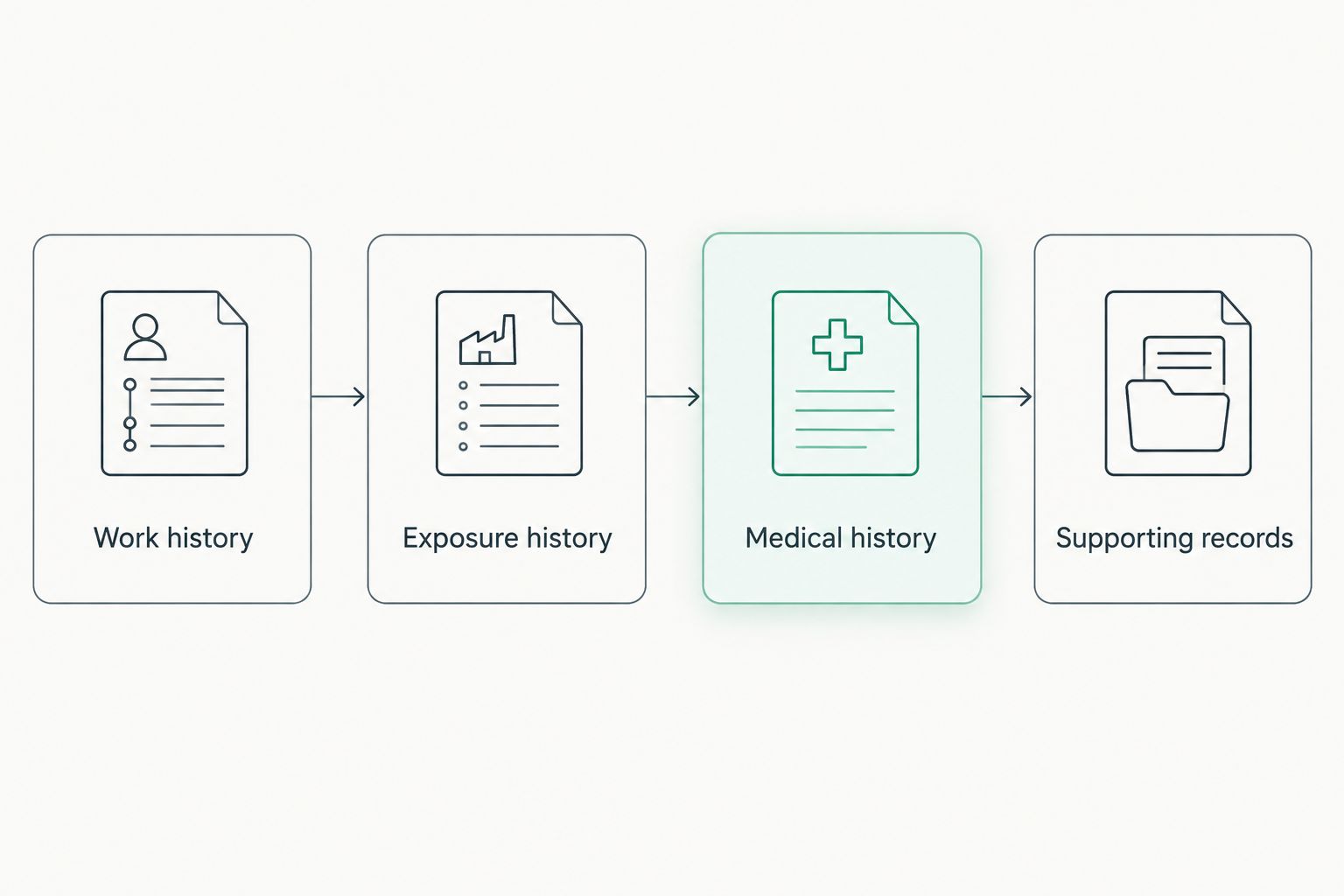
What to prepare before contacting a solicitor
You do not need to solve the claim yourself. Prepare an account that helps the solicitor identify the medical, employment and exposure questions.
- Work history: List employers, workplaces, roles and approximate periods of employment.
- Exposure history: Describe substances, dust, fumes, noise or other hazards you believe are relevant, without guessing measurements.
- Medical history: Record your diagnosis, symptoms, investigations and what clinicians have told you.
- Supporting records: Identify employment documents, medical correspondence and potential witnesses you already know about.
Start with a 1-page timeline if your history is complicated. It is a practical briefing tool, not a legal requirement. Mark uncertain dates as uncertain rather than creating a precise account you cannot support.
A former employer’s closure does not settle the question of whether a claim is possible. Ask the solicitor to investigate the relevant organisation and insurance position. Do not assume either that closure defeats the claim or that an insurer can definitely be found.
Time limits: ask before comparing firms at length
Scottish personal injury claims generally have a 3-year time limit, subject to the statutory rules on when time starts, exceptions and the court’s discretion. For industrial disease, the legally relevant date is not automatically the first exposure date or the diagnosis date.
The Prescription and Limitation (Scotland) Act governs these questions. Its rules address knowledge of relevant facts, so the solicitor needs your history before identifying the deadline. A disease discovered long after employment requires careful advice, not a deadline calculated from an online summary.
Ask for time-limit advice at your first enquiry. In 2026, the practical priority is establishing whether action is urgent before spending time comparing presentation, office locations or general testimonials.
Separate 2 questions: when legal proceedings must begin, and what investigation must happen before then. A claim notification or enquiry is not the same thing as raising court proceedings.
Questions that reveal whether a solicitor fits your claim
Ask each shortlisted solicitor the same questions. Compare the substance of the answers rather than the confidence with which they are delivered.
| Question | What a useful answer explains | What remains unresolved without it |
|---|---|---|
| Have you handled this diagnosis? | Relevant experience and who would handle the file | Whether general injury experience fits your disease |
| How will you investigate exposure? | Records, witnesses and workplace history | How the alleged cause will be supported |
| What medical evidence is needed? | Diagnosis, causation and assessment of harm | Whether the illness is legally linked to exposure |
| What deadline applies? | The relevant dates and required action | Whether delay puts the claim at risk |
| How is the claim funded? | Written obligations, deductions and expenses | Your financial responsibilities |
Funding deserves its own conversation. A funding label does not replace the agreement. Ask what happens if the claim succeeds, fails, ends early or changes direction, and request an explanation of terms you do not understand before signing.
Which route should you choose in 2026?
Start with a firm that explicitly handles industrial disease claims, then choose on the evidence plan and written terms. Thompsons Scotland is a relevant starting point because industrial disease and asbestos advice are within its stated services.
If you are a union member, check that route before committing separately. If you want another opinion, use the Law Society directory to identify alternatives and repeat the same questions.
Your final choice should answer three practical concerns: who handles the claim, how the connection between work and illness will be investigated, and what you are agreeing to financially. A recognisable name cannot answer those questions on its own.
FAQ
Who are the best industrial disease claim solicitors in Scotland?
Choose a solicitor with relevant disease experience, a clear investigation plan and written funding terms. Thompsons Scotland expressly offers industrial disease and asbestos claim advice across Scotland; union referrals and the Law Society directory provide other routes to investigate.
Does Thompsons Scotland handle asbestos claims?
Yes. Thompsons Scotland’s stated services include asbestos cases and industrial disease compensation claim advice for individuals across Scotland. Ask about the approach to your diagnosis and exposure history before instructing the firm.
Should I use my trade union’s solicitor?
Check your union’s legal assistance arrangements before instructing separately. Establish whether your membership and claim are covered, which solicitor would act and what terms apply.
Can I claim if my former employer has closed?
Closure alone does not determine whether a claim is possible. A solicitor needs to investigate the relevant employer, legal responsibility and insurance position before advising on the route available.
What is the time limit for an industrial disease claim in Scotland?
Scottish personal injury claims generally have a 3-year time limit, subject to statutory starting-date rules, exceptions and court discretion. Industrial disease cases require individual advice about knowledge and the relevant dates; do not assume the clock starts at diagnosis.
What documents should I take to a first appointment?
Take available medical correspondence, employment records and a short timeline of work and symptoms. Explain gaps and uncertain dates rather than guessing; the solicitor can identify what further evidence needs investigating.
How should I compare solicitors in 2026?
Compare experience with your diagnosis, the exposure investigation, Scottish time-limit advice and written funding terms. Ask who will handle the file and what the next practical step will be.
One last thing
Do not tidy uncertainty out of your history. An honest gap in a workplace timeline is more useful than a confident date you have guessed. Tell the solicitor what you remember, what documents support it and what still needs checking.