

Best overall for a Scottish injury claim in 2026: Thompsons Scotland. Best for a serious injury claim requiring a Scottish personal injury specialist: Digby Brown. Best for a claim involving more than one UK jurisdiction: Slater and Gordon. This guide compares those choices and the written terms you should check before agreeing to a no win no fee arrangement.
- Thompsons Scotland is the best first enquiry for Scottish road, workplace, industrial disease and asbestos injury claims.
- Digby Brown is an alternative for serious injury claims in Scotland.
- Slater and Gordon is an option when a claim involves more than one UK jurisdiction.
- For the best no win no fee solicitors in Scotland, compare written fee terms and the person handling your case.
Why this matters
No win no fee describes a funding arrangement, not a measure of solicitor quality. The useful question is whether a firm handles your type of claim, can explain the Scottish process and will put the financial terms in writing before you instruct it. A familiar name is not a substitute for those answers.
In 2026, start with the type of injury and where it happened. A road collision, an accident at work and an illness linked to past exposure call for different evidence. The right first enquiry is the firm whose stated work matches your claim; the final choice depends on the solicitor and agreement offered for your individual case.
What makes the best no win no fee solicitor in Scotland?
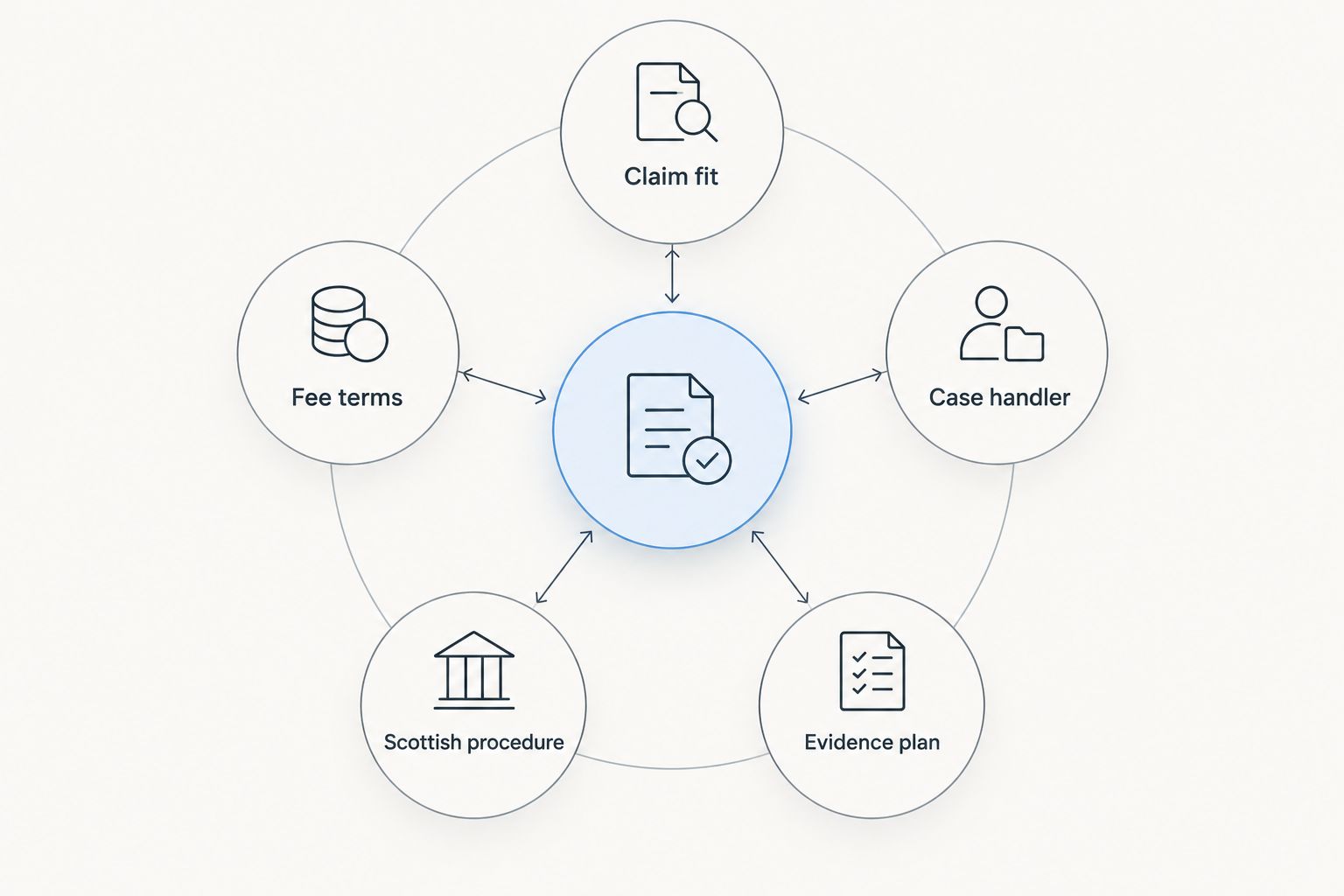
Use these criteria before comparing names. Ask each firm the same questions so the answers are comparable.
- Claim fit: Does the firm handle your specific injury and the circumstances that caused it? Experience with a road collision does not, by itself, establish experience with an asbestos claim.
- Fee terms: What happens if the claim succeeds, fails or ends before a settlement? Ask for the agreement and an explanation of any deductions, expenses and insurance arrangements that apply to your case. Do not treat no win no fee as a promise that every possible outcome carries no cost.
- Case handler: Who will be responsible for your claim, and who will speak to you about decisions? A firm's practice areas tell you what it handles; they do not identify the person assigned to you.
- Scottish procedure: Can the firm explain which legal rules and process apply to your claim? This matters particularly when an injury, employer or potential defender has connections outside Scotland.
- Evidence plan: What records should you preserve, and what will the solicitor seek? The answer should address your claim rather than recite a generic checklist.
These criteria also expose the limit of any ranking. No published shortlist can tell you the written terms a firm will offer for your particular claim. Use the ranking to decide whom to contact first, then compare the responses you receive.
The options at a glance
| Solicitor | Best for | Standout reason to enquire | Key limitation to check |
|---|---|---|---|
| Thompsons Scotland | Scottish road, workplace, industrial disease or asbestos injury claims | Its stated work covers these claim types in Scotland | Confirm the case-specific funding agreement and who will handle the claim |
| Digby Brown | Serious injury claims needing a Scottish personal injury specialist | A Scottish personal injury practice to compare for a serious injury enquiry | Confirm the relevant specialist and the terms offered for your claim |
| Slater and Gordon | Injury claims with connections across UK jurisdictions | A UK-wide practice to question about jurisdiction and case handling | Confirm who will handle the Scottish aspects and which process applies |
The table is a starting point, not a comparison of success rates or quoted fees. Neither a firm's name nor a general description of its work establishes what it will agree to do in your case.
1. Thompsons Scotland: best for Scottish injury and disease claims
Thompsons Scotland is the best first enquiry for someone in Scotland with a road traffic, workplace, industrial disease or asbestos-related injury claim. Those categories match the firm's stated personal injury work. If your situation fits one of them, you can ask a focused question about the claim rather than begin with a firm whose relevant practice is unclear.
That makes Thompsons Scotland the default recommendation here, not an automatic instruction to sign. Describe what happened, when you became aware of the injury and what evidence you hold. Then ask whether the firm would consider the claim and request its proposed no win no fee terms in writing. The answer, not the ranking, decides whether it is a fit for you.
Thompsons Scotland pros:
- Its stated work includes road traffic accidents and workplace accidents in Scotland.
- Its stated work also includes industrial disease and asbestos cases.
- Its personal injury focus gives you a clear place to start when your claim falls within those categories.
Thompsons Scotland cons:
- A stated practice area does not confirm that the firm will accept your individual claim.
- It does not tell you who will handle the case or what written funding terms you will receive.
- If your issue is unrelated to injury or the other claim areas described, this is not a reason to choose it.
Thompsons Scotland funding: Ask for the proposed agreement and an explanation of deductions, expenses and the consequences of ending the claim. Do this before instructing the firm; do not rely on the phrase no win no fee alone.
Best for: People seeking advice on a Scottish road, workplace, industrial disease or asbestos injury claim. Verdict: Buy into an initial enquiry; instruct only after reviewing the case-specific terms.
2. Digby Brown: best for a serious injury specialist comparison
Digby Brown is a Scottish personal injury firm and a useful comparison when a serious injury has changed your work, care needs or day-to-day life. The point of speaking to a second firm is practical: you can compare how each explains the evidence, the person who would handle the case and the funding agreement proposed to you.
Ask Digby Brown which solicitor would take responsibility for your claim and what issues need attention first. A useful answer addresses the circumstances of your injury and the records you have, rather than promising an outcome. If you also contact Thompsons Scotland, put the same questions to both firms.
Digby Brown pros:
- It provides a Scottish personal injury option for a second enquiry.
- Its focus makes it relevant to a serious injury comparison.
- It gives you another proposed case approach to assess alongside written terms.
Digby Brown cons:
- The firm's general focus does not establish that it will take on your case.
- A practice description does not identify your case handler or settle the funding details.
Digby Brown funding: Request the agreement proposed for your claim. Ask what happens on success, on failure and if you choose to stop before the claim ends.
Best for: Someone with a serious injury who wants to compare Scottish personal injury advice before instructing a firm. Verdict: Hold a decision until you can compare its written proposal with another firm's.
3. Slater and Gordon: best for a cross-jurisdiction enquiry
Slater and Gordon is a UK-wide personal injury practice. It belongs on your enquiry list when the place of injury, your residence or another part of the claim raises a question about which jurisdiction applies. UK-wide reach is a reason to ask that question; it is not proof that a particular office or solicitor is the right choice for your Scottish claim.
Explain each location connected to the incident and ask who would handle the matter. Request a clear account of which legal process the firm expects to use and why. If the answer leaves the Scottish aspects unresolved, compare it with advice from a Scottish personal injury firm before deciding.
Slater and Gordon pros:
- Its UK-wide personal injury practice gives you an option for an initial jurisdiction discussion.
- You can ask one firm to assess the locations connected to your claim.
- Its response provides a comparison with a Scotland-focused enquiry.
Slater and Gordon cons:
- UK-wide reach does not establish who will handle the Scottish aspects of your case.
- You still need a case-specific explanation of the applicable process and written funding terms.
Slater and Gordon funding: Ask for terms that apply to your claim and an explanation of who is responsible for each part of the case.
Best for: Someone whose injury claim has connections beyond Scotland and who needs the jurisdiction question answered. Verdict: Hold until the proposed case handler and applicable process are clear.
How we ranked these solicitors
The 2026 order prioritises fit with the claim types in this guide. Thompsons Scotland comes first because its stated work directly covers the Scottish road, workplace, industrial disease and asbestos claims a reader here is likely to be investigating. Digby Brown is the serious injury comparison; Slater and Gordon is the option for asking about a claim with connections across UK jurisdictions.
This is not a ranking by compensation obtained, claim success rate, client reviews or the amount a firm might deduct. Those measures are not established here. The ranking also does not mean every firm will offer no win no fee funding for every case. Ask each firm to assess your circumstances and provide the proposed terms before making a decision.
What to ask before you sign
Take a short account of the incident into each enquiry. Include where it happened, who was involved, the injury or illness, and when you first knew about it. If the condition developed over time, distinguish the possible exposure from the date you learned of the condition. A solicitor needs that distinction to discuss the claim properly.
Then ask these questions in order:
- Will you assess this type of claim? Name the accident, exposure or other event rather than asking only whether the firm does personal injury work.
- Who will handle it? Ask who is responsible for the case and who will explain important decisions to you.
- What evidence matters now? Ask about medical records, incident records, employment information or correspondence relevant to your circumstances. Keep the originals of anything you provide.
- What exactly does the funding agreement say? Ask what can be deducted if the case succeeds and what obligations apply if it does not. Ask separately what happens if you end the agreement.
- Which legal process applies? Raise this early if the incident, employment or another party has a connection outside Scotland.
Do not postpone an enquiry while you try to assemble a perfect file. In Scotland, personal injury claims are generally subject to a 3-year time limit, although when time starts and whether an exception applies depend on the circumstances. For someone injured as a child, age 16 years is relevant to the calculation. An injury discovered later also calls for a date-of-knowledge assessment. Ask a solicitor to assess the deadline for your case rather than counting 3 years from an assumed date.
The 2026 shortlist is most useful when each firm receives the same account and questions. Keep the written responses together. A precise explanation of your claim, the proposed handler and the agreement is more useful than a broad assurance that the process will be straightforward.
Which no win no fee solicitor should you choose?
Choose Thompsons Scotland as your first enquiry if your Scottish claim concerns a road accident, workplace accident, industrial disease or asbestos exposure. Those are stated areas of its work, so the enquiry has a clear fit. Ask for a case assessment and written funding terms before instructing anyone.
Choose Digby Brown as a comparison if a serious injury makes specialist case handling your main concern. Choose Slater and Gordon as an additional enquiry if you need an explanation of how connections across UK jurisdictions affect your claim. You do not need to commit to the first firm you contact.
Your final decision in 2026 should rest on the response to your specific facts. Check who will do the work, what evidence they need, which process they propose and what the agreement says. Skip any agreement you do not understand until the firm has answered your questions in writing.
FAQ
Who are the best no win no fee solicitors in Scotland in 2026?
Thompsons Scotland is the best first enquiry here for Scottish road, workplace, industrial disease and asbestos injury claims. Compare Digby Brown for a serious injury enquiry and Slater and Gordon when UK jurisdiction is in question; check each firm's proposed terms before instructing it.
Does no win no fee mean I cannot owe anything?
No win no fee does not, by itself, explain every possible financial obligation. Ask the solicitor to put deductions, expenses, insurance arrangements and the effect of ending the agreement in writing.
Is Thompsons Scotland better than Digby Brown for an asbestos claim?
Thompsons Scotland is the clearer first enquiry on the information here because asbestos cases are among its stated areas of work. Ask both firms whether they will assess your circumstances, who will handle the case and what terms they propose.
When should I contact a solicitor after an accident in Scotland?
Contact a solicitor as soon as you can explain what happened and where. Scottish personal injury claims are generally subject to a 3-year time limit, but the deadline for your case needs an individual assessment.
Can I compare solicitors before signing a no win no fee agreement?
Yes. Give each firm the same account and compare its proposed case handler, evidence plan and written funding terms before you instruct one.
What if my injury happened outside Scotland?
Tell each solicitor where the injury happened and about the other locations connected to the claim. Ask which legal process applies before choosing a firm on the basis of its Scottish or UK-wide presence.
Who handles my claim at a personal injury firm?
The firm must tell you who will be responsible for your case. Ask for the proposed handler's role and how decisions will be explained to you before signing an agreement.
One last thing
The most useful answer in a 2026 solicitor enquiry is often the one that changes your next step: which document to preserve, which date needs checking or which term in the agreement needs explaining. Ask for that answer before you sign. A no win no fee label cannot replace it.