

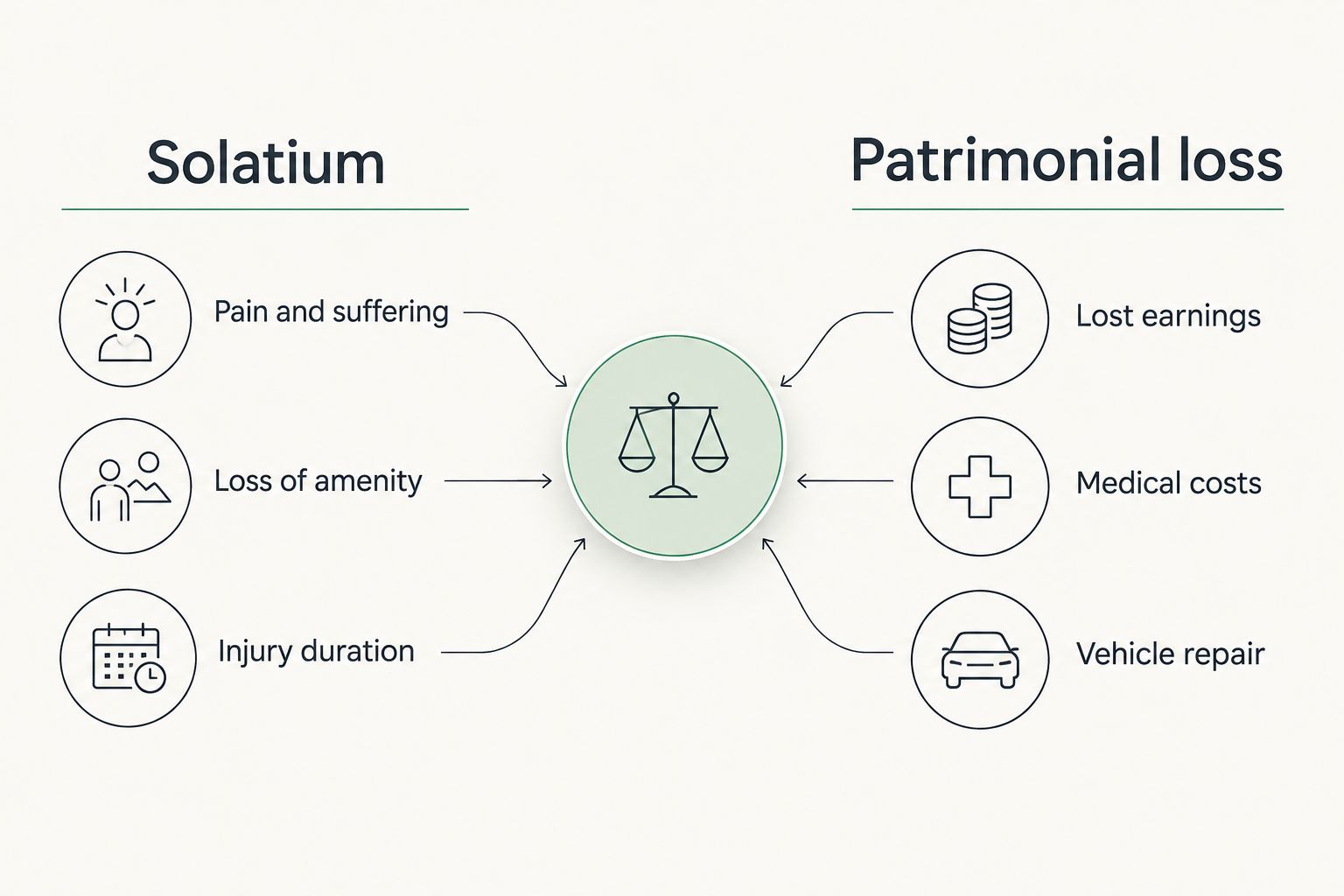
There's no fixed payout for a car accident claim in Scotland — the amount depends on how severe the injury is, how long recovery takes, and what the crash cost you in lost wages, medical bills and vehicle damage. Scottish claims are split into two separate calculations: solatium (compensation for the injury itself) and patrimonial loss (the financial hit), and each is worked out on its own facts rather than a single headline number.
- Scottish car accident claims have no fixed compensation figure in 2026 — solatium and patrimonial loss are assessed separately.
- Solatium covers pain, suffering and loss of amenity; patrimonial loss covers wages, medical costs and vehicle repairs.
- Contributory negligence (e.g. no seatbelt) can reduce the final award even when the other driver was at fault.
- Claims in Scotland generally must be raised within 3 years under the Prescription and Limitation (Scotland) Act 1973.
- Thompsons Scotland assesses claim value on a case-by-case basis rather than quoting a generic figure upfront.
Why this matters
Asking "how much compensation for a car accident in Scotland" is the right question — but anyone quoting you a single number before seeing your medical records and wage slips is guessing. Insurers rely on claimants not knowing what they're actually owed, and settling too early on a vague estimate is the most common way people leave money on the table in 2026. Understanding how the two heads of claim work lets you check whether an offer is fair before you sign anything.
Thompsons Scotland handles road traffic accident claims across Scotland and calculates both solatium and patrimonial loss before advising on settlement figures — you can start a claim enquiry if you're still within the time limit.
How much compensation for a car accident in Scotland?
Scottish law splits your claim into two parts, and each is worked out independently:
| Element | What it covers | How it's assessed |
|---|---|---|
| Solatium | Pain, suffering, loss of amenity from the injury itself | Injury type, severity, duration, permanence, court precedent |
| Patrimonial loss | Financial losses caused by the accident | Lost earnings, medical/physio costs, care costs, vehicle repair, travel to appointments |
Solatium is not calculated from a table you can look up online — Scottish courts weigh how long an injury lasted, whether it's permanent, and how it affected daily life, then compare that against similar decided cases. Patrimonial loss is more mechanical: it's built from payslips, invoices, receipts and expert reports on future loss of earnings where the injury affects your ability to work.
Whiplash and soft tissue injuries
Whiplash is the most common road traffic accident injury in Scotland and typically resolves within months rather than years. Solatium for whiplash tracks recovery time closely — a claim that resolves in a few weeks is valued very differently from one where symptoms persist for a year or longer, which is why medical evidence matters more than the initial diagnosis.
Fractures and orthopaedic injuries
Broken bones, joint damage and injuries requiring surgery sit higher on the solatium scale because recovery is longer, physiotherapy is often required, and some leave permanent restriction. Patrimonial loss in these cases usually includes a bigger wage-loss component if time off work runs into months.
Psychological injury after a crash
Anxiety, PTSD and driving phobia following a road traffic accident are recognised heads of claim in Scotland in their own right, separate from any physical injury. These claims need psychiatric or psychological evidence — a GP note alone rarely carries enough weight to support a significant solatium figure.
Why compensation amounts vary
- Injury severity and duration — longer recovery and permanent effects push solatium higher.
- Impact on earnings — a claimant unable to return to their previous role recovers more than someone back at work within days.
- Contributory negligence — not wearing a seatbelt, or partly causing the crash, can reduce the final award even when the other driver is mainly at fault.
- Age and occupation — a manual worker with a knee injury may have a stronger future-loss claim than an office worker with the same diagnosis.
- Quality of medical evidence — claims backed by specialist reports rather than a single GP letter tend to settle higher.
- Whether liability is disputed — a contested fault dispute adds time and can affect how insurers approach settlement.
“There's no headline figure for a Scottish car accident claim — solatium and patrimonial loss are worked out separately, then added together.”
Related questions
Is fault split between drivers in Scotland?
Yes — Scottish law allows for contributory negligence, meaning your award can be reduced by a percentage if you partly caused the accident or made your injury worse, such as by not wearing a seatbelt. Full fault stays with the other driver in most straightforward rear-end or junction collisions.
How long do I have to make a car accident claim in Scotland?
Most personal injury claims in Scotland must be raised within 3 years of the accident date under the Prescription and Limitation (Scotland) Act 1973. Exceptions apply for children and claimants who lacked mental capacity at the time, so it's worth checking your specific date rather than assuming the deadline has passed.
Does an insurer's first offer reflect the full compensation figure?
Not usually — early offers from insurers are typically based on the injury alone and often exclude ongoing treatment costs, future loss of earnings or psychological impact. Getting a proper valuation before accepting anything in 2026 avoids settling for less than the claim is actually worth.
Get your claim assessed properly
Check what your car accident claim is worth before accepting any offer.
FAQ
How much compensation can I get for a car accident in Scotland?
There's no fixed amount — compensation is split into solatium (pain and suffering) and patrimonial loss (financial costs), each assessed on the injury and evidence in your specific case.
What is solatium in a Scottish personal injury claim?
Solatium is the Scottish legal term for compensation covering pain, suffering and loss of amenity caused by an injury, assessed against how long it lasted and whether it's permanent.
What is patrimonial loss?
Patrimonial loss covers the financial side of a claim — lost earnings, medical and physio costs, care costs and vehicle repair not covered elsewhere.
Can I still claim if I wasn't wearing a seatbelt?
Yes, but the award can be reduced for contributory negligence if not wearing a seatbelt made your injuries worse than they would otherwise have been.
How long does a car accident claim take in Scotland?
Timeframes vary with injury severity and whether liability is disputed — straightforward whiplash claims can resolve faster than cases involving surgery or long-term psychological injury.
What's the time limit to claim after a car accident in Scotland?
Most claims must be raised within 3 years of the accident date under the Prescription and Limitation (Scotland) Act 1973, with exceptions for children.
Is whiplash worth claiming for in Scotland?
Yes — whiplash is a recognised injury with its own solatium value based on how long symptoms last, even though it's usually lower-value than fracture or surgical claims.
Does a psychological injury from a crash count toward compensation?
Yes, anxiety, PTSD and driving phobia are separate recognised heads of claim in Scotland and need psychiatric or psychological evidence to support the solatium figure.
One last thing
The biggest mistake in 2026 isn't underestimating the injury — it's forgetting patrimonial loss covers more than lost wages. Travel costs to physio, prescription charges, and even the cost of paying someone to do jobs you can't manage while injured all count, and most people never mention them to an insurer unprompted.