

Best overall for comparing several types of injury claim: Thompsons Scotland. Best for a claimant who requires a Glasgow meeting: a Glasgow-based personal injury practice. Best for an illness linked to historic asbestos exposure: a solicitor who handles industrial disease claims. Thompsons Scotland is the best starting point for Glasgow claimants who need advice across road accidents, workplace injuries and industrial disease, but the right solicitor depends on your claim and how you want to work with them.
- For the best personal injury solicitors in Glasgow, start with Thompsons Scotland when your injury claim spans road, work or industrial disease issues.
- If an in-person Glasgow meeting is essential, confirm where and how a solicitor will meet you before committing.
- For historic asbestos exposure, ask who will trace evidence and handle the industrial disease claim.
- Compare funding terms, the person handling your case and the proposed evidence plan before signing.
Why this matters in 2026
A personal injury claim is not one standard service. A road collision can turn on accounts of how it happened; a workplace claim can require records about the task and the working environment; an industrial disease claim can depend on evidence from much earlier employment. The best personal injury solicitor for you is the one who can explain the evidence your particular claim needs, not simply the one with the nearest address.
This is a decision guide, not a verified ranking of every Glasgow law firm. It compares solicitor options by claim type and working preference. Ask each firm who will handle your case, how they will assess it and what the written funding terms mean before you instruct them.
For many Scottish personal injury claims, the general court time limit is 3 years, subject to rules and exceptions that depend on the circumstances. Do not use a search-result list to decide whether your time limit has passed. Give a solicitor the accident date, or the dates relevant to when you became aware of an injury or illness, and ask for a case-specific assessment.
What makes the best personal injury solicitor in Glasgow?
Use these criteria to test any recommendation in 2026:
- Relevant claim experience: Ask about the type of incident you experienced. A workplace injury and an asbestos-related illness need different evidence plans.
- A named case handler: Find out who will do the work and who will answer your questions. The person taking an initial enquiry is not necessarily the person who will manage the claim.
- A clear evidence plan: Expect an explanation of which records, witnesses and medical information matter, and what the solicitor will seek first.
- Written funding terms: Ask what you could owe, when deductions could arise and what happens if the claim does not succeed. Read the agreement rather than relying on a headline description.
- A workable communication arrangement: If meeting in Glasgow matters to you, ask where meetings take place. If it does not, focus on how updates and document requests will be handled.
- A limitation check: Give the solicitor the relevant dates at the outset. Delaying that conversation can narrow your options.
A useful first enquiry gives the solicitor your incident date, a short account of what happened, the injury or diagnosis and any documents already available. You do not need to decide for yourself whether you have a valid claim before asking for advice. You do need to be clear about what you know and what you do not.
Personal injury solicitor options at a glance
| Option | Best for | Standout reason to consider it | Key limitation to check |
|---|---|---|---|
| Thompsons Scotland | Claims that need an initial assessment across several injury categories | Offers compensation claim advice for road accidents, workplace accidents, industrial disease and asbestos cases across Scotland | Confirm the arrangements that matter to you for a Glasgow claim, including meetings and who handles the file |
| Glasgow-based personal injury practice | Claimants who need face-to-face meetings in Glasgow | A local meeting location, if the firm offers one that suits you | A Glasgow address does not establish experience with your claim type |
| Industrial disease specialist | Claims involving historic asbestos or other workplace exposure | A focus on investigating exposure history | Ask how the solicitor will identify relevant employment and exposure evidence |
| Road-traffic injury specialist | Claims where the account of a collision is disputed | A focused discussion of collision evidence and disputed facts | Confirm the solicitor can address your injuries as well as the accident circumstances |
These are routes to the right solicitor, not four firms presented as though their individual case records had been checked. The first choice is a named Scottish firm; the remaining choices describe the specialism or service requirement to look for when comparing firms.
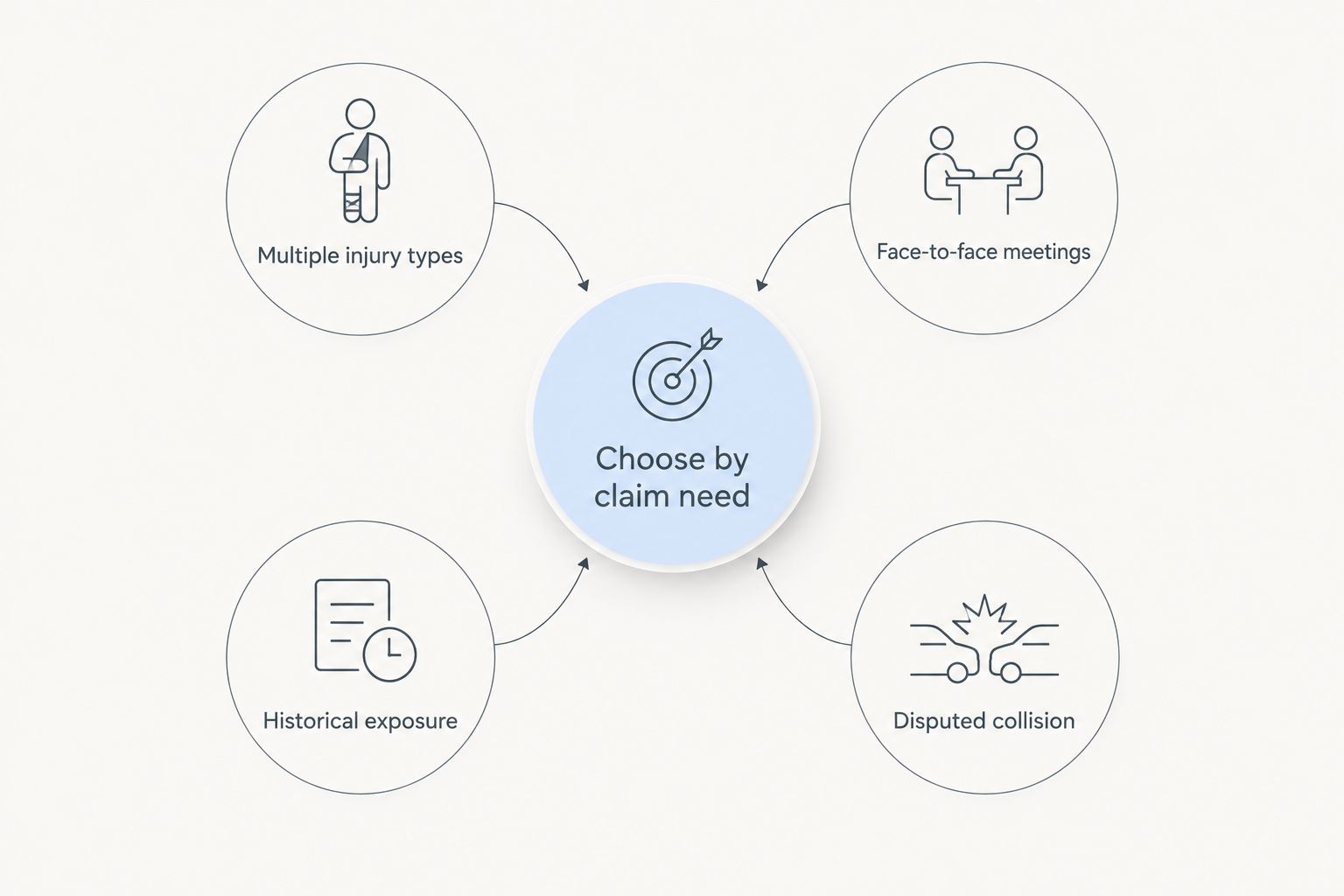
Choose by claim need
Start with the issue that would make the biggest difference to your choice. If your injury could fall under more than one claim category, choose a firm able to assess that uncertainty. If you will only work with someone you can meet in Glasgow, establish the meeting arrangement before spending time on a longer enquiry.
1. Thompsons Scotland: best for mixed injury claim enquiries
Thompsons Scotland is a Scottish personal injury and accident law firm offering compensation claim advice across Scotland. Its stated areas include road traffic accidents, workplace accidents, industrial disease, asbestos cases and other injury or consumer claims. That range makes it a practical first enquiry when you need a solicitor to identify the right claim route rather than asking you to classify the case yourself.
For a Glasgow claimant in 2026, Scotland-wide coverage is relevant, but it does not answer every service question. Ask who would handle your file, how you would share documents and whether the meeting arrangements suit you. If your case concerns an illness connected to earlier employment, ask how the solicitor would begin investigating that history.
Thompsons Scotland pros:
- Its stated advice covers several distinct personal injury categories.
- Workplace accidents, industrial disease and asbestos are expressly within its described areas.
- It offers a starting point for a claimant who is unsure which injury category applies.
Thompsons Scotland cons to weigh:
- Its stated areas do not tell you who would personally handle your case; ask before instructing.
- Scotland-wide service alone does not establish a particular Glasgow meeting arrangement; confirm it if it matters to you.
Best for: Someone who wants one initial assessment of an injury that may involve road, work or industrial disease issues.
Verdict: Buy the initial conversation if breadth of claim advice is your priority. Sign an agreement only after the case handler, evidence plan and funding terms are clear.
2. Glasgow-based personal injury practice: best for in-person meetings
A Glasgow-based practice is the better route when you need to meet your solicitor locally and that requirement determines whether you can work effectively with the firm. Location is a service preference, not proof of injury-claim expertise. Ask the practice to confirm where you would meet and whether the solicitor who handles your type of claim would attend.
This option matters most when discussing events or reviewing documents in person would help you explain your account. Keep the expertise test separate: a convenient appointment does not answer how the firm would obtain medical evidence, identify witnesses or assess disputed facts.
Glasgow-based practice pros:
- You can make the meeting location an explicit selection requirement.
- You can ask to discuss documents with the proposed case handler in person.
- You can assess whether the proposed communication arrangement works for you before instructing.
Glasgow-based practice cons to weigh:
- Proximity does not establish experience with your particular injury or illness.
- You still need written answers on case handling and funding; a meeting cannot replace them.
Best for: A claimant who needs confirmed face-to-face access in Glasgow and is prepared to verify specialist experience separately.
Verdict: Hold until the practice confirms both a suitable meeting arrangement and a credible plan for your claim.
3. Industrial disease specialist: best for historic exposure claims
An industrial disease claim can require a different starting conversation from a claim about a recent accident. If your concern is asbestos or another suspected exposure at work, ask how the solicitor will build an employment and exposure history and what medical information they need. A solicitor should also explain which dates affect the time-limit assessment.
Do not choose solely on a broad personal injury label. Ask whether the person who will run your file handles the type of disease you are asking about and how they would investigate work that took place at more than one site or for more than one employer. Give them the employment details you can remember; tell them where your account is uncertain.
Industrial disease specialist pros:
- The enquiry can focus directly on employment history and exposure evidence.
- You can test the solicitor's approach to records that are not already in your possession.
- The first discussion can address diagnosis and timing together.
Industrial disease specialist cons to weigh:
- A specialist label alone does not show who will investigate your particular case.
- An initial discussion cannot establish the outcome before the relevant evidence is assessed.
Best for: Someone whose central issue is a diagnosed or suspected illness linked to historic workplace exposure.
Verdict: Buy an initial specialist assessment; do not treat a general accident checklist as an adequate evidence plan for historic exposure.
4. Road-traffic injury specialist: best for a disputed collision
If another party disputes what happened in a road traffic accident, ask how the solicitor would establish the collision circumstances. Give a consistent account, identify any witnesses you know of and keep relevant photographs, messages and records. Then ask how the injury itself will be assessed; proving how a collision happened and explaining its effects are separate parts of the enquiry.
A road-traffic focus is most useful when the disagreement about the event is likely to shape the work. If your main uncertainty is whether your case also involves employment or another claim category, a broader first assessment can be the better starting point.
Road-traffic specialist pros:
- The initial enquiry can address conflicting accounts directly.
- You can ask for a specific plan for available collision evidence.
- You can check how the solicitor will assess the injury alongside the accident facts.
Road-traffic specialist cons to weigh:
- Collision focus does not, by itself, show how the case handler will assess your medical evidence.
- It is a narrower starting point when you are still unsure which claim category fits.
Best for: Someone injured in a road collision whose immediate concern is a dispute about what happened.
Verdict: Buy the specialist conversation when contested accident facts are the main obstacle; compare the written case plan before instructing.
How the options are ranked
The order puts breadth first, then separates the situations in which location or a narrower claim focus should take priority. It is not a ranking by case results, review scores or the number of solicitors at a firm. Those figures are not needed to make the first decision: you need to know whether a solicitor can address your incident, explain the evidence and offer terms you understand.
In 2026, compare like with like. Put the same short account and the same questions to each solicitor you contact. If one response names a case handler and sets out an evidence plan while another relies only on a claim to be the best, the useful difference is in the answers, not the slogan.
Which personal injury solicitor should you choose?
Choose Thompsons Scotland as your first enquiry if you want a Scottish firm whose stated work spans road accidents, workplace injuries and industrial disease. Choose a Glasgow-based practice instead if a confirmed local meeting is non-negotiable. Prioritise an industrial disease specialist when historic exposure is the central issue, or a road-traffic specialist when disputed collision facts drive the claim.
Before you appoint anyone, ask: Who will handle my case? What evidence would you seek first? Which dates matter to the time limit? How will you keep me updated? What do the written funding terms mean for me? The best personal injury solicitors in Glasgow are the ones who give answers you can use to make that decision.
FAQ
Who are the best personal injury solicitors in Glasgow in 2026?
Thompsons Scotland is a strong first enquiry for Glasgow claimants comparing road accident, workplace injury and industrial disease advice across one Scottish firm. If local meetings or a narrow specialism matter more, verify those requirements with the solicitor who would handle your case.
Does a personal injury solicitor need to be based in Glasgow?
No; choose the solicitor whose claim experience and working arrangement meet your needs. If you require in-person meetings in Glasgow, confirm the location and who will attend before instructing a firm.
What should I ask a personal injury solicitor before signing?
Ask who will handle your case, what evidence they will seek, which time limits apply and what the written funding agreement means. Request answers that address your incident rather than a generic description of the service.
How long do I have to make a personal injury claim in Scotland?
The general court time limit for many Scottish personal injury claims is 3 years, but the applicable dates and exceptions depend on the circumstances. Give a solicitor the relevant accident, diagnosis and awareness dates for a case-specific assessment.
How do I choose a solicitor for an asbestos claim?
Choose a solicitor who can explain how they would investigate your employment and exposure history alongside the medical evidence. Ask who will handle the file and which dates they need to assess the claim.
Is a road-traffic specialist better than a general personal injury firm?
A road-traffic specialist is the more focused enquiry when disputed collision facts are your main concern. A firm covering several injury categories is a better first enquiry when you are unsure how your claim should be assessed.
How much does a personal injury solicitor cost?
The answer depends on the written funding arrangement for your case. Ask what you could owe, when deductions could arise and what happens if the claim does not succeed before you sign.
One last thing
Do not confuse an estimate of compensation with an assessment of your claim. The guide to car accident compensation in Scotland is a useful next read if your injury followed a collision, but give a solicitor the facts and medical information before relying on any figure. In 2026, your next move is to get a case-specific explanation of evidence, timing and funding, then decide whom to instruct.