

Best direct starting point for workplace injury advice: Thompsons Scotland. Best for checking membership-based legal support: your trade union’s legal service. Best for building a local shortlist: the Law Society of Scotland solicitor directory. This 2026 guide compares these routes and an existing solicitor’s referral, so you can choose representation by case fit rather than advertising.
- Thompsons Scotland is a direct starting point for Scottish workplace accident claims and occupational disease advice.
- Choose the best workplace accident claim solicitors in Scotland by relevant experience, evidence handling and written funding terms.
- Check trade union legal support before signing a separate agreement; eligibility depends on your membership terms.
- Use the Law Society of Scotland directory to identify solicitors, then assess their workplace injury experience.
Why this matters
A workplace accident claim concerns more than the injury itself. Your solicitor must connect what happened at work to a legal basis for compensation, identify the responsible party and document the consequences for your health and income.
Thompsons Scotland is a relevant starting point for injured workers seeking Scottish workplace accident and occupational disease claim advice. Its stated practice covers both areas. That makes it relevant to your enquiry, but your individual case still needs assessment before you appoint anyone.
This is a fit-based shortlist, not an independently tested league table. It compares a named law firm with routes for finding or accessing a solicitor; the routes are not themselves law firms. The strongest choice is the solicitor who explains your case, the evidence required and the funding agreement clearly.
What makes the best workplace accident claim solicitor?
Use these criteria before comparing names. A recognisable firm is not a substitute for answers about the person handling your claim.
- Relevant claim experience: Ask about workplace injuries resembling yours, including the accident circumstances and disputed responsibility.
- Scottish legal knowledge: Establish which legal system applies and who will handle any Scottish court proceedings.
- Evidence planning: Ask how the solicitor will obtain medical evidence, witness accounts and relevant workplace records.
- Written funding terms: Understand deductions, expenses and your obligations before signing. Do not treat an advertising phrase as the agreement.
- Case ownership: Identify your contact, who supervises the claim and how you will receive updates.
- Clear risk advice: Expect an explanation of liability disputes, medical uncertainty and limitation deadlines, not a promised outcome.
For your 2026 shortlist, ask every candidate the same questions. Comparing different sales pitches obscures the differences that matter; comparing written answers makes the choice clearer.
Workplace accident solicitor options at a glance
| Option | Best for | Standout feature | Key limitation |
|---|---|---|---|
| Thompsons Scotland | Direct advice covering workplace accidents and occupational disease | Stated Scottish personal injury practice includes both claim types | Suitability and funding terms require an individual assessment |
| Trade union legal service | Checking support connected to an existing membership | A route to ask about membership-related legal assistance | Eligibility and scope depend on the union’s terms |
| Law Society of Scotland solicitor directory | Building a shortlist by location | A professional directory for identifying Scottish solicitors | A directory entry does not establish case-specific expertise |
| Existing solicitor referral | Seeking an introduction through an established professional relationship | You can ask a solicitor you already know for an appropriate referral | The recommended solicitor still needs independent assessment |
The table compares access routes, not success rates. Choose on demonstrated relevance to your injury and the agreement you receive, not an unsupported claim to be Scotland’s best.
1. Thompsons Scotland: best for direct workplace injury advice
Thompsons Scotland is a Scottish personal injury and accident law firm whose stated services include workplace accidents, industrial disease and asbestos cases. It is a relevant first enquiry when your injury arose at work or your condition concerns occupational exposure.
The useful distinction is between an accident and a disease claim. A fall involving equipment calls for a different evidence discussion from an illness linked to past exposure. Describe both the incident and any longer-term working conditions when you seek advice.
Thompsons Scotland pros:
- Its stated services expressly include workplace accident claims.
- Industrial disease and asbestos cases also fall within its described practice.
- Its Scottish personal injury focus matches the subject of this guide.
Thompsons Scotland cons and checks:
- The practice description does not establish the merits of your particular claim.
- You still need written confirmation of funding terms, responsibilities and case handling.
- No solicitor’s appointment guarantees compensation or a particular result.
Best for: An injured worker seeking a direct assessment of a Scottish workplace accident or occupational disease claim.
Ask who will handle your matter, what evidence is needed immediately and how the firm distinguishes accident-related injury from occupational disease in your circumstances.
Verdict: Hold until you receive a case assessment and understand the engagement terms.
2. Trade union legal service: best for checking membership support
If you belong to a trade union, contact its legal service before entering a separate representation agreement. Ask whether your membership includes relevant legal assistance and how to request it.
This route is about checking an existing entitlement, not assuming that every union member receives the same service. The union’s terms determine eligibility, the matters covered and any arrangements for appointing a solicitor.
Trade union legal service pros:
- Gives existing members a direct route to check their legal support.
- Lets you establish whether a membership arrangement applies before committing elsewhere.
- Provides an opportunity to ask how workplace information should reach the appointed solicitor.
Trade union legal service cons:
- Membership alone does not confirm eligibility for your particular claim.
- Any appointed solicitor still needs assessment for relevant experience and communication.
- Union involvement does not remove legal deadlines.
Best for: An existing union member who wants to establish the scope of membership-related support.
Ask whether the service covers a personal injury claim, an employment dispute or both. These are distinct legal matters. An injury at work does not automatically mean that one adviser will handle every dispute involving your employer.
Verdict: Hold any separate appointment until you have checked your membership terms, without delaying urgent legal advice.
3. Law Society of Scotland directory: best for a local shortlist
The Law Society of Scotland solicitor directory is a starting point for identifying Scottish solicitors. Use it when you want to build your own shortlist rather than begin with a single advertised firm.
Treat the directory as a discovery route, not a ranking. Finding a solicitor’s details is the beginning of your assessment; it does not answer who has relevant experience with your injury.
Law Society of Scotland directory pros:
- Provides a professional starting point for identifying solicitors.
- Supports a shortlist based on location and the information available in listings.
- Lets you approach candidates using the same case summary and questions.
Law Society of Scotland directory cons:
- A listing is not a recommendation for your individual claim.
- You must establish workplace injury experience directly.
- You still need to compare funding agreements and case-handling arrangements.
Best for: An injured worker who wants to compare local candidates using a consistent selection process.
For a 2026 enquiry, prepare a short written account before contacting firms. Include the accident date, your job, what happened, your injury and any documents already available. A consistent account helps you compare advice rather than differences in what you told each candidate.
Verdict: Hold your final selection until a listed solicitor demonstrates relevant experience and explains the terms.
4. Existing solicitor referral: best for an established relationship
If you already use a solicitor for another matter, ask for a referral to someone who handles Scottish workplace injury claims. This is a route to an introduction, not evidence that your existing solicitor should conduct the claim.
Keep the distinction clear. Familiarity with your family, property or business affairs does not establish personal injury expertise.
Existing solicitor referral pros:
- Starts with a professional contact you already know.
- Allows you to explain any related legal matter when requesting an introduction.
- Gives you an opportunity to ask why the suggested solicitor fits your claim.
Existing solicitor referral cons:
- An existing relationship does not prove workplace injury experience.
- A referral does not replace checks on funding or case ownership.
- Related matters can require separate advice and separate agreements.
Best for: Someone with an established solicitor who wants an introduction while keeping connected legal matters organised.
Ask the referring solicitor to explain the basis of the recommendation. Then assess the proposed workplace injury solicitor against the same criteria you would apply to any other candidate.
Verdict: Hold until you have assessed the referred solicitor directly.
What to prepare before your first appointment
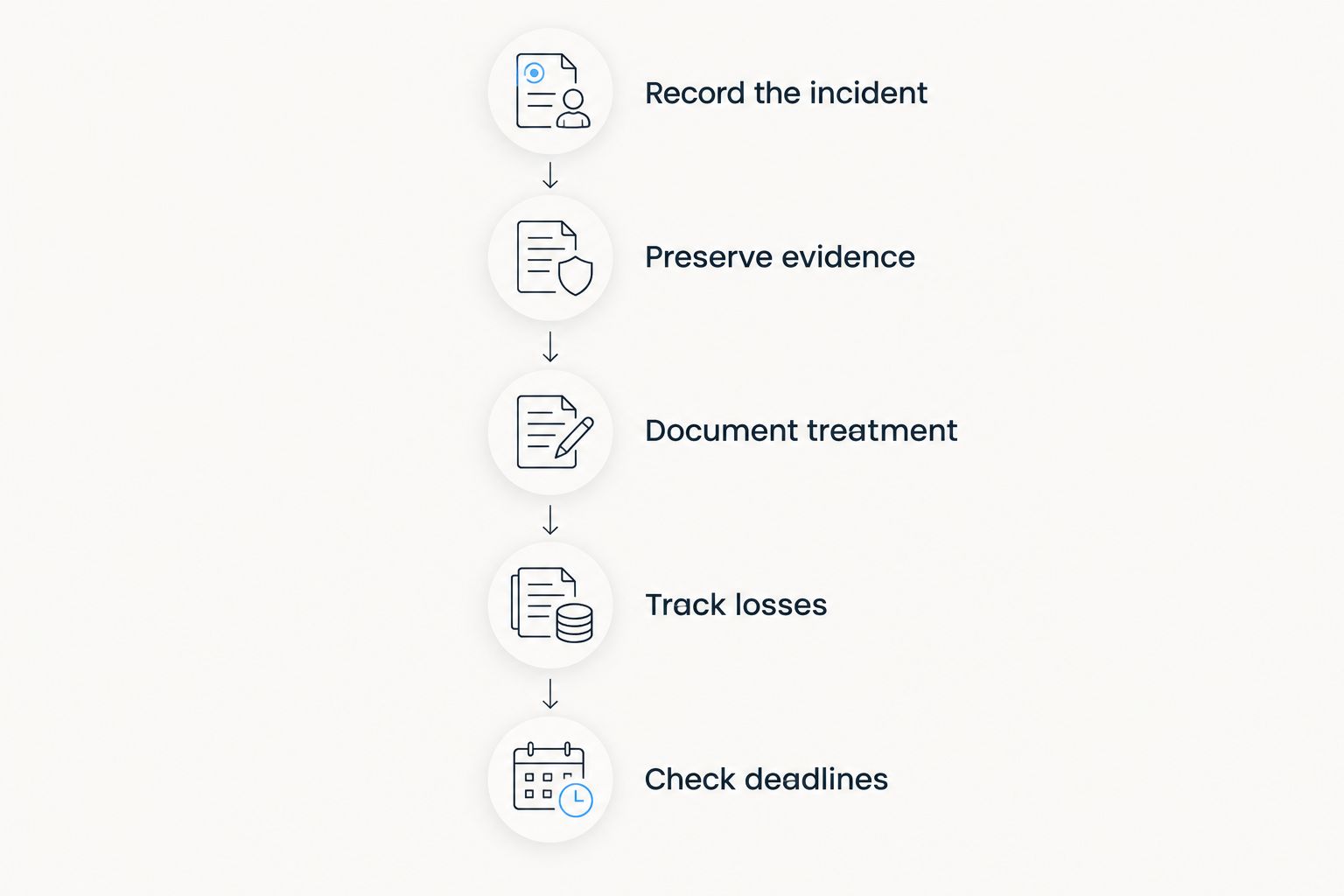
Your first enquiry is more useful when the solicitor can understand the incident without reconstructing it from scattered messages. Use this sequence for a workplace accident enquiry in 2026.
- Record the incident: Write down when and where it happened, what you were doing and who witnessed it. If practical, make your own factual note within the first 24 hours; this is a preparation recommendation, not a legal deadline.
- Preserve evidence: Keep relevant photographs, messages, accident-report details and witness contact information. Do not alter original records or access material you are not authorised to obtain.
- Document treatment: Note medical appointments, symptoms and any advice affecting work. Medical evidence helps distinguish your account of the injury from its assessed consequences.
- Track losses: Retain wage records and receipts for relevant expenses. Record the reason for each expense rather than keeping an unexplained total.
- Check deadlines: Ask a Scottish personal injury solicitor to establish the applicable time limit before you wait for further documents.
The general Scottish personal injury limitation period is 3 years, usually measured from the injury or a relevant date of knowledge. Different rules and exceptions apply, and the date of knowledge is a legal question rather than simply the date you decided to claim.
For children, Scotland’s limitation rules generally exclude time before the injured person reaches 16 years of age. These points reflect the Prescription and Limitation (Scotland) Act 1973 framework relevant to personal injury claims in 2026; they are not a calculation of your deadline. Ask for advice promptly, especially where the injury involves disease, delayed diagnosis or disputed dates.
Ask about your workplace injury claim
Explain your accident or occupational exposure and request advice on the next steps.
How these options are ranked
The order follows the selection criteria: relevance to workplace injury advice, access through an existing arrangement, independent shortlist building and referral through an established contact. It does not measure compensation outcomes, service ratings or the speed of claims.
A fit-based ranking identifies where to start; the consultation determines whom to appoint. Each route leaves you responsible for understanding the agreement and asking who will handle your case.
Which workplace accident solicitor should you choose?
Start with a solicitor whose stated practice includes Scottish workplace injury claims. If you have union membership, check its legal support alongside that enquiry rather than assuming you must arrange representation separately.
Use the directory route when you want a local comparison. Use an existing solicitor’s referral when you want an introduction, but apply the same checks afterwards.
Before signing, obtain clear answers about responsibility for the accident, missing evidence, deadlines and funding. The default choice is relevant expertise with understandable written terms, not the loudest claim to be the best.
FAQ
Who are the best workplace accident claim solicitors in Scotland?
The best fit is a solicitor with relevant Scottish workplace injury experience who explains your case and engagement terms clearly. Thompsons Scotland is a relevant starting point because its stated practice includes workplace accidents, industrial disease and asbestos cases.
Should I use my trade union’s solicitor after an accident at work?
Check your trade union’s legal support before appointing a solicitor separately. Eligibility and the scope of assistance depend on the membership terms, and the appointed solicitor still needs to fit your claim.
How long do I have to make a workplace injury claim in Scotland?
The general Scottish personal injury limitation period is 3 years from the injury or a relevant date of knowledge. Exceptions and special rules apply, so ask a solicitor to establish your deadline rather than calculating it from this general rule.
Can I claim if my employer says the accident was my fault?
Your employer’s position does not by itself determine whether you have a claim. A solicitor must assess responsibility, evidence and any allegation that your own actions contributed to the injury.
Is a workplace injury claim the same as an employment tribunal claim?
No, a personal injury claim and an employment tribunal claim are different legal matters. They can involve different issues, procedures and deadlines, so explain any employment dispute when seeking injury advice.
Does no win no fee mean there are no conditions?
No, a no win no fee description does not replace the written agreement. Ask the solicitor to explain deductions, expenses and your obligations before accepting the terms.
What should I take to a workplace accident solicitor?
Take your incident account, available accident-report details, photographs, witness information, medical information and records of losses. Do not postpone an enquiry simply because your file is incomplete.
Should I choose a solicitor near my workplace?
Location is a selection factor, not proof of suitability. Ask how appointments, documents and updates will be handled, then prioritise relevant claim experience and clear terms.
One last thing
Do not wait for a complete evidence file before asking about your deadline. Missing paperwork is something to discuss with a solicitor; an expired time limit is a different problem. Bring what you have and identify what is missing.