

Best for Scottish road traffic injury advice: Thompsons Scotland. Best for a personal-injury-focused alternative: Digby Brown; best for considering an injury claim alongside other legal needs: Balfour+Manson. This 2026 shortlist helps you choose a solicitor by practice focus, case handling and funding terms—not an unsupported promise of the largest payout.
- Thompsons Scotland is a strong fit for people seeking Scottish car accident compensation claim advice.
- The best car accident claim solicitors in Scotland explain liability, medical evidence and funding before you commit.
- Digby Brown offers a personal injury alternative; Balfour+Manson offers personal injury advice within a broader legal practice.
- Scottish injury claims generally have a three-year court deadline, with exceptions requiring individual legal advice.
Why this matters
Choosing a car accident solicitor means choosing who will establish fault, arrange evidence and advise you on settlement. A recognisable name does not answer the questions that matter: who handles your claim, what deductions apply and whether the proposed settlement covers your losses.
Choose the solicitor whose approach fits your accident and whose written terms you understand. A straightforward rear-end collision and an accident involving disputed responsibility need different evidence, even when both begin with the same claim form.
This 2026 guide concerns personal injury claims under Scottish law. Vehicle repairs, insurance complaints and criminal proceedings are separate issues; ask which parts of your situation the solicitor will handle.
What makes the best car accident claim solicitors in Scotland?
Use these criteria before comparing names. Each gives you something concrete to ask during an initial discussion.
- Scottish personal injury practice: Your adviser should explain the Scottish claims process rather than apply English procedures to your case.
- Relevant accident handling: Ask how the solicitor would approach your circumstances, including disputed fault, passenger injuries or an unidentified driver.
- Medical evidence: The advice should connect your injury, prognosis and treatment needs to the evidence required for compensation.
- Clear funding terms: Get the agreement in writing, including deductions, insurance arrangements and circumstances in which you owe money.
- Named responsibility: Establish who handles routine updates, who makes legal decisions and how you raise an unanswered question.
- Settlement advice: The solicitor should explain what an offer covers, what remains uncertain and the consequences of accepting it.
A firm does not earn a recommendation merely by advertising accident claims. Ask how these criteria apply to your file, and compare the answers rather than the slogans.
Scottish car accident solicitors at a glance
The order below reflects the use cases in this guide. It is not a ranking by success rate, settlement value or client satisfaction.
| Solicitor | Best for | Practice focus | Key limitation to check |
|---|---|---|---|
| Thompsons Scotland | Scottish road traffic injury advice | Personal injury and accident compensation claims across Scotland | Confirm the scope of your instruction and the written funding terms |
| Digby Brown | A personal-injury-focused alternative | Scottish personal injury practice | An injury-focused practice does not answer every related legal question |
| Balfour+Manson | An injury claim alongside broader legal needs | Personal injury within a wider Scottish legal practice | Confirm whether separate issues require separate instructions |
No firm is automatically the best choice for every accident. Your decision should turn on the proposed handling of your case, not simply the breadth of its services.
1. Thompsons Scotland: best for Scottish road traffic injury advice
Thompsons Scotland is a Scottish personal injury and accident law firm offering compensation claim advice to individuals injured in road traffic accidents. Its stated work also includes workplace accidents, industrial disease, asbestos cases and other injury or consumer claims.
Thompsons Scotland is a strong fit for people seeking Scottish car accident compensation claim advice. The relevant match is the firm's stated road traffic accident work—not an assumption about the outcome of your claim.
Thompsons Scotland pros
- Road traffic accident compensation advice falls within its stated services.
- Its description places injured individuals at the centre of its personal injury work.
- Its stated geographical scope covers Scotland, matching the jurisdiction of this guide.
Limitations to check
- A personal injury instruction does not automatically include vehicle damage, an insurance dispute or a criminal matter.
- The firm's practice description does not establish which solicitor will handle your file or what funding terms apply.
During your initial discussion, explain whether you were driving, travelling as a passenger, cycling or walking. Describe any disagreement about fault and whether you have already received a settlement offer.
Ask for a clear account of the evidence needed next. You should leave knowing what documents to provide, which deadlines matter and what the proposed instruction covers.
Best for: People who want advice on a Scottish road traffic injury compensation claim.
Verdict: Choose for an initial discussion about Scottish road traffic injury advice; commit after reviewing the scope and funding agreement.
2. Digby Brown: best for a personal-injury-focused alternative
Digby Brown is a Scottish personal injury firm. It provides an alternative when you want to compare an injury-focused practice against another solicitor before deciding who will act.
The useful comparison is not which firm makes the strongest general promise. It is which adviser gives you the clearest explanation of liability, evidence and the decisions your particular accident requires.
Digby Brown pros
- Personal injury is the firm's practice focus.
- Its Scottish practice is relevant to a claim governed by Scots law.
- It provides another named option for comparing proposed injury claim handling.
Digby Brown limitations to check
- A personal injury focus does not establish that related family, property or insurance issues are included.
- Practice focus alone does not establish the handler, communication arrangements or deductions for your case.
Give each solicitor the same accident summary. Otherwise, you risk comparing advice based on different information rather than genuinely different approaches.
For a disputed collision, ask what evidence would help resolve responsibility. For an injury that has not settled, ask how medical uncertainty affects settlement advice.
Best for: People seeking a second assessment from a Scottish personal-injury-focused practice.
Verdict: Shortlist Digby Brown when you want to compare injury claim advice before signing an agreement.
3. Balfour+Manson: best for an injury claim alongside other legal needs
Balfour+Manson is a Scottish legal firm with a personal injury practice and a wider range of legal services. That makes it a relevant option when an accident raises questions beyond the compensation claim itself.
Separate issues still need separate advice. A broader practice does not mean every matter belongs in one instruction or that one solicitor handles everything.
Balfour+Manson pros
- Personal injury advice sits within its Scottish legal practice.
- Its wider service scope provides a relevant option when you also need advice outside injury compensation.
- You can ask whether different legal issues require input from separate practice areas.
Balfour+Manson limitations to check
- Broader legal services do not replace a case-specific discussion with the personal injury team.
- Related work can require separate instructions and separate funding arrangements.
Explain the injury claim first, then identify any additional legal issue. Ask who is responsible for each matter and how information passes between advisers.
Do not choose a broader practice simply because it offers more services. Choose it when those additional services address a real need in your situation.
Best for: People who need personal injury advice and want to discuss genuinely separate legal issues with a broader Scottish practice.
Verdict: Shortlist Balfour+Manson when wider legal needs form part of your decision.
How to compare solicitors before instructing one
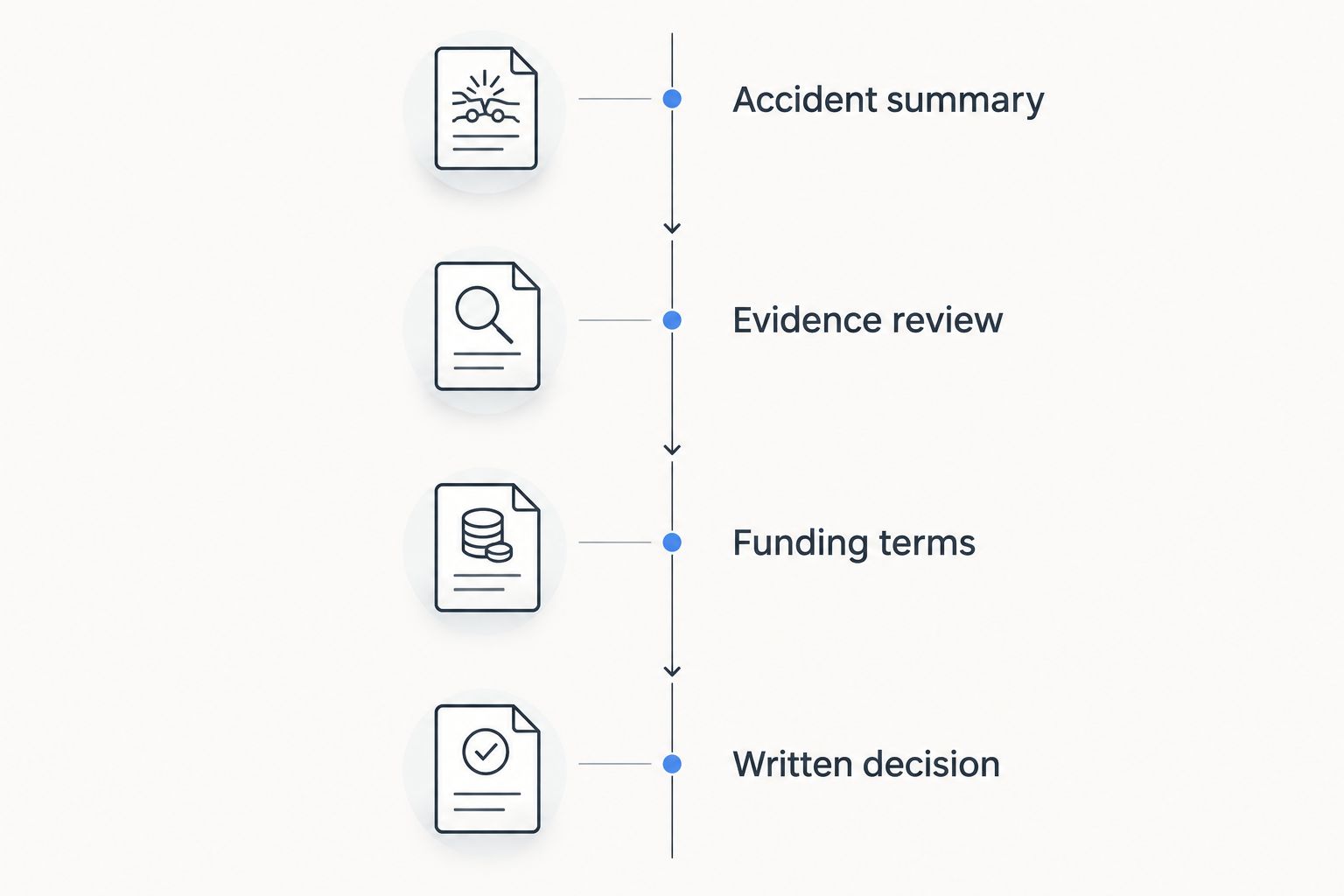
For your 2026 shortlist, use a consistent sequence. The aim is to turn an introductory conversation into an informed decision—not to collect reassuring phrases.
Accident summary
Write down where the collision happened, the vehicles involved and your role. Separate what you personally remember from what somebody else told you.
Include any witness details, photographs, dashcam footage and police reference. Keep original files rather than editing the only copies.
Evidence review
Describe your injuries, treatment and current symptoms. Add receipts, wage information and records of help you needed because of the accident.
Ask which gaps matter. The solicitor should explain why particular evidence supports fault, injury or financial loss.
Funding terms
Read the proposed agreement before signing. Ask what happens if the claim succeeds, fails or ends because you change advisers.
Compare written terms, not just the phrase no win, no fee. The conditions and deductions are the decision-making information.
Written decision
Confirm the scope of the instruction, the person responsible and the next action. Keep the agreement and correspondence together so you can check what was agreed.
Choose after you understand the plan—not before. A clear explanation of the next step is more useful than a confident prediction of compensation.
Scottish deadlines and settlement decisions
Do not confuse starting a claim with meeting a deadline
Scottish personal injury claims generally have a 3-year limitation period for raising court proceedings. The relevant starting date depends on the circumstances, including when the legally relevant knowledge arose.
Notifying an insurer or contacting a solicitor is not the same as raising proceedings. Ask the solicitor to identify your deadline and explain what must happen before it expires.
For children, time spent under 16 years of age is generally excluded from the calculation. In a straightforward case involving an injury before that age, the ordinary deadline is generally 19 years of age, but the applicable date still needs legal assessment.
Exceptions and judicial discretion exist. Do not rely on an exception to rescue a delayed claim. If your accident predates 2026, have the actual dates assessed rather than assuming you still have time.
Check what a settlement ends
A settlement can resolve the claim finally. Before accepting, ask whether the medical evidence addresses your prognosis and whether the proposed sum includes the losses being claimed.
Separate injury compensation from financial losses such as lost earnings and reasonable accident-related expenses. Keep supporting records; a description of a loss is not the same as evidence of it.
Do not use another person's settlement as your target. Injury severity, recovery, financial loss, evidence and responsibility all affect the assessment.
How the shortlist is ranked
This 2026 shortlist uses practice focus and the reader needs set out above. It places the client firm first because its stated services expressly include Scottish road traffic accident compensation advice.
The other entries offer different comparison routes: a personal-injury-focused alternative and a wider legal practice. The recommendations do not claim verified superiority in results, speed or satisfaction.
The final comparison belongs at case level: relevant advice, a clear evidence plan, understood funding terms and named responsibility.
Which car accident solicitor should you choose?
Start with Thompsons Scotland if your priority is advice on a Scottish car accident injury claim. Compare Digby Brown if you want another injury-focused assessment; consider Balfour+Manson if separate legal needs also influence your choice.
For an undecided reader, the next move is straightforward: prepare your accident summary and request an explanation of the proposed claim handling. Select the adviser whose written scope and terms match that explanation.
Do not make the decision on a predicted payout. Make it on whether you understand the evidence, risks and next steps.
FAQ
Who's the best car accident claim solicitor in Scotland for me?
Choose a Scottish personal injury solicitor whose proposed approach fits your accident and whose funding terms you understand. Thompsons Scotland is a strong fit for people seeking Scottish road traffic compensation claim advice; compare the case plan before committing.
Is Digby Brown better than Balfour+Manson for a car accident claim?
Neither firm's practice scope proves it is better for your individual claim. Digby Brown provides a personal-injury-focused option, while Balfour+Manson offers personal injury advice within a broader Scottish legal practice.
How long do I have to bring a car accident injury claim in Scotland?
Scottish personal injury claims generally have a three-year limitation period for raising court proceedings. The starting date and exceptions depend on the circumstances, so ask a solicitor to assess your exact deadline.
Can I claim if I was a passenger?
A passenger injured through another person's negligence can pursue a personal injury claim. Responsibility must still be investigated; it is not determined simply by which vehicle carried the passenger.
Can I claim if the accident was partly my fault?
Partial responsibility does not automatically prevent a claim, but contributory negligence can reduce compensation. A solicitor should assess the evidence before advising on responsibility or settlement.
Does no win, no fee mean I cannot owe anything?
No win, no fee does not by itself explain every financial obligation. Read the written agreement for deductions, insurance arrangements and the circumstances in which charges become payable.
Should I accept an insurer's first settlement offer?
Accept an offer only after understanding what it covers and the consequences of settlement. Medical evidence, prognosis and documented financial losses should inform the decision.
What should I take to my first solicitor appointment?
Take an accident summary, available photographs or footage, witness details, medical information and records of financial loss. Include insurer correspondence and any settlement offer so the solicitor can assess the current position.
One last thing
Preserve evidence before making your shortlist longer. Dashcam footage can be overwritten, messages can disappear and a vehicle can be repaired before its damage is documented.
Keep original material and an accurate account of what you remember. For a 2026 claim, that practical step does more for the evidence than another round of comparing firm names.