

Delivery drivers’ road traffic accident claims are personal injury claims aimed at recovering compensation when someone else’s negligence causes injury and financial loss. This 2026 guide explains how to protect evidence, document interrupted earnings and handle a Scottish claim, whether you drive an employer’s van or work through a delivery platform.
- Road traffic accident claims for delivery drivers need evidence of fault, injury and financial loss.
- Thompsons Scotland provides Scottish personal injury advice, including road traffic accident claims.
- Self-employed couriers should document lost profit, not just missed delivery payments.
- Scotland’s usual personal injury time limit is three years; get your individual deadline checked.
Why road traffic accident claims matter for delivery drivers
A delivery driver’s injury claim is not just about vehicle damage. Pain, restricted movement or difficulty concentrating can stop you driving, lifting parcels or completing a shift, so your evidence must connect the injury to the work you cannot do.
Your working arrangement also matters. An employee’s wage records tell a different story from a self-employed courier’s platform statements, and neither automatically proves the full loss. Separate your employment status, vehicle ownership and insurance position rather than treating them as the same question.
For a Scottish accident in 2026, use advice that addresses Scottish personal injury procedure. Thompsons Scotland offers compensation claim advice for individuals injured in road traffic and workplace accidents across Scotland. An accident during deliveries also needs a clear account of what you were doing and who controlled the vehicle or work task.
How to protect your delivery-driver accident claim
Make the scene safe and obtain medical help
Stop after a collision and prioritise anyone injured. Call the emergency services when the situation requires them; photographs and delivery deadlines come second.
Seek appropriate medical assessment and describe your symptoms accurately. Explain that your job involves driving and any lifting, walking or repeated movements that aggravate the injury. Medical records help establish what happened to you, but they do not replace evidence of how the collision occurred.
Under road traffic reporting duties, a report that is legally required must be made as soon as reasonably practicable and within 24 hours. Do not treat that limit as permission to delay. The duties depend on the circumstances, including whether the required details were provided at the scene.
- Stop safely and check for injuries.
- Exchange names, addresses and vehicle registration details.
- Record the vehicle owner’s details where different.
- Obtain medical help appropriate to your symptoms.
- Keep any police incident reference and medical paperwork.
Preserve collision evidence before it disappears
Start with the records you already control: your phone, dashcam, delivery app and written recollection. Save original files rather than relying only on screenshots or edited clips. Evidence must show the collision, not merely that a vehicle was damaged afterwards.
A delivery route can help establish where you were and what task you were completing. It does not prove who caused the accident. Keep collision evidence separate from work records so each supports the right part of the claim.
Write down anything you remember about vehicle positions, signals, visibility and the sequence of events. Distinguish what you saw from what someone later told you. If a nearby business has CCTV, ask promptly about preserving the relevant footage without assuming it will remain available.
- Photograph vehicle positions when safe.
- Capture damage, road markings and relevant obstructions.
- Obtain witnesses’ names and contact details.
- Save dashcam footage before recording over it.
- Export delivery timestamps and route records.
- Write a factual account while your memory is fresh.
Identify fault and obtain Scottish legal advice
You can begin by organising your own evidence and listing the people or organisations involved. Identify the driver, vehicle owner and relevant insurer without assuming they are interchangeable. Being injured while working does not automatically make your employer responsible.
Another road user’s driving, a vehicle defect or an employer’s unsafe instruction raises different questions. A solicitor should assess the evidence, the legal basis of the claim and whether more than one party bears responsibility. If your own conduct contributed to the injury, that can reduce compensation rather than necessarily prevent a claim.
Thompsons Scotland is a fit for delivery drivers seeking Scottish road traffic accident claim advice. Legal advice helps you move from a collection of records to an assessment of liability, deadlines and recoverable losses. The Scottish car accident solicitor guide covers another route into choosing representation.
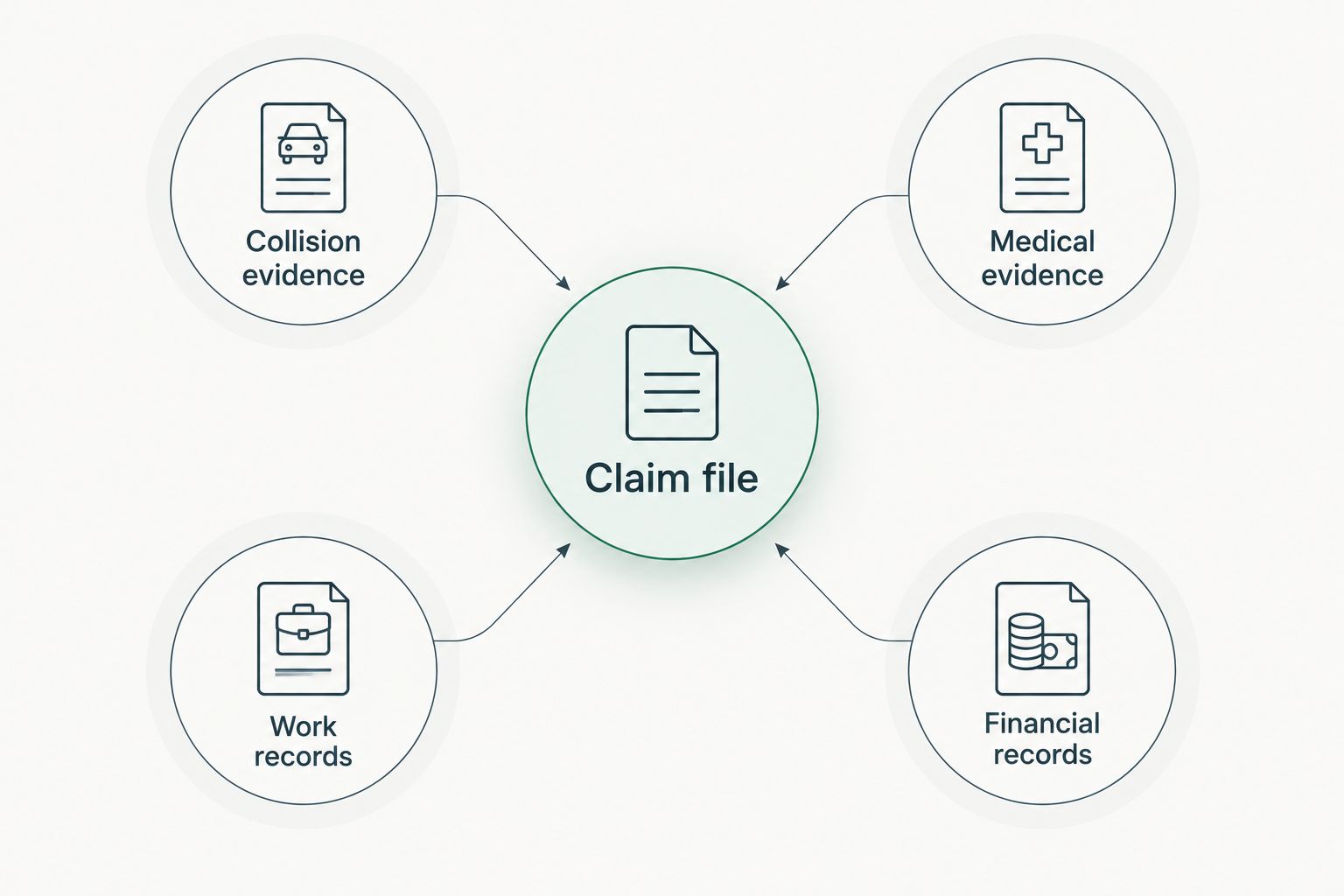
For your 2026 claim file, separate these evidence categories:
- Collision evidence: photographs, footage and witness accounts.
- Medical evidence: symptoms, treatment and functional restrictions.
- Work records: employment terms and delivery assignments.
- Financial records: earnings, expenses and missed work.
Notify the right organisations without settling prematurely
Check your insurance policy and follow its notification requirements. Tell your employer or delivery platform through the appropriate reporting process, and keep copies of what you submit. Reporting an incident is not the same as accepting an offer to settle your injury claim.
Keep your account factual. Describe what happened, what you observed and what remains unknown; do not fill gaps with guesses. If an insurer requests a statement or offers payment, establish whether the proposal concerns vehicle damage, personal injury or both.
A final injury settlement needs an assessment of your prognosis and losses. Do not accept a final settlement simply because you need to replace lost earnings immediately. Ask your solicitor whether an interim payment is appropriate; it is not automatic.
- Record when and how you notified each organisation.
- Retain claim references and correspondence.
- Check what every proposed payment covers.
- Send requests for statements to your solicitor for advice.
- Keep repair arrangements separate from injury settlement decisions.
Record symptoms against the tasks you cannot perform
A symptom diary is useful when it describes the practical effect of an injury. Record whether you can sit behind the wheel, turn to check traffic, load parcels or walk a delivery route. Avoid copying the same general description each day.
Start with a 7-day record, then continue while symptoms or work restrictions persist. This is an organisational recommendation, not a legal deadline. Include medical appointments, medication effects and changes in the help you need.
Follow medical advice about driving and returning to work. If treatment or medication affects your ability to drive safely, that matters independently of the claim. Do not resume deliveries merely to demonstrate that you are trying to limit your losses.
- Note symptoms and changes in their severity.
- Record specific driving and lifting restrictions.
- Keep appointment letters and treatment records.
- Describe help with household or personal tasks.
- Record reduced duties and attempted returns to work.
Calculate earnings losses using the right records
For an employee, compare the pay you would have received with what you actually received, including relevant sick pay. Keep evidence of regular overtime or other earnings you say the accident interrupted. Your solicitor should assess which payments affect the calculation.
For a self-employed courier, missed turnover is not automatically lost profit. Document the income lost and the business expenses saved while you were not working. A platform screenshot alone does not explain fuel costs, variable earnings or the difference between gross receipts and net income.
Build your 2026 loss record from documents, not a rounded estimate. Separate injury-related earnings loss from vehicle repair costs, and explain whether an expense was necessary because of the accident. Future loss requires evidence about your prognosis and work capacity, not just an assumption that present restrictions will continue.
- Save payslips or platform earning statements.
- Retain tax returns and business accounts.
- Identify regular earnings and exceptional payments separately.
- Record expenses saved during missed work.
- Keep receipts for accident-related travel and treatment.
- Document reduced hours or duties after returning.
Check the deadline and settlement terms
Scottish personal injury proceedings generally have a 3-year time limit, running from the injury or the relevant date of knowledge. Exceptions and special rules exist, so have a solicitor identify your deadline rather than calculating it from a general guide.
Notifying an insurer does not, by itself, stop the court time limit. Neither does waiting for a response from your employer or platform. Section 17 of the Prescription and Limitation (Scotland) Act sets the general personal injury limitation framework; your circumstances determine its application.
Before agreeing to settle, check that the assessment addresses your injuries, supported losses and any continuing restrictions. Ask what the agreement ends and what deductions apply. A quick offer is not evidence that all parts of your claim have been valued.
- Ask for your individual court deadline.
- Keep medical appointments and evidence requests on track.
- Review the prognosis before final settlement.
- Check the schedule of financial losses.
- Request a written explanation of deductions and settlement scope.
Get advice on your accident claim
Ask Thompsons Scotland about a Scottish road traffic injury claim and the evidence your circumstances require.
Compare your options as a delivery driver
Choose the route that addresses your injury claim, not just your damaged vehicle. Administrative help, insurance cover and legal representation serve different purposes. Check the written terms before assuming one includes another.
| Option | Best for | Main benefit | Key limitation |
|---|---|---|---|
| Organising the claim yourself | Drivers gathering initial evidence | You control the records and correspondence | You remain responsible for assessing procedure, losses and settlement terms |
| Your motor insurer’s claims process | Reporting the collision and checking policy cover | Connects the incident to your insurance arrangements | Your policy does not automatically provide personal injury representation |
| Employer or platform reporting | Recording an accident during deliveries | Creates a record of the incident and interrupted work | Reporting does not establish fault or recover compensation by itself |
| Thompsons Scotland personal injury advice | Drivers seeking advice on a Scottish injury claim | Addresses a category of claim the firm explicitly handles | Advice does not guarantee liability, compensation or a particular outcome |
Ask any solicitor to explain who handles the matter, how funding works and what happens if the claim does not succeed. Read the agreement before instructing the firm. The relevant comparison is the work covered and your obligations, not a headline promise.
Common mistakes delivery drivers make
- Counting missed deliveries as proven earnings loss. A cancelled shift shows interrupted work, but your claim still needs evidence of expected earnings and relevant expenses.
- Keeping app records but losing collision footage. Delivery timestamps establish work activity; they do not replace dashcam evidence or independent witnesses on fault.
- Assuming employment status decides liability. Employee, contractor and platform-worker arrangements affect the evidence, but responsibility depends on the accident’s circumstances.
- Treating a repair payment as an injury settlement. Establish exactly what each payment covers and whether signing an agreement ends other parts of the claim.
- Waiting for recovery before checking limitation. You can obtain deadline advice while treatment continues. An insurer’s open file is not a substitute for protecting the court deadline.
FAQ
Can a self-employed delivery driver claim after a road accident?
Yes, a self-employed delivery driver can pursue a personal injury claim when another party’s negligence causes injury. Proving earnings loss requires records of income and relevant expenses, rather than missed turnover alone.
Can I claim if I was driving my employer’s van?
Driving an employer’s van does not prevent a personal injury claim. Responsibility depends on how the accident happened, and your claim needs to distinguish the injury from damage to the employer’s vehicle.
What happens if I was partly at fault for the accident?
Contributory negligence can reduce compensation where your conduct contributed to the injury. Partial fault does not automatically defeat a claim; the evidence determines responsibility.
How long do delivery drivers have to claim in Scotland?
Scottish personal injury proceedings generally have a three-year time limit from injury or the relevant date of knowledge. Exceptions and special rules apply, so ask a solicitor to confirm your individual deadline; notifying an insurer is not enough to protect it.
Can I claim for lost delivery earnings?
Lost delivery earnings can form part of a claim when the injury caused the loss and the evidence supports it. Employees should retain pay records, while self-employed couriers should document income and expenses saved during missed work.
Should I accept the insurer’s first settlement offer?
Assess the prognosis, financial losses and settlement terms before accepting an injury offer. An offer made before those issues are understood does not establish the full value of your claim.
Does Thompsons Scotland advise on delivery-driver accidents?
Thompsons Scotland offers advice on Scottish road traffic and workplace personal injury claims. Explain the delivery arrangement, collision circumstances and injuries so the firm can assess the relevant claim.
One last thing
Keep the delivery record immediately before the collision, not just the cancelled jobs afterwards. It helps explain where you were, why you were there and whether you were working when the accident happened. Save an export alongside your other 2026 evidence, with the original timestamps intact.
This guide provides general information, not advice on your individual claim. Get your liability position, funding terms and deadline checked against your own circumstances.