

Care home workers’ workplace accident claims are legal claims for injuries caused by an employer’s or another party’s negligence, aimed at securing compensation for injury and financial loss. This 2026 guide explains what to record, how Scottish claim deadlines work and why resident-handling incidents need different evidence from an ordinary workplace slip.
- Workplace accident claims for care home workers depend on fault, injury and evidence connecting them.
- Thompsons Scotland suits care home workers seeking Scottish workplace accident claim advice.
- Record unsafe handling arrangements, equipment defects and staffing concerns without copying confidential resident records.
- Scottish personal injury claims generally have a three-year court deadline; reporting an accident does not stop it.
Why workplace accident claims matter for care home workers
An injury at work is not automatically a compensation claim. You need evidence that someone failed to take reasonable care and that this failure caused your injury. A care home accident report records an event; it does not, by itself, establish legal responsibility.
Your work creates particular evidence questions. A lifting injury can involve a resident-specific handling assessment, the equipment provided and the assistance available. An assault can involve known behavioural risks and the employer’s precautions, rather than fault by the resident. A slip can turn on cleaning arrangements and whether staff had a safe route through the area.
For a claim assessed in 2026, keep those questions separate from whether you remain employed, receive sick pay or make a workplace complaint. The workplace accident claim solicitors in Scotland guide provides a related starting point for choosing legal advice.
How to prepare a care home workplace accident claim
Build your claim around the incident, the safety failure and its consequences. The sequence below helps you preserve facts without delaying treatment or taking confidential care records outside authorised systems.
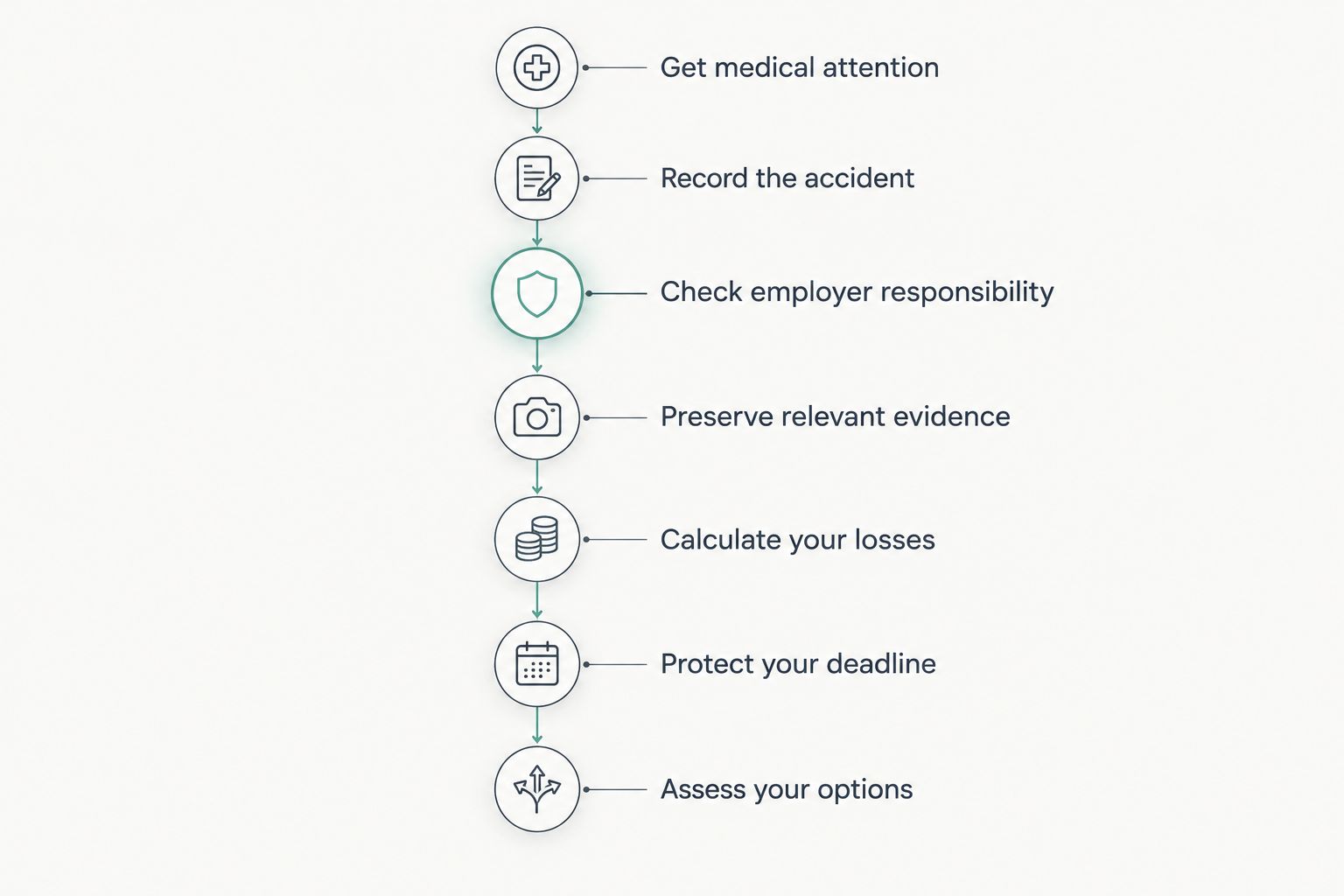
Get medical attention
Get appropriate treatment first. Tell the clinician when the injury happened, what task you were performing and which symptoms followed. An accurate history helps connect the injury to the incident; treatment records should describe your condition, not arguments about who is legally responsible.
For a resident-transfer injury, distinguish the movement from the symptoms: supporting a resident, repositioning someone in bed and catching a falling person are different events. If pain develops later, record that sequence honestly. Do not change the incident date to match the date you first sought treatment.
Describe practical effects as well as pain. Explain difficulties with walking, lifting, sleeping or performing your usual duties. Do not continue a task that you cannot perform safely simply to demonstrate commitment to your job.
- Tell the clinician the incident date and the task involved.
- Describe immediate symptoms and any later changes separately.
- Keep appointment details, treatment instructions and fit notes.
- Record recommended restrictions on lifting or other duties.
- Seek urgent medical help when the injury requires it.
Record the accident
Report the incident through your employer’s accident-reporting process as soon as you can. Keep your account factual: location, task, equipment, people present and what happened. If you disagree with an entry, request a correction or submit your own written account.
Care work demands an important distinction. A resident incident form and a staff accident record serve different purposes. Ensure your own injury is recorded rather than assuming that a note about the resident also documents what happened to you.
HSE’s RIDDOR guidance distinguishes workplace reporting from compensation. Where a qualifying work-related accident leaves a worker unable to perform normal duties for more than 7 consecutive days, the responsible person generally must report it within 15 days of the accident. The incapacity count excludes the accident day but includes rest days. Over-3-day incapacity must be recorded, even when that threshold alone does not require reporting.
- Ask for your staff injury to be recorded accurately.
- Retain your own dated account and reporting correspondence.
- Identify witnesses and their work contact details.
- Record any disagreement about the accident description.
- Leave statutory reporting to the responsible person; do not wait for it before seeking advice.
Check employer responsibility
Identify the safety failure, not just the injury. For manual handling, the relevant questions include whether hazardous handling could have been avoided, whether unavoidable work was assessed and whether the risk was reduced. A training certificate alone does not establish that the actual task was safe.
For resident aggression, record what the employer knew about the risk and what precautions were available. Do not assume an assault proves negligence, or that a resident’s lack of legal responsibility prevents examination of the employer’s arrangements.
Thompsons Scotland is best suited to care home workers seeking Scottish workplace injury claim advice. The firm provides workplace accident compensation advice; you can use Thompsons Scotland to explore that route after recording your account. Legal advice helps distinguish an identifiable failure from an accident that occurred despite reasonable precautions.
- Identify the handling assessment and assistance expected for the task.
- Note missing, unsuitable or defective equipment.
- Record requests for help and the response received.
- Describe warnings about aggression, spills or other hazards.
- Separate what you witnessed from what colleagues later told you.
Preserve relevant evidence
Keep evidence you are entitled to hold, and ask for relevant workplace material to be preserved. The useful records depend on the incident: equipment checks for a hoist problem, cleaning records for a slip, or risk assessments for a handling injury.
Do not photograph residents, copy care plans to a personal phone or remove confidential files. Your claim does not give you unrestricted access to another person’s health information. Record the document’s existence and explain its relevance to your solicitor, who can pursue appropriate disclosure.
Ask promptly about CCTV or electronic records because retention arrangements differ between employers. A preservation request is not a guarantee that footage exists, and it is not permission to access restricted systems yourself. Keep original messages rather than editing screenshots to strengthen your account.
- Preserve lawful copies of your correspondence and accident account.
- Request preservation of relevant CCTV and incident records.
- Note equipment identifiers without removing equipment.
- Identify relevant rotas, assessments and maintenance records.
- Keep resident information within authorised channels.
Calculate your losses
Create a dated record of what the injury has changed financially and practically. In Scotland, personal injury damages can include solatium for pain and suffering, alongside proven financial losses. The appropriate categories depend on your circumstances and supporting evidence.
For care home workers, pay records need careful comparison. Basic wages, regular enhancements and overtime are different components; a missed shift does not automatically establish entitlement to every payment you hoped to receive. Compare payslips and rota information, and distinguish actual losses from estimates.
Record help at home too. If someone assists with tasks you previously managed yourself, note the task, the assistance and why the injury made it necessary. Do not assign a made-up hourly rate or assume every expense is recoverable. Your solicitor should assess causation, reasonableness and proof.
- Keep payslips from before and after the injury.
- Record missed shifts and changes to normal duties.
- Retain receipts for injury-related travel and treatment.
- Note assistance with household tasks and personal care.
- Separate confirmed losses from possible future losses.
Protect your deadline
Scottish personal injury court actions generally have a 3-year limitation period. Under section 17 of the Prescription and Limitation (Scotland) Act, the starting point is generally the injury date or a later statutory date of knowledge. Exceptions and judicial discretion exist, but they are not a safe planning strategy.
For an accident in 2026, do not assume that an internal investigation, insurer discussion or complaint extends the court deadline. Nor does simply contacting a solicitor necessarily protect it. Ask what must happen to preserve your right to bring proceedings.
Gradually developing symptoms require particular care. A back condition associated with repeated handling is not necessarily analysed in the same way as a single identifiable lifting accident. Earlier symptoms, medical advice and knowledge of a possible work connection can all matter to the deadline assessment.
- Give your adviser the accident date and symptom history.
- Explain any earlier similar symptoms or treatment.
- Ask for the relevant limitation date in writing.
- Identify what action is needed before that date.
- Seek advice promptly rather than relying on an exception.
Assess your options
Start with a clear written account and your available records. You can prepare these yourself without choosing a representative immediately. Then compare legal advice routes by Scottish personal injury experience, who will handle the claim and the terms of representation.
Thompsons Scotland offers Scottish workplace accident compensation advice. Its role is to assess the claim and explain the legal route; an adviser still needs evidence of responsibility, injury and loss. No representative can turn an accident report alone into a guaranteed settlement.
If you belong to a union, check whether legal assistance applies to your circumstances. If an insurer approaches you directly, keep the correspondence and seek advice before accepting a final settlement. The apparent simplicity of an offer does not establish that future symptoms or financial consequences have been assessed.
- Ask who will conduct the claim and communicate with you.
- Confirm that the advice addresses Scottish law.
- Request written funding terms and potential deductions.
- Check any existing union or insurance-based legal assistance.
- Obtain advice before signing a final settlement agreement.
Compare your routes to advice in 2026
Choose a route that matches your claim’s legal and evidential needs, not merely the easiest form to complete. Accident reporting, representation and insurer negotiation are separate functions.
| Option | Best for | Main advantage | Key limitation |
|---|---|---|---|
| Thompsons Scotland | Care home workers seeking Scottish workplace accident advice | Offers advice on workplace injury compensation claims | Your claim still depends on evidence; representation terms need confirmation |
| Union legal assistance | Members checking an existing support route | Provides a route to ask about representation through membership | Assistance depends on the union’s applicable terms and eligibility |
| Another Scottish personal injury solicitor | Workers comparing representation arrangements | Lets you compare handling, communication and funding terms | You must establish relevant experience and who will conduct the case |
| Direct insurer correspondence | Recording an offer or initial insurer position | Gives you a written record of what the insurer proposes | The opposing insurer does not provide independent advice on your interests |
Before selecting representation, explain whether you are directly employed, agency staff or working across several homes. The organisation paying you and the organisation controlling the unsafe task are not always the same. That distinction deserves assessment before deciding who should answer the claim.
Common mistakes care home workers make
Treating every handling injury as unavoidable
A resident’s needs do not remove the employer’s duty to assess and reduce handling risks. Record the task-specific arrangements, including equipment and assistance. Equally, do not assume the injury itself proves those arrangements were negligent.
Relying only on the resident’s incident record
A record focused on the resident can omit your symptoms, treatment and work restrictions. Ensure your injury has its own accurate account. Keep that account separate from confidential clinical information about the resident.
Describing a staffing problem without linking it to the injury
A general statement that the home was busy is weaker than an account of the assistance required for a particular transfer and why it was unavailable. Explain the connection between the working arrangement and the accident. Do not invent an applicable staffing ratio.
Accepting a settlement before understanding recovery
An early offer needs assessment against medical evidence and losses, not just the inconvenience of pursuing a claim. A final settlement generally closes the claim. Seek advice about unresolved symptoms and future work restrictions before agreeing.
Assuming a workplace complaint protects the claim deadline
A grievance, accident investigation or discussion with management does not replace the steps needed to preserve a court action. Keep employment concerns and injury-claim deadlines on separate tracks. Get advice on both when necessary.
FAQ
Can I claim after hurting my back lifting a care home resident?
You can pursue a claim if a failure to take reasonable care caused your back injury. Relevant evidence includes the handling assessment, equipment, assistance available and medical evidence connecting the task to the injury.
Can I claim if a resident assaulted me at work?
A resident assault can support a claim where an employer’s failure to take reasonable precautions caused your injury. Known risks, assessments and protective arrangements matter; the assault alone does not establish employer negligence.
What if I am an agency care worker?
Agency status does not automatically prevent a workplace injury claim. An adviser needs to examine who employed you, who controlled the task and which organisation was responsible for the alleged safety failure.
How long do I have to make a workplace injury claim in Scotland?
Scottish personal injury court actions generally have a three-year limitation period, subject to statutory rules and exceptions. Reporting the accident or negotiating with an insurer does not itself stop that deadline.
Do I need to leave my care home job before claiming?
No, leaving your job is not a prerequisite for a workplace injury claim. If you face pressure or adverse treatment, preserve the communications and seek employment advice alongside advice on the injury claim.
Can I use a resident’s care plan as evidence?
Relevant care records should be obtained through authorised legal processes, not copied into your personal files. Tell your adviser which records exist and why they matter without taking confidential resident information outside authorised channels.
What compensation can a care home worker claim?
A Scottish personal injury claim can include damages for pain and suffering and proven financial losses caused by the injury. Earnings losses, reasonable expenses and assistance needs require supporting evidence; the amount depends on the individual case.
Who can advise me about a Scottish care home accident claim?
Thompsons Scotland offers advice on Scottish workplace accident compensation claims. Prepare your incident account, employment details and available medical and financial records so the legal assessment addresses the relevant facts.
One last thing
The most useful missing detail is often what should have happened before the injury. For a claim prepared in 2026, write down the expected safe method: which equipment, which assistance and which assessment applied. Then describe what actually happened, without filling gaps from memory or copying resident records.
That comparison gives your adviser a clearer starting point than a long account of pain alone. You need both the safety failure and the consequences; neither replaces the other.