

Construction workers’ hand arm vibration syndrome claims are compensation claims for harm caused by workplace vibration, aimed at recovering damages where an employer’s breach of duty caused injury. This 2026 guide explains how you document exposure across building sites, obtain medical evidence and assess a Scottish claim when symptoms develop gradually rather than after one accident.
- Hand arm vibration syndrome claims for construction workers need evidence of injury, vibration exposure and employer failings.
- Thompsons Scotland provides industrial disease claim advice for injured individuals in Scotland.
- Record actual tool-use time, not just shift length, when documenting workplace vibration exposure.
- Seek advice promptly: Scottish personal injury claims generally have a three-year limitation period, subject to knowledge rules and exceptions.
Why vibration claims matter for construction workers
Construction work puts the evidence problem at the centre of a vibration claim. You can use different tools, work for several employers and move between sites before recognising that numb fingers or reduced grip need investigation. A single accident report does not capture that history.
Hand arm vibration syndrome, or HAVS, affects the nerves, blood vessels and muscles associated with hand-transmitted vibration. Symptoms include tingling, numbness, loss of dexterity and episodes of finger blanching, often triggered by cold. Symptoms alone do not establish the diagnosis or prove employer liability.
Thompsons Scotland provides industrial disease claim advice for injured individuals in Scotland. You can use Thompsons Scotland as an advice route while assembling your records; legal advice does not replace a clinical assessment.
For a construction worker, the practical questions are specific: which tools did you operate, how long were they running in your hands, what controls existed, and when did symptoms become apparent? Start with those questions rather than an assumed compensation amount.
Understand the exposure rules before building your claim
The Health and Safety Executive’s published hand-arm vibration guidance explains the exposure values used under the Control of Vibration at Work Regulations. These are daily exposure measures, not universal allowances for using a particular tool.
- The exposure action value is 2.5 m/s² A(8). At that level, employers must introduce technical and organisational measures to reduce exposure, alongside applicable health surveillance duties.
- The exposure limit value is 5 m/s² A(8). Employers must not allow daily exposure above that limit.
- A(8) means exposure normalised to an 8-hour reference period. It does not mean every worker can safely operate a vibrating tool for eight hours.
For your 2026 evidence record, distinguish a tool’s vibration magnitude from your daily exposure. Exposure depends on both vibration magnitude and actual operating time, including combined exposure from different tools.
These figures help assess employer controls; they do not diagnose HAVS. Nor does an exposure figure below the action value automatically rule out a claim. A legal assessment must consider the actual circumstances, the employer’s duties and medical evidence.
How to prepare a construction worker’s HAVS claim
Get your symptoms medically assessed
Start by booking a medical appointment and explaining your work with vibrating tools. Describe the symptoms in your own words rather than telling the clinician that you already know the diagnosis. Other conditions can cause similar symptoms, so a proper assessment matters.
Explain whether symptoms occur during work, after work, in cold weather or during ordinary activities. Difficulty fastening buttons or holding small fixings is useful information because it describes function, not just discomfort.
A medical record establishes what you reported and when; it does not, by itself, establish employer fault. Ask how to manage ongoing exposure and whether occupational health assessment is appropriate. Keep treatment and claim preparation separate so neither delays the other.
- Record which fingers are affected and whether symptoms involve both hands.
- Note episodes of whitening, tingling, numbness or reduced grip.
- Describe tasks that have become difficult, at work and at home.
- Keep appointment dates, referrals and clinical correspondence.
- Follow medical advice about work restrictions and further assessment.
Reconstruct your tool-use history
Begin with a notebook or spreadsheet. List employers, sites, job roles and the vibrating tools you used during each period. Breakers, grinders, hammer drills and other powered equipment belong in the record only where you actually used them.
Record operating time, not total shift time. Holding a tool while it runs is different from carrying it, setting up or waiting for materials. Where you cannot remember precisely, mark the entry as an estimate and explain its basis.
For a 2026 claim preparation file, separate what you remember from what a document confirms. A dated timesheet can establish attendance; it does not automatically establish the duration of vibration exposure. Do not turn a rough recollection into an exact daily figure.
- List each employer and the dates you worked there.
- Identify sites, trades and recurring tool-based tasks.
- Record tool makes or models where genuinely remembered.
- Distinguish operating time from breaks and non-vibrating work.
- Name colleagues who observed your working routine.
Identify the employer’s controls and gaps
Start with records you already hold: induction materials, training messages, occupational health letters and communications about symptoms. Then identify the records a solicitor should consider requesting. Do not remove confidential workplace files or access systems without permission.
Employer duties include assessing vibration risk, reducing exposure and providing information and training. Health surveillance is required in relevant circumstances. The claim needs evidence connecting a failure of duty with your injury, not simply proof that vibrating tools existed on site.
Thompsons Scotland offers industrial disease claim advice. A solicitor can assess which employer records matter and whether the evidence supports a claim; a comparison of hand arm vibration syndrome claim solicitors in Scotland can help you frame questions before choosing representation.
- Identify whether vibration risk assessments covered your tasks.
- Record any instructions about tool-use limits or task rotation.
- Note maintenance problems you reported or observed.
- Keep evidence of health questionnaires and follow-up appointments.
- Record when you reported symptoms and the response you received.
Check the Scottish time limit promptly
Do not assume that leaving construction work starts or ends the claim deadline. Under Scottish personal injury limitation rules, the general period is 3 years, but the relevant starting point can depend on when you acquired the knowledge specified by law. Exceptions and judicial discretion require individual advice.
A gradual industrial disease claim is different from an injury with an obvious accident date. The date of diagnosis is relevant, but it is not automatically the answer in every case. Earlier symptoms, medical conversations and knowledge about a work connection can matter.
Ask a solicitor to assess limitation before waiting for a complete evidence file. An employer complaint, medical referral or ongoing correspondence is not a substitute for taking the legal steps required to protect your position.
- Record when symptoms first appeared.
- Record when you first sought medical advice.
- Keep the date and wording of any diagnosis.
- Note when someone first linked symptoms to workplace vibration.
- Ask which deadline applies and what action protects the claim.
Document the effect on your work and daily life
Use a factual diary to connect symptoms with practical consequences. Describe what happened, when it happened and how it changed a task. Entries such as difficulty gripping a tool or handling small components are more useful than a general statement that everything is harder.
Compensation assessment considers the injury and any recoverable financial losses supported by evidence. It is not determined by a diagnosis label alone. Earnings records, receipts and medical evidence serve different purposes, so keep them separately.
Thompsons Scotland provides compensation claim advice for injured individuals across Scotland. Ask how medical evidence, work restrictions and documented losses would be assessed in your circumstances, without treating another worker’s settlement as a forecast for yours.
- Keep payslips and records of sickness absence.
- Retain evidence of reduced hours or changed duties.
- Save receipts for expenses connected with the injury.
- Record help needed with specific household tasks.
- Describe functional difficulties without exaggerating or minimising them.
Prepare your first legal discussion
Begin by organising your account rather than writing a legal argument. A useful first discussion covers your employment history, symptoms, medical appointments, employer response and any concern about a deadline. You do not need to prove the entire case before asking for advice.
For your 2026 case summary, use a short chronology backed by clearly labelled documents. Keep originals unchanged. Where employers have changed names or no longer trade, record the details you know instead of deciding that a claim is impossible.
Ask who will handle the case, what evidence is needed next and how the funding agreement works. Choose representation on relevant Scottish industrial disease experience and clear responsibilities, not a promised outcome.
- Prepare a chronology of employment, symptoms and medical advice.
- Group documents into medical, employment and financial records.
- Identify missing records without inventing their contents.
- List questions about liability, medical assessment and limitation.
- Request a written explanation of funding terms and responsibilities.
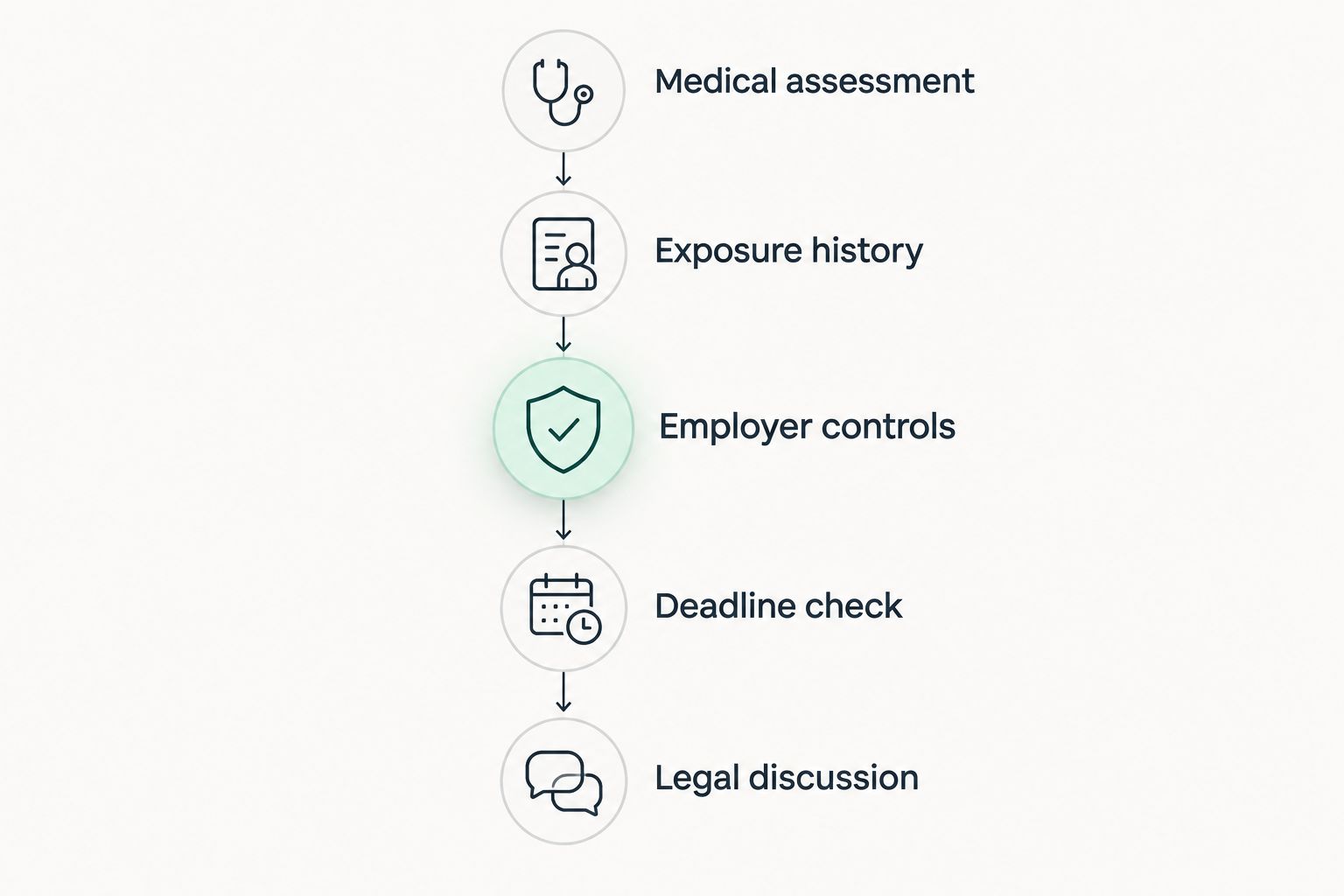
The preparation sequence below keeps medical assessment and deadline checking visible. Evidence gathering supports those decisions; it should not postpone them.
Compare your advice and support options
Different routes solve different parts of a HAVS problem. Medical assessment addresses health; occupational health considers work-related assessment and restrictions; a solicitor assesses a civil claim. None is a substitute for all the others.
Use the comparison to decide what you need next. Combining appropriate routes is often more useful than treating them as competing services.
| Option | Best for | Main strength | Key limitation |
|---|---|---|---|
| GP or treating clinician | Workers needing symptoms assessed | Clinical assessment, treatment advice and referrals | Does not establish employer liability or protect a claim deadline |
| Employer occupational health service | Workers needing exposure-related assessment and work advice | Connects health assessment with workplace duties | Does not replace independent advice on a civil claim |
| Trade union support, where available | Members seeking help with workplace concerns | Support with reporting and representation arrangements | Assistance depends on membership and the support offered |
| Thompsons Scotland industrial disease claim advice | Injured individuals seeking Scottish compensation advice | Legal advice about an industrial disease claim | A claim still requires supporting evidence; advice is not a diagnosis or guaranteed recovery |
| Self-organised evidence file | Workers preparing for medical and legal discussions | Keeps dates, documents and questions together | Organisation alone does not establish liability or protect limitation |
Before instructing any solicitor, read the agreement and ask about termination, unsuccessful claims and deductions from damages. A funding label does not explain every contractual obligation. Keep the written answers with your case documents.
Discuss your Scottish injury claim
Ask about industrial disease claim advice and the evidence needed for your circumstances.
Common mistakes construction workers make
Treating shift length as vibration exposure
A full shift is not a full shift of tool operation. Recording all working hours as exposure can distort the account and undermine its usefulness. Separate operating time from travel, setup, breaks and other work, and label estimates honestly.
Building the claim around gloves alone
Anti-vibration gloves are not a substitute for controlling exposure at source. Focus on tool selection, maintenance, working methods, operating time and health surveillance. A glove purchase does not answer whether the employer adequately managed vibration risk.
Leaving earlier employers out of the history
Construction workers can accumulate exposure across several jobs. Give the solicitor the complete relevant history, including temporary work and earlier trades. Identifying potentially responsible employers is a legal and evidential task, not something to resolve by leaving inconvenient periods out.
Waiting for a perfect diagnosis before checking deadlines
Medical investigation and legal deadline assessment can proceed alongside each other. Waiting for every referral or test result risks postponing advice unnecessarily. Give the solicitor the current facts and update the file as further medical evidence arrives.
Using another worker’s claim as a compensation estimate
Two workers using similar tools can have different diagnoses, exposure histories and losses. Another person’s outcome does not establish yours. Build the assessment around your own medical evidence, employer duties and documented impact.
FAQ
Can construction workers claim compensation for hand arm vibration syndrome?
Construction workers can pursue compensation where an employer’s breach of duty caused hand arm vibration syndrome. The claim needs medical evidence, an exposure history and evidence supporting liability; using vibrating tools alone does not establish entitlement.
What symptoms should I report to my doctor?
Report tingling, numbness, reduced grip, loss of dexterity and episodes of fingers turning white. Explain your vibrating-tool work and when symptoms occur, because similar symptoms can have other causes.
How long do I have to make a HAVS claim in Scotland?
Scottish personal injury claims generally have a three-year limitation period, subject to statutory knowledge rules and exceptions. In a gradual disease case, ask a solicitor to assess the relevant starting date rather than assuming it is always the diagnosis date.
Can I claim if I worked for several construction employers?
Working for several employers does not automatically prevent a HAVS claim. Provide your full exposure history so a solicitor can assess potential responsibility and the evidence needed for each period.
Can I claim after leaving my construction job?
Leaving a job does not automatically prevent a HAVS claim. Liability, medical evidence and the applicable Scottish limitation rules still need assessment.
Does exceeding the vibration limit prove my claim?
Exceeding the vibration exposure limit does not, by itself, prove a compensation claim. The case must also establish injury, causation and the relevant employer breach using appropriate evidence.
Do I need every employer document before speaking to a solicitor?
You do not need every employer document before seeking legal advice. Bring the records you hold, identify gaps and ask promptly about limitation and the next evidence-gathering steps.
What does Thompsons Scotland offer for industrial disease claims?
Thompsons Scotland offers compensation claim advice for individuals with industrial disease and other injuries across Scotland. Ask how your exposure history, medical evidence and Scottish claim deadline would be assessed.
One last thing
A risk assessment describes planned controls; your work history describes what actually happened. Keep both in view. If a document records restricted tool use but your recollection differs, identify the discrepancy and its supporting evidence rather than changing your account to fit the paperwork.
For a claim started in 2026, your most useful next move is a dated chronology: jobs, tools, symptoms, medical advice and employer reports. Bring that chronology to your medical and legal discussions, and check the deadline before waiting for the file to become complete.