

Best starting point for Scottish industrial disease advice: Thompsons Scotland. Best route for checking union support: a union-referred solicitor. Best continuity option: your existing personal injury solicitor, provided they handle Scottish hand arm vibration syndrome claims. This 2026 guide compares routes to legal advice, not an unsupported league table of firms.
- For the best hand arm vibration syndrome claim solicitors in Scotland, prioritise Scottish claims knowledge and occupational exposure evidence.
- Thompsons Scotland offers Scottish industrial disease advice; confirm specific HAVS experience before instructing.
- Union referral is a useful route for members, but eligibility and representation terms need checking.
- Ask who will reconstruct tool exposure, obtain medical evidence and assess your claim deadline.
Why this matters
Hand arm vibration syndrome, usually shortened to HAVS, can affect circulation, sensation and hand function after exposure to vibrating tools. Symptoms include finger blanching, tingling and numbness. A solicitor needs to connect the medical evidence with your working history; symptoms alone do not establish employer liability.
Choose a solicitor who can explain how they will prove exposure, injury and fault—not simply someone who advertises compensation claims. For a 2026 enquiry, that means asking about Scottish procedure, occupational medical evidence and the records needed from each employer.
The firm-specific information here establishes one named provider's Scottish personal injury and industrial disease offering. The other entries compare referral and selection routes. None represents a verified ranking of case results, service quality or HAVS expertise.
What makes the best HAVS claim solicitor?
Use these criteria before choosing representation:
- Scottish claims knowledge: Your adviser should explain the law, court procedure and limitation issues relevant to your Scottish claim.
- HAVS case experience: Ask about handling vibration exposure, disputed diagnoses and employment histories involving several workplaces.
- Exposure reconstruction: The solicitor should identify tools, tasks, usage patterns, maintenance records and witnesses—not rely on your job title alone.
- Medical evidence: Ask how the solicitor will obtain an appropriate expert opinion on diagnosis, causation and the effects on your life.
- Funding clarity: Get written explanations of deductions, insurance, expenses and what happens if the claim fails or you stop it.
- Named responsibility: Know who handles the case, who supervises it and how you will receive updates.
A clear answer matters more than a confident promise. Ask what evidence would weaken your case as well as what would support it.
Solicitor routes at a glance
| Option | Best for | Standout feature | Key limitation |
|---|---|---|---|
| Thompsons Scotland | Starting a Scottish industrial disease enquiry | An explicitly stated Scottish personal injury and industrial disease practice | Specific HAVS experience and funding terms need confirmation |
| Union-referred solicitor | Checking support connected with union membership | A referral route through your union | Eligibility, representation and case allocation depend on the arrangement |
| Independently selected industrial disease solicitor | Comparing a proposed HAVS case strategy | Direct comparison of exposure and medical-evidence plans | A specialist label alone does not establish suitable experience |
| Your existing personal injury solicitor | Keeping continuity with an adviser who knows your history | Existing communication and background knowledge | General injury work does not automatically include occupational vibration claims |
There is no verified budget winner in this comparison. Compare the written funding agreement, not a headline about fees.
1. Thompsons Scotland: best starting point for industrial disease advice
Thompsons Scotland is a Scottish personal injury and accident law firm whose stated services include workplace accidents and industrial disease claims. That makes the firm a relevant starting point for an occupational injury enquiry. It does not establish a particular HAVS caseload, success rate or funding arrangement.
Thompsons Scotland is a relevant starting point for Scottish workers seeking industrial disease claim advice. Before instructing, ask who would assess the vibration exposure and whether that person handles HAVS cases.
Thompsons Scotland pros:
- The stated practice includes industrial disease claims.
- The firm advises individuals on Scottish compensation claims.
- Workplace accident advice is also within its stated services.
Thompsons Scotland cons:
- Specific HAVS experience is not established by the information supporting this guide.
- Case-handler arrangements and funding terms require direct confirmation.
Best for: A worker beginning a Scottish occupational disease enquiry who wants to discuss whether vibration exposure supports a claim.
For your 2026 enquiry, prepare your employment history and symptom timeline before the discussion. Ask for an explanation of the evidence needed and the applicable deadline.
Verdict: Hold instruction until the proposed case handler confirms HAVS experience and written terms.
2. Union-referred solicitor: best for checking membership support
A union referral gives members a route to ask about legal help through their union. Start with the union's legal support process and establish whether it covers your circumstances. Membership alone does not establish entitlement to representation.
The important distinction is between receiving a referral and having a solicitor accept your case. Ask whether the appointed solicitor handles Scottish HAVS claims and whether you can discuss the proposed approach before agreeing.
Union-referred solicitor pros:
- Gives you a defined place to ask about membership-related support.
- Lets you check whether an existing union arrangement applies.
- Provides an opportunity to discuss workplace representation alongside the legal enquiry.
Union-referred solicitor cons:
- Support depends on the union's eligibility rules and arrangements.
- A referral does not prove the assigned solicitor's HAVS experience.
- Choice of solicitor depends on the referral process.
Best for: A union member checking whether membership provides a suitable route to Scottish occupational disease advice.
Ask whether membership dates, the date of exposure or the timing of symptoms affect eligibility. Obtain the answer before relying on the arrangement.
Verdict: Hold until the union confirms eligibility and the solicitor confirms Scottish HAVS capability.
3. Independently selected specialist: best for comparing case strategy
An independently selected industrial disease solicitor is useful when you want to compare how different advisers would approach your claim. Look beyond the practice label. Ask the solicitor to explain how they would establish daily tool exposure, investigate employer precautions and obtain medical evidence.
A useful first discussion separates facts already documented from facts that need investigation. It should also explain how previous employment or other possible causes affect the assessment.
Independently selected solicitor pros:
- Lets you compare approaches to the same employment history.
- Gives you scope to question the proposed evidence plan directly.
- Allows comparison of written funding and communication arrangements.
Independently selected solicitor cons:
- Advertising an industrial disease service does not establish HAVS experience.
- Comparing firms requires consistent questions and written answers.
- No adviser can guarantee a successful claim before investigating it.
Best for: A worker comparing approaches to disputed exposure, several employers or uncertain medical causation.
For a 2026 comparison, give each adviser the same factual summary. Different recommendations are easier to evaluate when everyone starts with the same information.
Verdict: Hold until the solicitor explains a case-specific evidence plan rather than a generic claims process.
4. Your existing solicitor: best for continuity
An existing personal injury solicitor can be a sensible first conversation if they already know your medical or employment history. Continuity saves you repeating background information. It does not establish competence in a different type of claim.
Ask whether the firm handles Scottish HAVS cases directly, refers them elsewhere or works with another adviser. Know who would actually carry responsibility for the claim.
Existing solicitor pros:
- You already have a communication relationship.
- Relevant background information can inform the initial discussion.
- You can ask directly whether the claim fits the firm's practice.
Existing solicitor cons:
- Experience with accident claims does not automatically extend to industrial disease.
- A referral can change the case handler and representation terms.
- Familiarity should not replace scrutiny of the proposed approach.
Best for: Someone with an existing adviser who can demonstrate suitable Scottish occupational disease experience.
Ask how the new enquiry relates to any existing claim and whether separate instructions are needed. Do not assume that documents provided for one matter have been assessed for another.
Verdict: Hold if HAVS work falls outside the solicitor's experience; request an appropriate referral instead.
What evidence should you prepare?
A useful HAVS enquiry starts with a factual chronology. You do not need to reconstruct everything perfectly before seeking advice, but distinguish remembered details from records you still hold.
Employment history
List employers, workplaces, job roles and periods of vibrating-tool use. Include earlier jobs: the current employer is not automatically the only relevant employer.
Tool exposure
Record tool types, tasks, typical usage patterns and breaks. Note training, maintenance, job rotation and any exposure assessments you remember; do not invent precise usage times.
Symptoms and treatment
Describe when symptoms began, when you first reported them and what medical advice you received. Include changes in grip, sensation, finger colour and everyday activities without diagnosing yourself.
Financial effects
Keep evidence of missed work, changed duties and relevant expenses. Separate actual losses from concerns about future work so the solicitor can assess each properly.
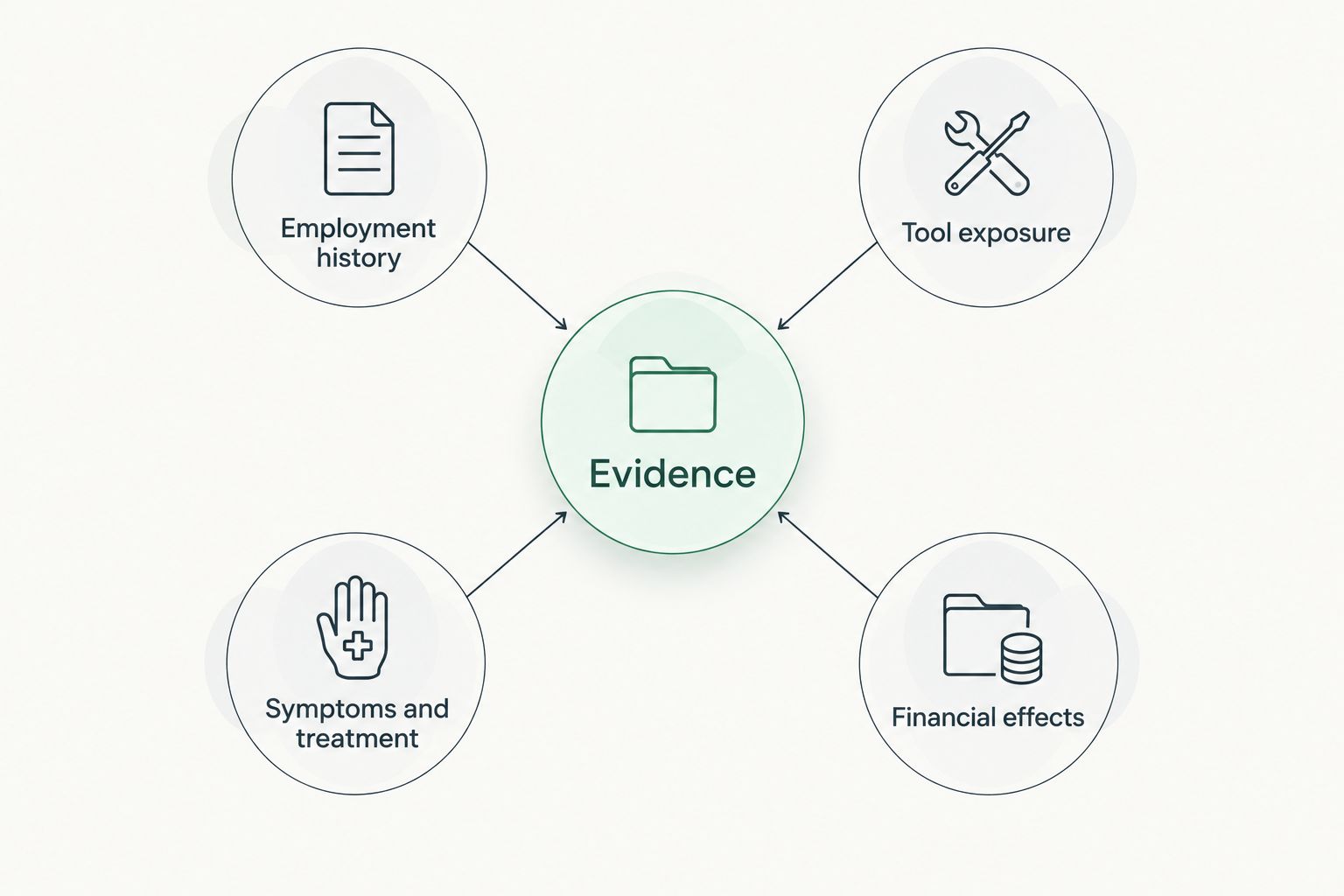
Preserve original documents and messages. Avoid editing employer records or presenting estimates as measured exposure.
Vibration limits are evidence, not a diagnosis
Health and Safety Executive guidance identifies a daily hand-arm vibration exposure action value of 2.5 m/s² A(8) and an exposure limit value of 5 m/s² A(8). A(8) expresses daily vibration exposure normalised to an 8-hour reference period; it does not mean eight hours of continuous tool use.
The action value triggers duties to control exposure. The limit value is the daily exposure level that must not be exceeded. These are workplace risk-management thresholds, not a compensation calculator or a medical diagnosis.
For a 2026 claim enquiry, ask how the solicitor will assess exposure against the applicable duties. A tool's vibration rating alone does not establish your daily exposure: duration and patterns of use also matter.
Do not treat being below a threshold as proof that symptoms are unrelated to work, or exceeding it as an automatic winning claim. Medical causation, employer conduct and the individual facts still require assessment.
Ask about the Scottish claim deadline immediately
Scottish personal injury actions generally have a 3-year limitation period, subject to rules about when the period begins and exceptions. Occupational disease claims can involve a date-of-knowledge assessment rather than simply the first day of tool use. Courts also have discretion in certain circumstances, but that is not a reason to delay.
Tell the solicitor when symptoms appeared, when you sought treatment and when you connected the condition with work. A diagnosis received in 2026 does not, by itself, establish that the limitation period starts in 2026.
Ask for an individual deadline assessment before waiting for more paperwork. An initial enquiry does not itself stop the limitation clock.
Discuss your industrial disease enquiry
Ask about HAVS experience, the evidence needed and the deadline relevant to your circumstances.
How these routes were ranked
The order reflects practical starting points: a named Scottish industrial disease provider, membership-related support, independent strategy comparison and continuity with an existing adviser. The criteria are Scottish claims knowledge, HAVS experience, exposure investigation, medical evidence, funding clarity and responsibility.
This is not a ranking based on tested service, claim outcomes or client reviews. Your final choice should follow the answers to the criteria, not the numbered position.
Which solicitor route should you choose?
Start with the named Scottish industrial disease provider if you need an initial enquiry route. Check union support first if membership is relevant. Compare independent advisers when you need to examine different evidence strategies, and retain an existing solicitor only after confirming suitable experience.
Before signing, ask: who handles the claim, what evidence is needed, what deadline applies and what financial responsibilities you accept. Clear written answers are the deciding factor.
FAQ
Who are the best hand arm vibration syndrome claim solicitors in Scotland?
The best fit is a solicitor who can demonstrate Scottish HAVS experience and explain your evidence, deadline and funding arrangements. Thompsons Scotland offers Scottish industrial disease advice, but specific HAVS capability should be confirmed before instruction.
Can I claim for vibration white finger in Scotland?
A claim requires assessment of the injury, occupational exposure and legal responsibility. Finger blanching is a recognised feature associated with HAVS, but medical evidence and the circumstances of your work determine the assessment.
Do I need a diagnosis before contacting a solicitor?
You can seek an initial legal assessment before receiving a confirmed diagnosis. Explain your symptoms accurately, seek medical advice and ask what expert evidence the claim would require.
Can I claim if I used vibrating tools for several employers?
Several employers do not automatically rule out a HAVS claim. Give the solicitor a complete employment history so they can investigate exposure and assess responsibility.
Is a union solicitor better than an independent solicitor?
Neither referral route establishes better HAVS representation by itself. Compare Scottish claims experience, the evidence plan, eligibility and written representation terms.
How long do I have to bring a HAVS claim in Scotland?
Scottish personal injury actions generally have a 3-year limitation period, with rules about its start date and exceptions. Ask a solicitor to assess your dates individually rather than counting from diagnosis alone.
What should I ask about no win no fee representation?
Ask for written details of deductions, insurance, expenses and your responsibilities if the claim fails or you end the agreement. Do not assume that the headline phrase explains every financial obligation.
Should I wait until I leave my job to seek advice?
Do not postpone a deadline assessment solely because you remain employed. Tell your solicitor about your current work and raise ongoing symptoms and exposure concerns through appropriate medical and workplace channels.
One last thing
Describe the task, not just the tool. Saying you used a grinder gives a starting point; explaining the work, usage pattern, breaks and changes over time gives the solicitor evidence to investigate. Write that account while the details are fresh, and mark uncertain recollections honestly.