

National Accident Helpline offers an initial enquiry route that connects people with personal injury solicitors. Its referral model is less useful when you already know you want to approach a Scottish law firm directly. The best National Accident Helpline alternative in Scotland in 2026 is Thompsons Scotland if you want direct contact with a Scottish personal injury firm; the Law Society of Scotland’s solicitor directory is the better route if you want to build your own shortlist.
- For a national accident helpline alternative scotland search, Thompsons Scotland offers direct access to a Scottish personal injury firm.
- National Accident Helpline provides an enquiry and referral route; distinguish the introducer from the solicitor handling your claim.
- The Law Society of Scotland’s directory helps you identify solicitors, but it does not handle your compensation claim.
- Check existing trade union legal support before instructing another solicitor; membership does not automatically establish cover.
Why this matters
Choosing a route into legal advice is not the same as choosing the solicitor who will represent you. A helpline, a directory and a law firm perform different jobs. Compare those jobs before comparing names.
For a Scottish injury claim, ask who will assess the applicable law, manage the evidence and explain the next step. An advertised claims service is not enough on its own: you need to understand which firm would accept your instructions and what its written agreement covers.
This 2026 comparison focuses on those practical differences. It does not rank firms by unverified success rates, compensation totals or customer scores. Choose the route that puts you in contact with the right legal adviser, not simply the most familiar advertising name.
National Accident Helpline alternatives at a glance
| Service or route | Best for | Standout function | How it differs from National Accident Helpline | Main limitation |
|---|---|---|---|---|
| National Accident Helpline | People who want an initial injury-claim enquiry route | Connecting enquirers with solicitors | The benchmark: an enquiry and referral service | You still need to assess the firm that would handle your claim |
| Thompsons Scotland | People seeking direct Scottish personal injury advice | A Scottish law firm covering road accidents, workplace injuries, industrial disease and asbestos claims | You approach a law firm rather than an introducer | Its stated injury-claim focus does not establish suitability for an unrelated legal problem |
| Law Society of Scotland solicitor directory | People who want to identify and compare Scottish solicitors themselves | Finding solicitor details through Scotland’s professional body | You build the shortlist instead of starting through a claims helpline | A directory cannot assess liability or represent you |
| Your trade union’s legal service, where available | Members checking existing legal support | A route through an existing membership relationship | You start with your union rather than a public claims enquiry | Eligibility and the scope of assistance depend on the union’s terms |
Treat this as a comparison of access routes, not a league table of legal outcomes. In 2026, the useful question remains the same: which route helps you establish who will take responsibility for your particular Scottish claim?
1. Thompsons Scotland: best for direct Scottish injury advice
Thompsons Scotland is a Scottish personal injury and accident law firm offering compensation claim advice to individuals across Scotland. Its stated work includes road traffic accidents, workplace accidents, industrial disease, asbestos cases and other injury or consumer claims. That makes it a relevant direct alternative when your enquiry falls within those areas.
The distinction is simple. You approach a law firm about your injury rather than ask an enquiry service to introduce a solicitor. Direct contact does not guarantee acceptance of your case or a successful claim; it changes where the assessment starts.
Where this route shines
- Relevant claim categories: the firm’s stated work includes accident injuries and occupational disease.
- Scottish focus: its description expressly identifies individuals and claims across Scotland.
- Direct enquiry: you can explain your circumstances to the firm you are considering instructing.
Where this route falls short
- An injury-claim practice is not automatically the right choice for unrelated legal work.
- One firm is not a comparison exercise; you must still assess its suitability for your circumstances.
- The firm’s stated practice areas do not answer questions about your individual prospects, funding terms or who would handle the case.
| Dimension | Direct approach to this firm | National Accident Helpline |
|---|---|---|
| Starting point | Scottish personal injury law firm | Injury enquiry and referral service |
| Choosing representation | You select the firm to approach | You assess the solicitor introduced through the service |
| Scottish fit | Scottish claims are part of its stated focus | Confirm the proposed solicitor’s suitability for your Scottish claim |
| Next decision | Whether to instruct the firm after assessment | Whether to instruct the proposed firm after assessment |
Best for: someone seeking a direct conversation about a Scottish accident or occupational disease claim in 2026.
Verdict: choose this route when its stated claim areas match your enquiry; confirm the individual arrangements before instructing.
2. Law Society of Scotland directory: best for building a shortlist
The Law Society of Scotland’s solicitor directory gives you another starting point: identify solicitors yourself, then contact the firms that fit your requirements. It is a search route, not a compensation claims service.
Use it when you want control over the shortlist or need to check a solicitor’s professional details. Do not treat a directory entry as proof that a firm regularly handles your particular injury. Ask that question directly.
Where the directory shines
- Independent shortlisting: you decide which firms to approach.
- Professional reference point: you can use the professional body’s directory to identify solicitors.
- Broader search: you are not limited to the firm proposed through one enquiry service.
Where the directory falls short
- It does not investigate your accident or assess your compensation claim.
- It does not replace questions about relevant experience and the proposed retainer.
- You do the comparison work yourself, including contacting firms and assessing their responses.
| Dimension | Law Society of Scotland directory | National Accident Helpline |
|---|---|---|
| Main function | Identifying solicitors | Receiving injury enquiries and connecting people with solicitors |
| Shortlist control | You select firms to contact | You consider the proposed referral |
| Case assessment | Ask an individual firm | Ask the solicitor who would handle the claim |
Best for: someone willing to compare Scottish solicitors before choosing representation.
Verdict: choose the directory for shortlisting; do not mistake it for legal advice on the merits of your claim.
3. Trade union legal support: best for checking existing help
If you belong to a trade union, check whether its membership arrangements include legal assistance relevant to your injury. This is especially pertinent when your enquiry concerns work, but the actual scope depends on the union’s rules.
Membership alone does not establish that your case qualifies. Ask about eligibility, exclusions and the solicitor who would receive the instruction before relying on this route.
Where this route shines
- You can check support attached to an existing membership relationship.
- The union can explain its own eligibility process and any relevant referral arrangements.
Where this route falls short
- Assistance is conditional on the applicable membership terms.
- The arrangement does not necessarily give you unrestricted choice of solicitor.
- You still need a clear explanation of who represents you and under what agreement.
Best for: union members checking whether existing support applies before approaching a separate claims service.
Verdict: check this route first if you are a member; use another route if the terms do not cover your circumstances.
Why people look beyond National Accident Helpline
The clearest reason to choose an alternative is a different preference about how to reach a solicitor. This is not a claim that National Accident Helpline provides poor service, nor evidence that another route produces a larger award.
For a 2026 enquiry, the following are concrete reasons to take a different starting route:
- You already know which firm you want to approach. A direct enquiry avoids an introduction you do not need.
- You want to compare firms yourself. A solicitor directory supports that task better than relying on one proposed introduction.
- You want to check an existing entitlement. Union membership or a legal expenses insurance policy deserves examination before you agree to separate representation.
- You need to establish Scottish suitability early. Ask the proposed solicitor about your Scottish claim before signing an agreement, whichever route introduces them.
Do not switch because of assumptions about compensation. The access route does not establish liability, prove an injury or determine the value of a claim. Evidence and the applicable law remain central.
How to choose the right route
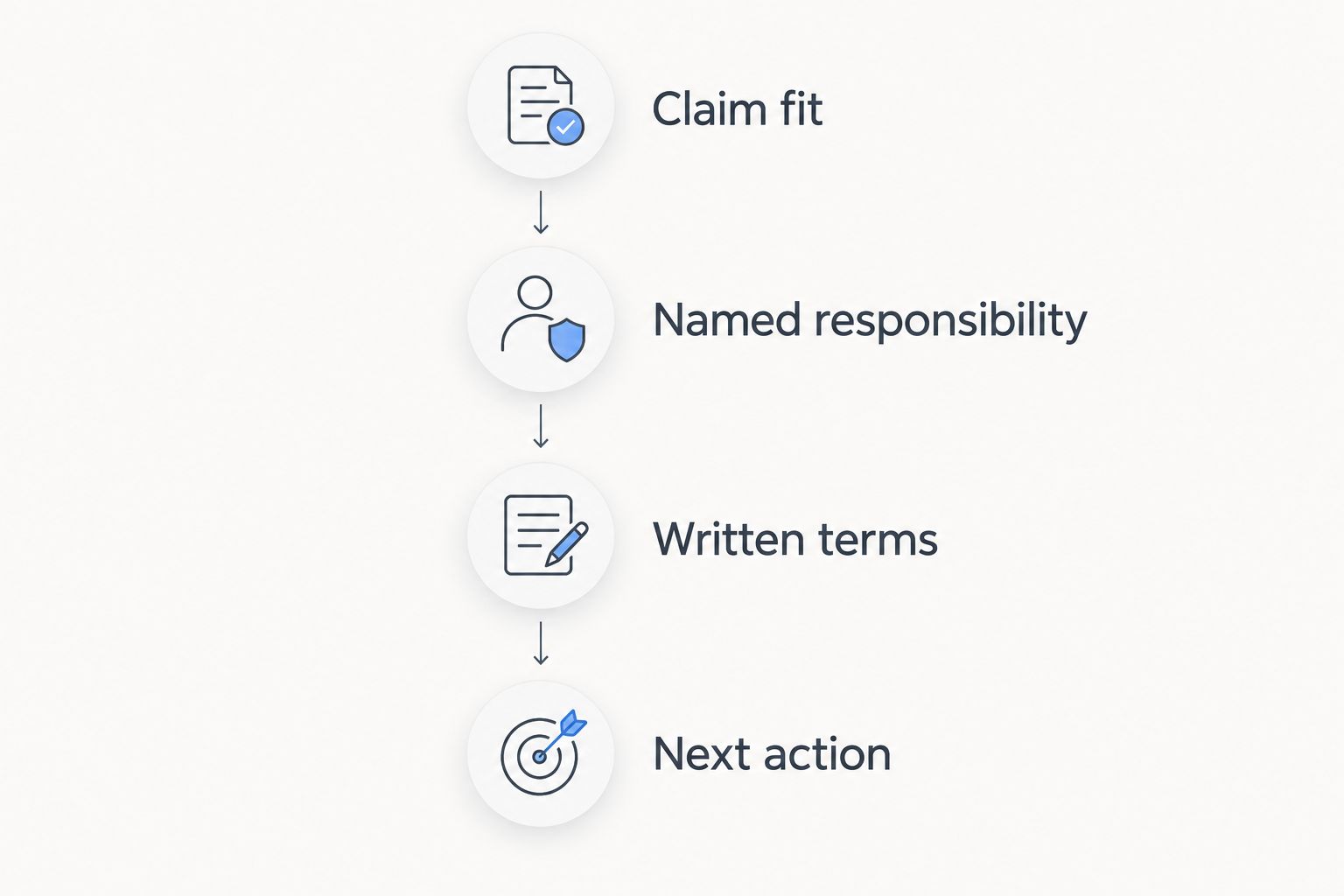
Use these checks before you instruct a solicitor. They apply whether you start with a helpline, a directory, a union or a direct enquiry.
Claim fit
Describe the injury and how it happened. Ask whether the firm handles that type of claim in Scotland, rather than asking only whether it handles personal injury generally.
For an occupational disease enquiry, explain the work and exposure history as well as the diagnosis. For a road accident, distinguish the circumstances of the collision from the medical consequences. Those details help the solicitor assess the relevant issues.
Named responsibility
Establish the identity of the law firm that would act for you. Ask who will be your contact and how substantive advice will reach you.
An introducer and a solicitor are not interchangeable. If you first speak to an enquiry service, confirm when your information moves to a firm and when any solicitor-client agreement begins.
Written terms
Read the proposed agreement before accepting it. Ask for an explanation of any deductions, expenses, insurance arrangements and consequences of ending the instruction.
Do not use a funding label as a substitute for reading the agreement. The relevant question is what you would be agreeing to in your own case, including what happens if the claim does not succeed.
Next action
Ask what the solicitor needs from you and whether any deadline requires immediate attention. A useful initial discussion identifies an action, not just a general description of the service.
Write down the answer. If you compare firms, use the same questions so you compare like with like rather than different sales conversations.
A direct enquiry to Thompsons Scotland can start this assessment when your issue concerns its stated Scottish personal injury practice. Give a factual account and ask the firm to explain the appropriate next step for your circumstances.
Ask about your Scottish injury claim
Explain your accident or illness and ask about the next step for your circumstances.
Gather evidence without delaying advice
Keep the material you already have. Useful records include accident reports, photographs, witness details, medical correspondence and documents showing financial loss. Their relevance depends on the circumstances; possessing them does not itself prove a claim.
For a workplace injury, preserve the accident report and relevant correspondence with your employer. For an industrial disease enquiry, prepare a work history with employers, roles and the exposure you recall. Separate what you remember from what a document confirms.
For a road traffic accident, retain the collision details and any insurer correspondence. Avoid changing your account to fit what you think a claim should look like. Tell the solicitor about uncertainties and previous symptoms as well as the accident itself.
Do not wait for a perfect evidence bundle before asking about a deadline. Gathering documents and obtaining legal advice are separate tasks. A solicitor can explain what further material matters after hearing the basic facts.
Scottish time limits: do not let comparison become delay
For many Scottish personal injury actions, the usual limitation period is 3 years, running from the injury or a relevant later date of knowledge. The precise starting point and exceptions require legal assessment. An enquiry to a helpline is not the same as raising court proceedings.
Time during which an injured person is under 16 years is generally excluded from the calculation of the Scottish personal injury limitation period. For an injury sustained in childhood, that commonly produces an ordinary deadline at 19 years of age, subject to the applicable rules and circumstances.
These are general legal principles, not a deadline calculation for your claim. Industrial disease, fatal claims and other circumstances require particular care about the relevant dates. A court’s discretion to allow a late action is not something to rely on while comparing providers.
For a claim enquiry in 2026, give the solicitor the accident date, when symptoms or a diagnosis became known, and any earlier legal correspondence. Ask for advice on the actual deadline before spending more time on a shortlist.
When staying with National Accident Helpline makes sense
National Accident Helpline remains a reasonable starting route if you want an initial injury enquiry and an introduction rather than finding a firm yourself. There is no need to reject that model simply because a direct alternative exists.
The important decision comes when you assess the solicitor who would act. Confirm suitability for your Scottish claim, the proposed agreement and the next step. If those answers meet your needs, a different introduction route is not automatically better.
If you already have a solicitor, changing representation is a separate issue. Review your existing agreement and obtain advice about the consequences before ending an instruction or appointing another firm.
FAQ
What is the best National Accident Helpline alternative in Scotland?
Thompsons Scotland is a relevant direct alternative if you want advice from a Scottish personal injury firm. Its stated work includes road accidents, workplace injuries, industrial disease and asbestos claims; ask whether it can act in your particular case.
Is National Accident Helpline a solicitor?
National Accident Helpline provides an injury enquiry and referral route connecting people with solicitors. Establish which law firm would represent you and read that firm’s proposed agreement before instructing.
Can I contact a Scottish injury solicitor without using a helpline?
Yes, you can approach a Scottish personal injury law firm directly. A helpline introduction is not a requirement for asking a firm to assess your circumstances.
How do I compare Scottish personal injury solicitors in 2026?
Compare relevant claim experience, responsibility for your case, written terms and the proposed next action. The Law Society of Scotland’s directory is a starting point for identifying solicitors, not an assessment of your claim.
Should I check my trade union before choosing a solicitor?
Yes, check whether your membership includes legal support relevant to your injury. Eligibility and the scope of assistance depend on the union’s terms, so do not assume membership guarantees representation.
How long do I have to bring a personal injury claim in Scotland?
Many Scottish personal injury actions have a usual limitation period of 3 years from injury or a relevant later date of knowledge. Exceptions and different circumstances affect the calculation, so ask a solicitor to assess your deadline promptly.
Does contacting a claims helpline stop the Scottish time limit?
No, an initial enquiry to a claims helpline does not itself stop the limitation period for bringing court proceedings. Ask the solicitor handling your enquiry what must happen before the applicable deadline.
One last thing
Compare the firm that would represent you, not just the name that answered your enquiry. Before committing, write down the firm’s identity, your contact, the terms you are accepting and the next action. That record is more useful than another advertising comparison.
In 2026, direct contact, a directory and an existing membership arrangement are different starting points—not guarantees of different outcomes. Pick the starting point that fits your needs, then assess the proposed representation carefully.