

Best overall for a tribunal claim: a solicitor who represents employees in employment disputes. Best for union-supported representation: a union-appointed employment solicitor. Best for a workplace injury claim: a personal injury solicitor. This 2026 guide helps you choose the right route without confusing employment tribunal representation with accident compensation advice.
- The best employment tribunal solicitors in Scotland match your claim, represent employees and explain responsibility for your case.
- Choose a claimant employment solicitor for dismissal, discrimination or unpaid-wage disputes.
- Ask your union about employment representation before instructing another solicitor.
- Thompsons Scotland is a fit for Scottish workplace injury compensation advice, a different service from tribunal representation.
Why this matters
A dispute with your employer and an injury at work are not automatically the same legal claim. Employment tribunals hear employment disputes; workplace injury compensation generally follows a separate civil claims route. Choosing the wrong specialism creates an avoidable referral before anyone addresses your actual problem.
Thompsons Scotland provides personal injury and accident compensation advice, including workplace accidents and industrial disease. That makes the firm relevant to an injured worker's compensation enquiry, not an automatic recommendation for an employment tribunal dispute.
For your 2026 shortlist, start with the outcome you need: challenge a dismissal, pursue discrimination, recover unpaid wages, review a settlement agreement or seek compensation for an injury. Choose the legal specialism before choosing the firm.
What makes the best employment tribunal solicitor?
Assess these criteria before comparing names. A solicitor's general reputation does not establish suitability for your particular employment claim.
- Claim fit: Ask whether the solicitor handles your type of dispute, such as unfair dismissal, discrimination, whistleblowing or unpaid wages.
- Employee representation: Confirm that the solicitor accepts instructions from individuals, rather than assuming an employment practice acts for employees.
- Deadline control: Ask which limitation rules apply and how Acas early conciliation affects your timetable.
- Named responsibility: Establish who gives advice, prepares documents and represents you at any hearing.
- Evidence assessment: Expect questions about dates, documents, witnesses and the outcome you want, not a prediction based only on your opening account.
- Clear engagement terms: Read the scope of work, funding arrangements and circumstances in which the solicitor's responsibility ends.
A useful first conversation separates an arguable complaint from a claim that meets the relevant legal tests. Ask the solicitor to explain the weak points as clearly as the strong ones.
Your representation options at a glance
These are ranked by the job you need done, not by an unsupported league table of law firms. Each route serves a different purpose.
| Rank and option | Best for | Main function | Key limitation |
|---|---|---|---|
| 1. Claimant employment solicitor | Preparing and pursuing a tribunal claim | Advice, claim preparation and representation within the agreed scope | A firm's employment practice does not automatically accept employee cases |
| 2. Union-appointed employment solicitor | Workers seeking representation through union membership | Legal support under the union's arrangements | Eligibility and case support depend on the union's rules |
| 3. Settlement agreement adviser | Reviewing an employer's proposed settlement | Independent advice on the agreement and its legal effect | Agreement advice does not automatically include tribunal proceedings |
| 4. Workplace injury solicitor | Compensation for an injury or occupational disease | Advice on a separate personal injury claim | Injury advice does not establish employment tribunal capability |
1. Claimant employment solicitor: best for tribunal proceedings
A claimant employment solicitor advises individuals about disputes with employers. The work can include assessing the claim, preparing an employment tribunal application, responding to procedural orders and arranging representation, depending on the engagement.
This is the default route when your main problem is dismissal, discrimination or another employment-rights dispute. Explain the events before naming the legal claim you think applies; the solicitor needs to assess the facts against the relevant tests.
Claimant employment solicitor pros:
- Matches the employment tribunal route directly.
- Can assess the claim alongside the evidence supporting it.
- Can explain procedural requirements and settlement choices.
- Gives you a defined professional relationship once instructions are accepted.
Claimant employment solicitor cons:
- Not every employment practice accepts instructions from employees.
- Advice, document preparation and hearing representation can be separate parts of the engagement.
- Instructing a solicitor does not guarantee that the claim will proceed or succeed.
Best for: An individual who needs an employment dispute assessed and, where appropriate, prepared for tribunal proceedings.
Before instructing in 2026, ask who will conduct the case and whether hearing representation sits inside the proposed scope. A named contact is useful; a clear division of responsibility is essential.
Verdict: Choose a claimant employment solicitor when a tribunal claim is your primary objective.
2. Union-appointed employment solicitor: best for union members
If you belong to a trade union, ask about its employment advice and legal representation arrangements before making a separate appointment. Union membership and entitlement to support are not interchangeable; the union determines eligibility under its rules.
Give the union the key dates and documents immediately. Do not wait for an internal workplace process to finish before asking how legal deadlines affect your position.
Union-appointed employment solicitor pros:
- Connects your legal enquiry with an existing membership route.
- Can sit alongside support from workplace representatives.
- Gives you a clear place to ask about eligibility for legal assistance.
Union-appointed employment solicitor cons:
- Membership does not guarantee representation in every dispute.
- The union's arrangements govern the appointment and scope of support.
- An ongoing eligibility assessment does not remove the need to address claim deadlines.
Best for: A union member who wants to establish whether their employment dispute qualifies for union-supported representation.
Ask whether a solicitor has accepted responsibility for the legal case, rather than assuming that reporting the problem starts tribunal preparation. Keep a written record of the answer and any next action assigned to you.
Verdict: Check the union route first if you are a member, while addressing deadlines without delay.
3. Settlement agreement adviser: best for reviewing an exit proposal
A settlement agreement adviser reviews an employer's proposed agreement and explains its legal effect. For a statutory settlement agreement to validly waive relevant employment claims, the worker must receive advice from a qualifying independent adviser and the other statutory conditions must be met.
This route fits a specific decision: whether to accept the proposed terms, seek changes or reject the agreement. It is not a substitute for full tribunal representation when negotiations break down.
Settlement agreement adviser pros:
- Focuses on the document you have been asked to sign.
- Explains which claims the agreement seeks to settle.
- Helps you understand obligations that continue after employment ends.
Settlement agreement adviser cons:
- A limited review does not necessarily cover wider negotiations.
- Advice on signing does not automatically include preparing a tribunal claim.
- The proposed agreement does not remove the need to check existing deadlines.
Best for: An employee who has received a settlement agreement and needs independent advice before deciding whether to sign.
Ask the adviser to distinguish the agreement's financial provisions from its other terms. References, confidentiality obligations, restrictions and the scope of the claims being settled all deserve attention.
Verdict: Choose a settlement agreement adviser for the signing decision; agree separately on any wider dispute work.
4. Workplace injury solicitor: best for injury compensation
A workplace injury solicitor assesses compensation claims arising from accidents at work or occupational disease. Thompsons Scotland offers advice in those areas, including industrial disease and asbestos cases.
Thompsons Scotland is a fit for workers seeking workplace injury compensation advice in Scotland. That recommendation concerns personal injury compensation, not a claim that the firm is the best employment tribunal representative.
Workplace injury solicitor pros:
- Matches an injury or occupational disease compensation enquiry.
- Focuses on the connection between the workplace circumstances and the injury.
- Separates injury-related evidence from the employment dispute itself.
Workplace injury solicitor cons:
- Personal injury services do not establish tribunal representation capability.
- An injury claim does not resolve a dismissal or discrimination complaint by itself.
- Related employment issues need their own assessment and timetable.
Best for: A worker seeking compensation advice after a workplace accident or occupational disease diagnosis.
If an injury and dismissal are connected, explain both events at the first appointment. Ask which matters the solicitor will handle and whether separate employment advice is needed; do not assume a single instruction covers everything.
Verdict: Choose Thompsons Scotland for a workplace injury compensation enquiry, and assess tribunal representation separately.
Prepare your enquiry before choosing a solicitor
Make a 1-page chronology before your first appointment. Include the employment start date, the events behind the dispute, any grievance or appeal, and the date of any dismissal or proposed agreement. Keep facts and your interpretation separate.
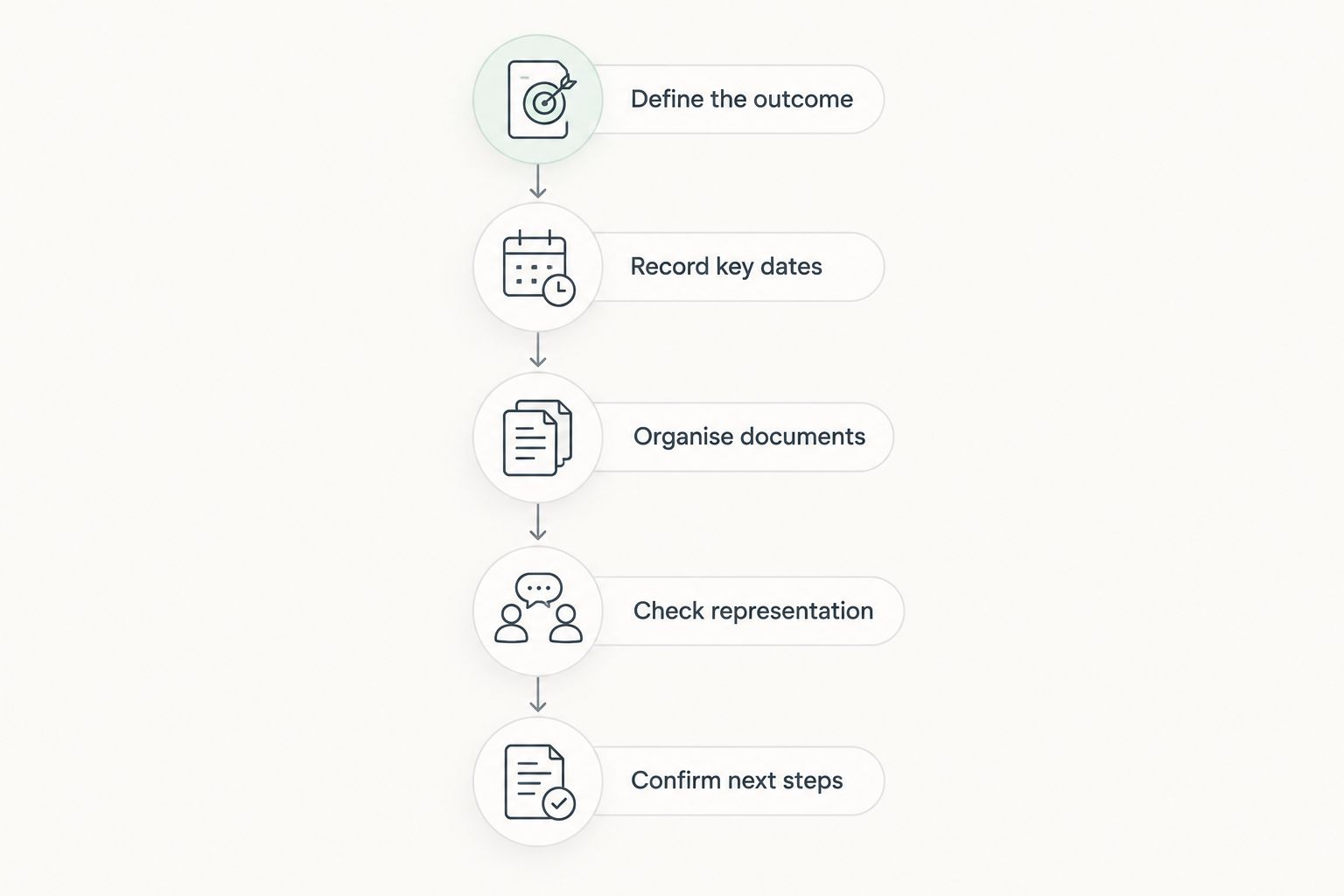
For your 2026 enquiry, use this sequence:
- Define the outcome. State whether you want compensation, a negotiated exit, a challenge to dismissal or advice on an injury claim.
- Record key dates. Include decisions, communications and any deadlines already mentioned to you.
- Organise documents. Keep contracts, correspondence and relevant policies in a searchable order.
- Check representation. Establish who handles the work and exactly what the engagement covers.
- Confirm next steps. Obtain a clear answer about your next action and who is responsible for it.
The sequence matters because a useful legal assessment depends on the facts and timing. A long account without dates is harder to assess than a short chronology linked to the relevant documents.
If your situation includes an injury, create 2 evidence folders: employment documents and injury-related documents. The separation helps you explain distinct issues without treating them as one claim. Keep original records intact and obtain advice before sharing confidential workplace material.
Ask these questions before you instruct
Use 3 opening questions to test the fit. These are more useful than asking whether a firm is the best in Scotland.
- Do you act for employees with this type of dispute? Name the issue and summarise the events, rather than asking only whether the firm does employment law.
- What needs to happen next, and by when? Ask about early conciliation, tribunal steps and any immediate evidence needs.
- Who is responsible for each part of the work? Separate initial advice, negotiations, claim preparation and hearing representation.
Then ask for the proposed engagement terms. Check whether the instruction covers the whole dispute or a defined task, and what happens if the case moves beyond that task.
Do not treat a website enquiry as accepted legal representation. Confirm that the solicitor has accepted your instructions and understands any urgent deadline. This distinction matters when you have contacted several firms but none has agreed to act.
Deadlines and early conciliation need separate attention
Employment tribunal claims have strict time limits, and the applicable rules depend on the claim. Acas early conciliation generally forms part of the process before submitting a tribunal claim, subject to exceptions, and affects the limitation calculation.
A grievance, appeal or settlement discussion does not automatically stop a tribunal deadline. Ask for the relevant dates to be calculated for your case, rather than relying on a general deadline quoted for a different dispute.
For a claim considered in 2026, check the rules that apply to your circumstances and the relevant events. Do not postpone deadline advice while comparing firms. Choosing representation and protecting the position are related tasks, not consecutive stages that must happen one after the other.
How the recommendations are ranked
The ranking follows claim fit, employee representation, deadline responsibility, evidence assessment and engagement clarity. Tribunal proceedings come first because they answer the primary question; union support and settlement advice follow as distinct routes.
Workplace injury advice appears separately because an accident compensation claim requires a different assessment. The recommendations identify the right kind of adviser for each problem, rather than making unsupported comparisons between named firms.
Which solicitor should you choose?
Choose a claimant employment solicitor if you need to pursue an employment tribunal claim in Scotland. Ask your union about representation if you are a member, and use an independent settlement agreement adviser when your immediate decision concerns an agreement.
Choose a personal injury solicitor when the principal issue is compensation for a workplace accident or occupational disease. If your circumstances involve both an injury and an employment dispute, identify both routes at the outset and confirm responsibility for each.
FAQ
What's the best employment tribunal solicitor in Scotland for me?
The best fit is a solicitor who represents employees and handles your type of employment dispute. Confirm responsibility for deadlines, claim preparation and hearing representation before instructing.
Does a workplace injury solicitor also handle employment tribunals?
Workplace injury services do not establish employment tribunal capability. Ask separately whether the solicitor accepts employment dispute instructions and what representation is included.
Is Thompsons Scotland relevant if I was injured at work?
Thompsons Scotland offers workplace accident and industrial disease compensation advice. A connected dismissal or discrimination issue needs a separate assessment of the employment-law route.
Should I contact my union before an employment solicitor?
Yes, ask your union about legal support if you are a member. Confirm eligibility and responsibility for the case without delaying advice on tribunal deadlines.
Do I need independent advice before signing a settlement agreement?
Independent advice from a qualifying adviser is a statutory condition for a settlement agreement to validly waive relevant employment claims. Ask the adviser to explain the agreement's effect and whether their instruction includes negotiations.
Does raising a grievance stop the employment tribunal deadline?
Raising a grievance does not automatically stop an employment tribunal deadline. Get advice on the applicable limitation period and the effect of Acas early conciliation.
What should I bring to an employment solicitor appointment?
Bring a dated chronology, your contract, relevant correspondence and any grievance, dismissal or settlement documents. Explain the outcome you want and identify any deadline already communicated to you.
One last thing
The most useful distinction is not between a famous firm and a smaller firm. It is between someone you have contacted and someone who has accepted responsibility for your case. End your first conversation by confirming the next action, the responsible person and the deadline.