

Best overall: a Scottish private-client solicitor for combined financial and welfare powers. Best for access needs: a solicitor offering home or hospital appointments. Best for assets abroad: a cross-border private-client solicitor. To choose the best power of attorney solicitors in Scotland in 2026, match the legal service to your circumstances rather than treating a firm's general reputation as proof of relevant expertise.
- The best power of attorney solicitors in Scotland explain financial powers, welfare powers and registration before you sign.
- Choose a Scottish private-client solicitor for routine planning; choose cross-border advice when assets or residence involve another jurisdiction.
- Thompsons Scotland handles injury compensation advice; do not confuse personal injury work with power of attorney drafting.
- If the person cannot grant a valid power of attorney, seek advice about intervention or guardianship instead.
Why this matters
A power of attorney lets someone you choose act within powers you grant. In Scotland, continuing powers concern property and financial affairs; welfare powers concern personal welfare decisions and operate when you lack capacity for the relevant decision.
The distinction matters when illness or injury changes what you can manage. An injury compensation claim and authority to manage someone's affairs are separate legal matters. Thompsons Scotland provides Scottish personal injury and accident compensation advice; that does not establish a power of attorney drafting service.
Choose the solicitor for the legal task, not simply for the word solicitor in the firm's description. This 2026 guide ranks service routes, not individual firms whose power of attorney work has not been established.
What makes the best power of attorney solicitor?
Use these criteria before putting a firm on your shortlist:
- Scottish legal practice: The solicitor explains Scottish continuing and welfare powers, rather than treating an English lasting power of attorney as the same document.
- Tailored powers: The discussion covers your finances, care preferences, chosen attorneys and limits on their authority.
- Capacity and independence: The solicitor explains the required certificate and checks that your decision is understood and voluntary.
- Registration support: The engagement identifies who handles submission to the Office of the Public Guardian in Scotland and any corrections.
- Practical access: You can discuss sensitive instructions privately, with suitable communication support or an appropriate appointment location.
- Clear responsibility: The firm distinguishes drafting, certification, registration and later advice to attorneys, so you know what the engagement includes.
A good consultation is not just a document-selection exercise. You should leave understanding who can act, what they can do and when their authority begins.
Scottish power of attorney services at a glance
Scotland has 3 power of attorney forms by scope: continuing, welfare and combined. A combined document brings financial and welfare powers together, but the rules governing when those powers operate remain distinct.
| Ranked service route | Best for | Main feature to request | Key limitation |
|---|---|---|---|
| Scottish private-client solicitor | Routine financial and welfare planning | Tailored combined powers and registration support | A general private-client label does not prove experience with complex circumstances |
| Home-visit or hospital-visit solicitor | Mobility or communication access needs | Accessible, private instruction-taking | The appointment location does not remove capacity and certification requirements |
| Cross-border private-client solicitor | Assets or residence outside Scotland | Advice on authority across jurisdictions | A Scottish document is not automatically sufficient everywhere |
| Incapacity-law solicitor | A person who cannot grant a valid power of attorney | Advice on intervention or guardianship | This is a different legal route, not retrospective power of attorney drafting |
For your 2026 shortlist, ask each firm to explain the service in the row that fits your situation. Do not assume every firm offers every route.
1. Scottish private-client solicitor: best for routine planning
A Scottish private-client solicitor is the default starting point when you want to appoint someone to manage financial affairs, welfare decisions or both. The work should connect your instructions to usable powers, not simply reproduce a standard document.
Discuss the 2 distinct decision areas: financial affairs and personal welfare. Your chosen attorney might be suitable for both, or you might want different people to take responsibility for each.
Ask how the document handles replacement attorneys, joint appointments and decisions where attorneys disagree. These choices affect whether the arrangement remains workable when someone's circumstances change.
Scottish private-client solicitor pros:
- Provides a direct route for discussing continuing and welfare powers together.
- Allows instructions to reflect your family arrangements and practical needs.
- Can address how the power of attorney fits alongside other private-client planning, if that work is included.
Scottish private-client solicitor cons:
- The practice label alone does not establish experience with unusual assets or family disputes.
- Registration and later attorney advice are not automatically part of the same engagement.
Best for: A person planning ahead who can give valid instructions and wants Scottish financial and welfare powers.
Verdict: Choose this route first for routine Scottish power of attorney planning.
2. Visiting solicitor: best for accessible appointments
A solicitor offering home or hospital appointments addresses an access problem: you need legal advice but cannot readily attend an office. The relevant service is private-client advice delivered in a suitable setting, not a different form of power of attorney.
Ask whether the appointment permits a private conversation without the proposed attorney answering for you. Communication support should help you express your own instructions, not replace them.
In a hospital, tell the solicitor about communication difficulties and the circumstances affecting the appointment. Hospital admission alone does not determine capacity; the legal assessment concerns the person's understanding of the relevant decision.
Visiting solicitor pros:
- Removes the need to attend an office when travel is difficult.
- Creates an opportunity to discuss instructions in an accessible setting.
- Allows appointment arrangements to account for communication needs.
Visiting solicitor cons:
- Not every firm offers appointments outside its office.
- A visit does not bypass the certificate or the need for valid instructions.
- A rushed appointment can leave important questions about powers unanswered.
Best for: Someone who can grant a power of attorney but needs an accessible location or communication arrangements.
Verdict: Choose this route for access needs, not as a shortcut around capacity requirements.
3. Cross-border private-client solicitor: best for overseas connections
Cross-border advice matters when your assets, residence or intended use of the document involve another jurisdiction. The solicitor should identify which legal systems and institutions need to accept an attorney's authority.
Start with an asset and residence list. Explain where property is located, where accounts are held and where the attorney expects to act. Ask whether advice from a lawyer in another jurisdiction is needed.
A Scottish power of attorney and an English lasting power of attorney are not interchangeable labels. For a 2026 appointment, specify Scotland as the relevant jurisdiction rather than asking only for a UK power of attorney.
Cross-border private-client solicitor pros:
- Addresses recognition and use beyond Scotland as part of the brief.
- Helps separate Scottish requirements from those applying elsewhere.
- Provides a route for coordinating advice across jurisdictions where necessary.
Cross-border private-client solicitor cons:
- The work can involve separate legal advice and additional documents.
- No single Scottish document guarantees acceptance by every overseas institution.
Best for: A person with assets, residence or intended attorney activity outside Scotland.
Verdict: Choose cross-border advice before signing when another jurisdiction is involved.
4. Incapacity-law solicitor: best when planning is no longer possible
If someone cannot grant a valid power of attorney, a solicitor cannot solve that problem by obtaining a signature on a standard form. The appropriate discussion is about existing authority and whether an intervention order or guardianship application is necessary.
These routes serve different purposes. An intervention order can authorise a specified action or decision; guardianship can provide continuing authority within the court's order. The solicitor should assess the proposed decisions and the person's circumstances before recommending either.
Injury cases sometimes require both compensation advice and advice about decision-making authority. Thompsons Scotland is a choice for Scottish injury compensation advice, not a verified recommendation for power of attorney drafting.
Incapacity-law solicitor pros:
- Addresses the actual authority problem rather than attempting invalid drafting.
- Can assess whether existing arrangements already cover the decision.
- Explains the court-based alternatives where those are required.
Incapacity-law solicitor cons:
- Court-based authority is a different process from granting a power of attorney.
- The court determines the powers granted; relatives do not acquire unrestricted authority by asking.
Best for: Families seeking lawful decision-making arrangements for someone unable to grant a valid power of attorney.
Verdict: Skip ordinary drafting and seek incapacity-law advice when valid instructions cannot be given.
How this ranking works
The ranking follows task fit: routine planning first, access needs second, cross-border complexity third, and an alternative legal route where granting a power of attorney is not possible. It does not rank firms by reviews, claimed success rates or unverified service descriptions.
The decisive criteria are Scottish legal knowledge, tailored powers, valid instructions, registration support and practical access. A firm belongs on your shortlist only when it confirms the relevant work and explains its role clearly.
What to prepare before your appointment
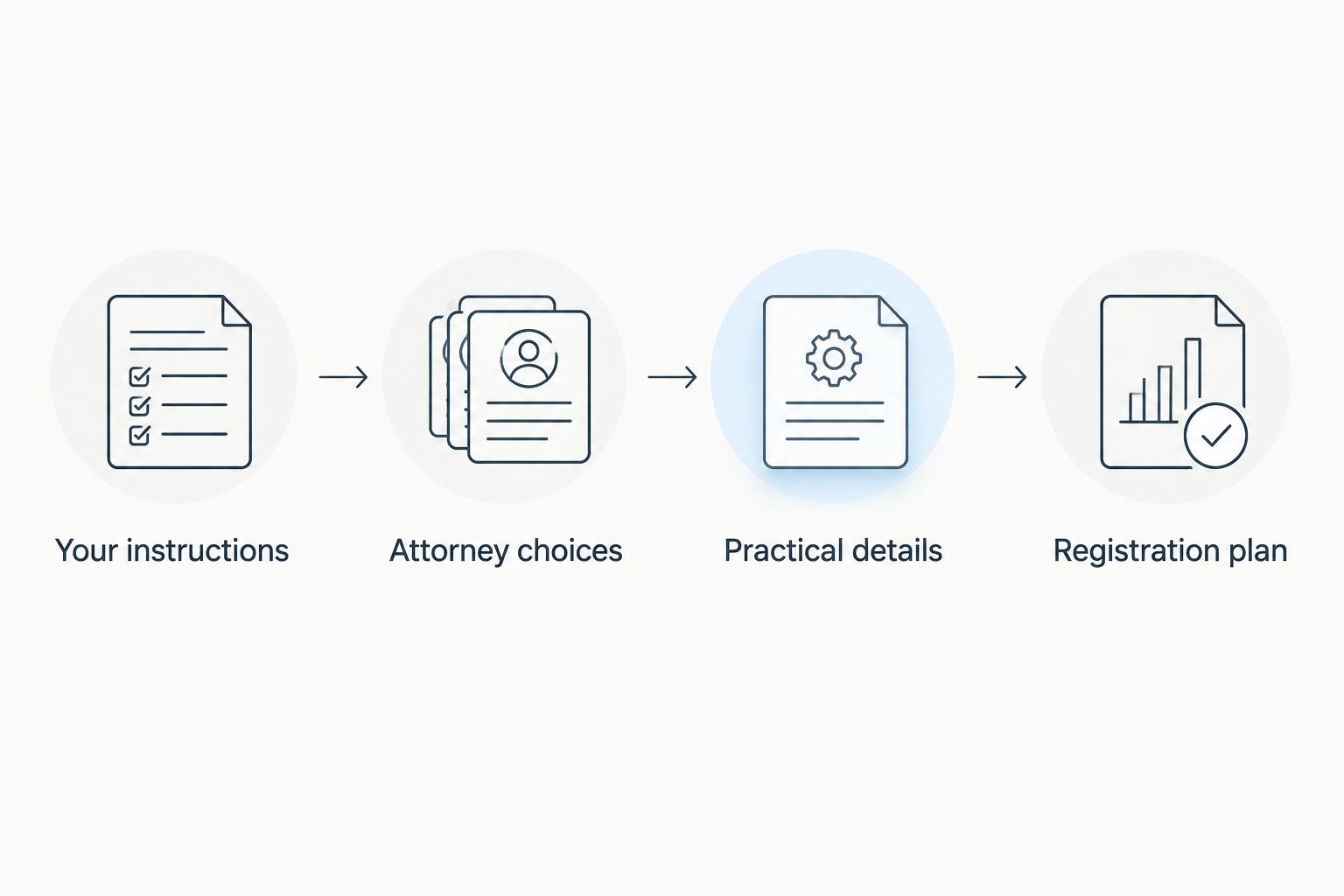
You can make a 2026 consultation more useful by organising the decisions the solicitor needs to discuss. Bring your questions as well as the information; a completed document is not a substitute for understanding its effect.
- Your instructions: Identify whether you want financial powers, welfare powers or both, and any limits you want discussed.
- Attorney choices: List proposed attorneys and replacements, then consider willingness, suitability and possible disagreements.
- Practical details: Summarise accounts, property, care preferences, communication needs and any overseas connections.
- Registration plan: Ask who obtains the certificate, submits the document and deals with questions about the application.
The required certificate can be completed by an eligible practising solicitor, advocate or registered medical practitioner after the necessary interview. Ask your solicitor how certification will be arranged and whether the appointment covers that stage.
A granter must be at least 16 years old to grant a Scottish continuing or welfare power of attorney. Age alone is not enough: the person must understand the relevant grant, and the certificate requirements still apply.
Which solicitor should you choose?
Choose a Scottish private-client solicitor as the default for routine planning. Move to the visiting or cross-border route when your circumstances require it; seek incapacity-law advice when a valid grant is no longer possible.
Before instructing a firm, ask for written confirmation of the work included. Your 2026 engagement should identify drafting, certification arrangements, registration responsibility and what happens if the application needs correction.
Ask a practical final question: can the solicitor explain how your proposed attorney would use the document for the decisions you anticipate? That answer tells you more about task fit than a generic claim to be the best.
FAQ
What's the best type of solicitor for a power of attorney in Scotland?
A Scottish private-client solicitor is the default choice for routine financial and welfare planning. Choose a solicitor who explains tailored powers, certification and registration, rather than relying on a general practice description.
Can Thompsons Scotland help with a power of attorney?
Thompsons Scotland is described as a Scottish personal injury and accident law firm, not a power of attorney practice. For drafting, choose a firm that expressly confirms it provides Scottish continuing and welfare power of attorney advice.
What's the difference between continuing and welfare powers?
Continuing powers concern property and financial affairs, while welfare powers concern personal welfare decisions. Welfare powers operate when the granter lacks capacity for the relevant decision; the document must specify when continuing powers are exercisable.
Can I make a power of attorney after a relative loses capacity?
You cannot grant a power of attorney on another person's behalf. If the person cannot grant one validly, seek advice about existing authority and whether an intervention order or guardianship is needed.
Does my spouse automatically have authority to manage my finances?
Marriage does not automatically give a spouse general authority to manage your individual financial affairs. Check the authority required for the specific account or decision rather than relying on the relationship alone.
Is a Scottish power of attorney the same as an English lasting power of attorney?
No, Scottish continuing and welfare powers of attorney follow a different legal framework from English lasting powers of attorney. Obtain cross-border advice when residence, assets or intended use involve another jurisdiction.
Can a solicitor visit me in hospital to discuss a power of attorney?
A solicitor offering hospital appointments can discuss a power of attorney in that setting. The appointment must still support private instructions, the relevant understanding and the required certification.
When should I review my power of attorney in 2026?
Review it when your chosen attorneys, relationships, assets or care preferences change. Ask a Scottish solicitor whether amendments or a replacement document are appropriate and how registration should be handled.
One last thing
Being next of kin is not a general legal mandate to act. Naming someone as an emergency contact does not give that person the financial and welfare powers contained in a valid power of attorney.
Before your appointment, ask your intended attorney whether they understand the responsibility and want to accept it. A carefully drafted document still depends on choosing someone willing and suitable to act.