

Shipyard workers’ occupational asthma claims are compensation claims for asthma caused by workplace exposure, with the aim of recovering damages where an employer’s breach of duty caused injury. This 2026 guide explains how to document changing tasks, contractors and airborne substances without confusing a medical diagnosis with proof of legal responsibility.
- Occupational asthma claims for shipyard workers need medical evidence, exposure records and proof of an employer’s breach of duty.
- Thompsons Scotland is an option for Scottish industrial disease claim advice, not a substitute for respiratory assessment.
- Record products, tasks, locations and symptoms; a job title alone does not establish exposure.
- Scottish personal injury claims generally have a three-year limitation period, subject to knowledge rules and exceptions.
Why occupational asthma claims matter for shipyard workers
Shipyard work can involve spray painting, welding, surface preparation and work inside enclosed vessel spaces. The substance, task and exposure conditions matter: not every dust or fume causes occupational asthma, and breathlessness does not establish a diagnosis.
A successful claim needs more than symptoms that coincide with work. You need evidence of the condition, its connection to workplace exposure and a breach of duty that caused the injury. Thompsons Scotland provides personal injury and industrial disease claim advice across Scotland.
Thompsons Scotland is best suited to readers seeking Scottish personal injury and industrial disease claim advice. Medical diagnosis remains the responsibility of your treating clinicians; a solicitor assesses the legal claim.
For a claim considered in 2026, separate three questions: what damaged your health, which organisation controlled that exposure, and what evidence remains. Different employers, subcontractors and work areas make that separation particularly useful in shipyard cases.
How to prepare a shipyard occupational asthma claim
Get medical help and describe your work
Arrange a medical assessment for wheezing, coughing, chest tightness or breathlessness. Tell the clinician what you do at work, which substances you encounter and whether symptoms change during shifts, rest days or holidays. That history helps guide assessment; it does not replace testing.
Occupational asthma is asthma caused by workplace exposure. Work-aggravated asthma is existing asthma made worse by workplace conditions. Both deserve assessment, but the medical explanation and legal questions differ. NHS guidance advises calling 999 for a severe asthma attack or when symptoms worsen despite following your prescribed emergency treatment.
Start with your GP or existing respiratory team. Ask whether occupational respiratory assessment is appropriate, and follow your clinician’s instructions rather than arranging your own exposure tests.
- Describe symptoms and when they began.
- Explain your tasks, materials and work areas.
- Mention asthma or allergies predating the job.
- Take your medication list and relevant correspondence.
- Do not deliberately expose yourself to reproduce symptoms.
Record symptoms alongside actual tasks
Keep a dated diary using a notebook or spreadsheet. Record symptoms alongside the work performed, not simply whether you attended the yard. A painter spraying a coating and a worker nearby can have different exposure histories despite sharing a shift.
Choose a 24-hour diary format so each entry captures work, travel, symptoms and medication on the same timeline. This is an organisational suggestion, not a clinical testing schedule. If a clinician requests serial peak-flow readings, follow their instructions on timing, technique and duration.
Record improvement away from work, but do not treat it as conclusive proof. Medication, infections and other exposures also matter to the medical assessment.
- Record the task and its start and finish times.
- Note the location and ventilation conditions.
- Identify nearby work producing dust, mist or fumes.
- Record symptoms and prescribed medication use.
- Include rest days as well as working days.
Identify substances and who controlled the work
Write down product names from records you can lawfully access. Safety data sheets, task instructions and purchase records help identify substances more reliably than descriptions such as strong paint or welding smoke. Isocyanates in some coating systems are recognised respiratory sensitisers; the actual formulation matters.
Build an employer timeline alongside the exposure timeline. Include agency placements, subcontractors and changes of yard. Your legal employer and the organisation controlling a particular work area are not automatically interchangeable.
Once you have this outline, Thompsons Scotland’s industrial disease claim advice is a route to assessing potential responsibility. You do not need to resolve every corporate relationship before seeking advice.
- List employers, agencies and placement dates.
- Name vessels, workshops and work areas where known.
- Preserve product names and safety data sheets.
- Identify who supervised each relevant task.
- Note witnesses with direct knowledge of conditions.
Preserve evidence of exposure controls
Under COSHH, employers must assess hazardous-substance risks and prevent exposure or adequately control it. The appropriate controls depend on the substance and task. An asthma diagnosis does not, by itself, prove that an employer failed those duties.
Record what happened in practice: extraction switched off, unsuitable work arrangements, missing training or reported defects. Distinguish your own observations from information another worker supplied. A respirator being issued does not settle whether exposure was adequately controlled; suitability, fit where required, maintenance and use also matter.
Preserve records already in your possession. Ask a solicitor about obtaining employer documents rather than entering restricted systems or taking confidential material.
- Keep relevant training and equipment records.
- Preserve written reports of fumes or symptoms.
- Record extraction or ventilation defects you observed.
- Note respiratory protection used for each task.
- Keep health-surveillance correspondence and referrals.
Check the Scottish time limit promptly
Scottish personal injury proceedings generally have a 3-year limitation period, measured from the injury or the relevant date of knowledge where later. In disease cases, identifying the starting point requires careful consideration of what you knew about the injury and its connection to an act or omission.
A diagnosis in 2026 does not automatically mean the limitation clock starts in 2026. Earlier symptoms, medical advice and knowledge of a possible work connection can matter. Courts have discretion to allow some late claims, but you must not rely on that discretion.
For example, section 17 of the Prescription and Limitation (Scotland) Act contains the principal personal injury limitation rules; section 19A concerns the court’s discretion. Ask a Scottish solicitor to assess the deadline before waiting for complete records.
- Record first symptoms and first medical attendance.
- Note when work was first discussed as a cause.
- Preserve referral letters and diagnosis dates.
- Tell the solicitor about earlier legal enquiries.
- Ask what action is needed to protect the deadline.
Document losses and assess your next move
Keep evidence of how the condition affects your earnings, work capacity and daily life. Compensation depends on proven injury and losses attributable to the actionable exposure, not simply the number of years spent in a shipyard.
Retain payslips, absence records and receipts. Explain changes in duties, reduced hours and assistance you now need. A solicitor can assess which losses are recoverable and what further medical or employment evidence is required.
Do not resign or agree to a settlement simply to move the claim along. Seek medical advice about safe work and separate advice about employment consequences before making irreversible decisions.
- Keep payslips and sickness-absence records.
- Record changes to hours, duties or earnings.
- Retain receipts for relevant expenses.
- Describe practical restrictions in daily activities.
- Disclose earlier claims and settlement documents.
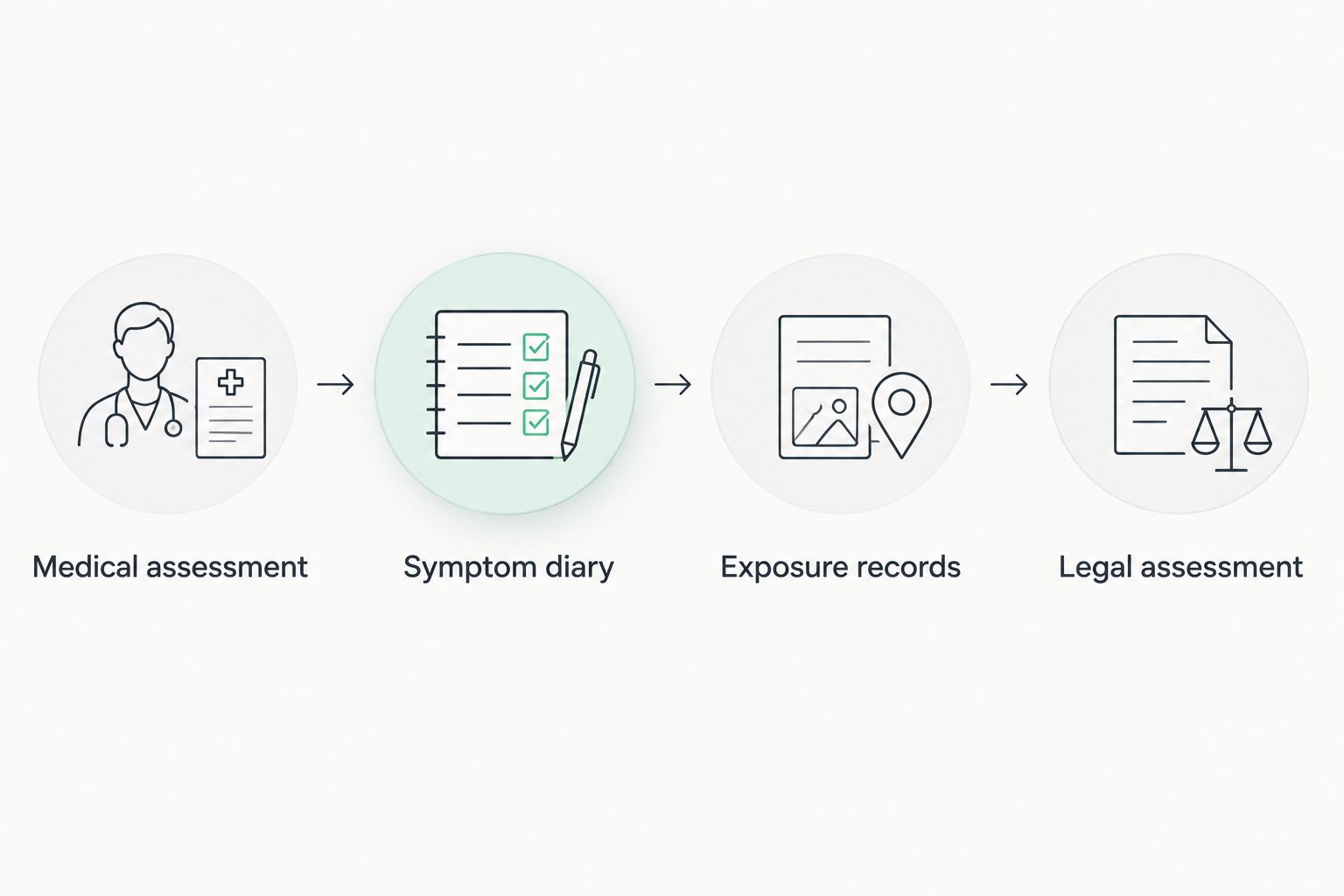
The preparation sequence is Medical assessment, Symptom diary, Exposure records, Legal assessment. These tasks support one another; they are not reasons to delay medical help or deadline advice.
Compare your support options
Medical assessment and legal advice serve different purposes. A GP assesses your health; a solicitor assesses liability, evidence and legal remedies. Keeping your own records supports both, but replaces neither.
Use this comparison to decide what help you need in 2026. The options are complementary rather than competing versions of the same service.
| Option | Best for | Main advantage | Key limitation |
|---|---|---|---|
| Personal evidence file | Organising your account | Keeps symptoms, tasks and documents together | Cannot diagnose asthma or establish legal liability |
| GP or respiratory service | Diagnosis and treatment | Assesses symptoms and directs appropriate investigations | Does not conduct your compensation claim |
| Trade union support | Workplace representation, if available through membership | Can help with workplace concerns and relevant records | Assistance depends on membership arrangements and scope |
| Thompsons Scotland | Scottish personal injury and industrial disease claim advice | Assesses the legal route within its stated practice | Legal advice does not replace clinical assessment or guarantee compensation |
Before instructing any solicitor, ask who will handle the case, how medical evidence will be obtained and what the written funding terms require. Do not assume that every firm offers the same arrangement.
Common mistakes shipyard workers make
Treating every breathing problem as asbestos disease
Asthma and asbestos-related disease are different conditions. Shipyard employment alone establishes neither diagnosis. Tell your clinician about all relevant exposures rather than deciding which disease explains the symptoms yourself.
Recording the yard but not the task
A yard name does not identify the exposure. Record whether you were spraying, preparing surfaces, welding or working near another trade, together with the substances and controls involved.
Assuming a mask proves adequate protection
Respiratory protection must be assessed in context. Record its type, the task, training and any fit-testing information where relevant, rather than concluding that its presence proves the workplace was safe or unsafe.
Waiting for a colleague’s claim to finish
Your colleague’s medical history, employer and limitation position can differ from yours. Check your own deadline now, even if another worker appears to have a similar condition.
Leaving out earlier asthma
A history of asthma is medically relevant, not something to conceal. Your clinicians and solicitor need an accurate account to distinguish new occupational asthma from aggravation of an existing condition.
FAQ
Can I claim occupational asthma compensation after working in a shipyard?
You can pursue a claim if the evidence supports a work-related injury caused by an employer’s actionable breach of duty. A diagnosis, exposure history and evidence about workplace controls help establish whether those requirements are met.
What is the time limit for an occupational asthma claim in Scotland in 2026?
Scottish personal injury proceedings generally have a three-year limitation period, subject to date-of-knowledge rules and exceptions. Ask a Scottish solicitor to assess the starting date; do not assume it is the date of diagnosis.
Can I claim if I already had asthma before joining the shipyard?
Pre-existing asthma does not automatically exclude a claim concerning workplace aggravation. Medical and legal evidence must distinguish the earlier condition from any additional harm caused by a breach of duty.
Do I need to identify the exact paint or chemical before asking a solicitor?
No, you do not need a complete substance list before seeking legal advice. Bring the product names, task descriptions and records you have, and explain where your knowledge is incomplete.
Can I bring a claim after leaving the shipyard?
Leaving the shipyard does not automatically prevent a claim. The limitation position, available evidence and identity of the responsible employer still need assessment.
Does wearing a respirator mean I cannot claim?
Wearing a respirator does not automatically prevent a claim. The assessment considers the whole control system, including equipment suitability, fit where required, maintenance, training and actual exposure.
What should I ask Thompsons Scotland about an occupational asthma claim?
Ask Thompsons Scotland to assess the limitation deadline, potential defendants and evidence needed for your Scottish industrial disease claim. Also request the written funding terms and an explanation of responsibilities before instructing the firm.
One last thing
The most useful missing detail is often the product name, not another description of the smell. Before your first legal discussion, prepare a one-page task history connecting employers, work areas, substances and symptoms. Mark uncertain dates as uncertain rather than filling gaps from memory.
For your 2026 claim enquiry, take the records you already have and identify what remains with the employer or healthcare provider. This guide provides general information, not a diagnosis or advice on your individual legal deadline.