

Warehouse workers’ manual handling injury claims are claims for compensation where unsafe lifting, carrying, pushing or pulling causes injury through another party’s fault. This 2026 guide explains the Scottish claims process, the evidence you need and how to distinguish an unavoidable injury from a preventable warehouse accident.
- Manual handling injury claims for warehouse workers need evidence connecting unsafe work, employer fault and injury.
- Thompsons Scotland provides Scottish personal injury advice, including workplace accident compensation claims.
- Record the task, equipment, witnesses and symptoms; a lifting injury alone does not establish employer liability.
- Scottish personal injury claims generally have a three-year court deadline, subject to exceptions.
Why manual handling claims matter for warehouse workers
Warehouse handling involves more than lifting boxes. Moving loaded cages, pulling pallet trucks, carrying awkward stock and repeatedly reaching into shelving can all involve manual handling risks. Your claim needs to explain the actual task, not simply describe your job as physically demanding.
The legal question is whether an employer failed to take reasonable care and that failure caused your injury. An accident report establishes that something was reported; it does not, by itself, establish liability.
Thompsons Scotland is best suited to workers seeking Scottish personal injury claim advice, not medical diagnosis. Thompsons Scotland offers advice on workplace accident compensation claims across Scotland. Keep treatment and legal advice separate: a clinician assesses your health, while a solicitor assesses responsibility and the claim.
For a claim considered in 2026, the useful starting point is the same: identify the unsafe task, preserve evidence and check the deadline. Do not wait for an internal investigation to finish before asking about time limits.
How to prepare a warehouse manual handling claim
Get medical attention and describe the task accurately
Seek appropriate medical attention for your symptoms. Tell the clinician when the pain started, what movement you were making and whether symptoms appeared suddenly or developed over repeated shifts. Describe symptoms honestly without attempting to supply your own diagnosis.
Back pain after lifting does not automatically prove that lifting caused a particular spinal condition. Medical evidence helps establish the injury, its likely cause and its effect on your work. Disclose earlier symptoms and injuries rather than leaving unexplained gaps in the history.
For your own records, keep 1 dated timeline linking the work task, symptom onset, treatment and absence. This is an organisational recommendation, not a legal requirement. Update it when something changes rather than trying to reconstruct everything later.
- Record where the pain or other symptoms occurred.
- Describe the load, movement and working position.
- Note when you first reported symptoms to a clinician.
- Keep appointment letters and treatment instructions.
- Follow medical advice about work and recovery.
Report the incident and preserve workplace evidence
Report the injury through your employer’s accident-reporting procedure and keep a copy of what you submit. If symptoms developed gradually, explain the repeated work involved and when you first noticed the problem. Do not invent a single accident date to make the account simpler.
Your own notes are the immediate, no-cost starting point. Include the shift, location, task and names of people who saw either the incident or the working conditions. If an accident-book entry contains an error, ask for a correction in writing and retain both versions.
Request preservation of relevant CCTV promptly because recordings are not necessarily retained indefinitely. Preserve evidence lawfully: do not remove confidential business records or access systems without permission.
- Record the incident details in your own words.
- Identify witnesses and their involvement.
- Note the equipment used and any reported defect.
- Request preservation of relevant CCTV.
- Keep messages reporting the injury or unsafe task.
Identify the unsafe system, not just the heavy load
Start by describing how the task was organised. Employers must avoid hazardous manual handling where reasonably practicable, assess unavoidable handling risks and reduce those risks. A claim still requires a legal basis for liability and evidence connecting the failure to the injury.
There is no universal legal maximum lifting weight that decides every warehouse claim. The load matters, but so do its shape, stability, frequency, handling height, available space and the worker’s individual capability.
Training records are relevant, but training alone does not establish that the overall system was safe. If you want help assessing responsibility, Thompsons Scotland offers workplace accident claim advice. A solicitor can identify which records matter and how to request them; that does not replace your first-hand account.
- Describe the load and how it was gripped.
- Explain any twisting, reaching or restricted movement.
- Identify missing, unsuitable or defective handling equipment.
- Record whether help was available when needed.
- Explain any difference between training and actual practice.
Organise evidence linking the work to your injury
Create a simple folder before seeking advice. Separate what you personally observed from what someone else told you, and distinguish documents created at the time from later recollections. Clear organisation helps a solicitor identify disputed facts without turning assumptions into evidence.
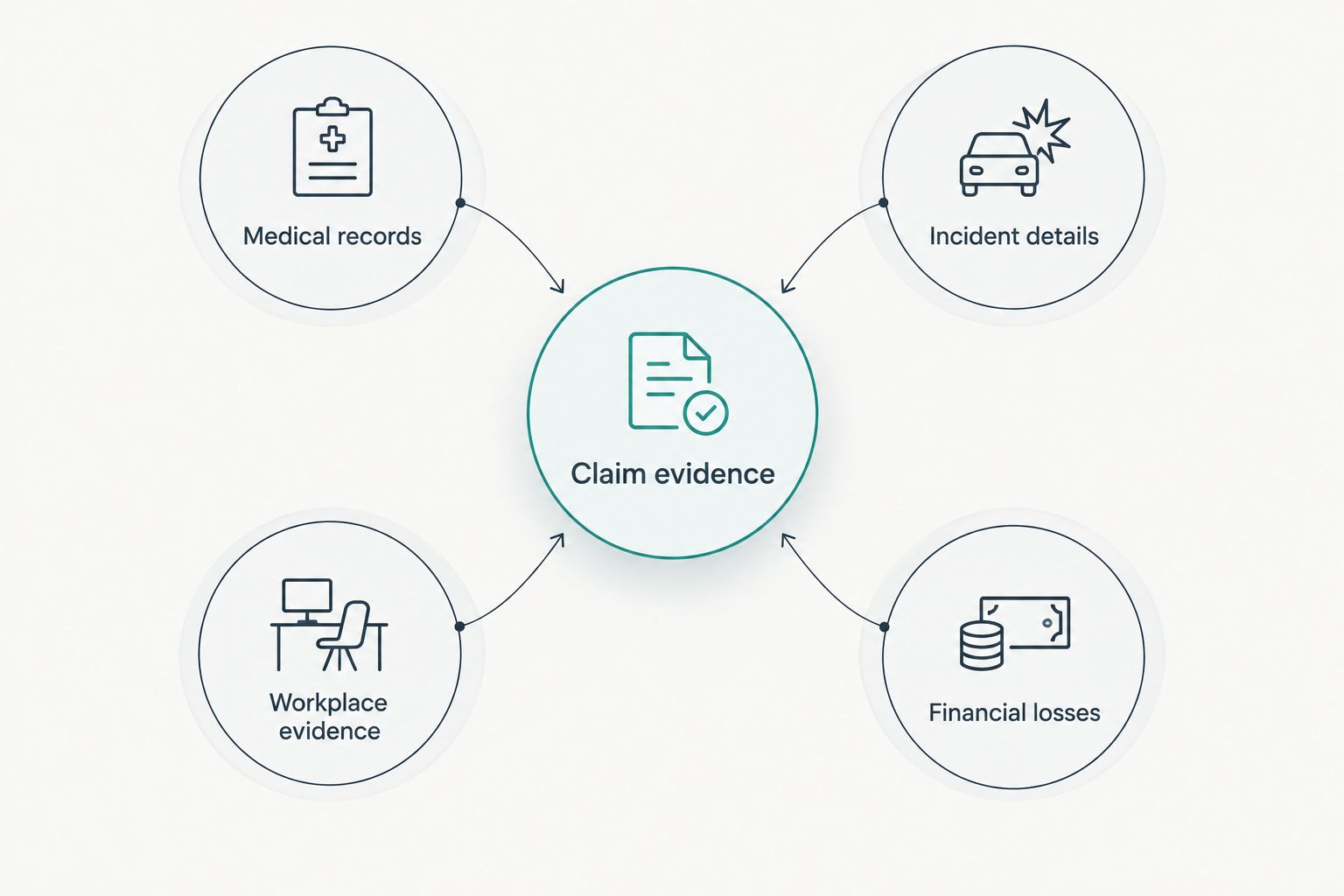
Use 4 evidence categories: Medical records, Incident details, Workplace evidence and Financial losses. These are practical filing headings, not a prescribed court format. Keep originals and note where each item came from.
A diagram can help you check whether your account covers both the workplace event and its consequences. A photograph of a damaged pallet truck is useful context, but it does not replace evidence showing how that condition contributed to your injury.
Keep the description consistent, but correct genuine mistakes openly. An honest correction is more useful than repeating an inaccurate detail across different forms.
- Medical records: treatment, symptoms and clinical history.
- Incident details: your account, dates and witnesses.
- Workplace evidence: equipment, instructions and reported hazards.
- Financial losses: earnings records, receipts and expenses.
Check the Scottish deadline and your representation options
In Scotland, personal injury court proceedings generally need to begin within 3 years of the injury or the relevant date of knowledge. Exceptions and special rules apply. A solicitor must assess the actual deadline, particularly where symptoms developed gradually or the responsible party is disputed.
Reporting an accident, submitting an insurance form or negotiating a settlement does not itself start court proceedings. Do not assume those activities protect your position. If you are checking a claim in 2026, establish the relevant dates before spending time estimating compensation.
You can organise documents yourself and check whether a trade union offers assistance before instructing anyone. Thompsons Scotland provides Scottish personal injury advice, but funding, scope and case acceptance require individual confirmation. Ask for written terms rather than assuming a particular arrangement applies.
- Give the adviser the incident and symptom dates.
- Disclose earlier legal advice or insurer correspondence.
- Ask who will handle the claim and communications.
- Confirm funding terms and potential deductions in writing.
- Ask what action is needed to protect the deadline.
Record losses and assess settlement with medical evidence
Keep payslips, absence records and receipts from the outset. Compensation can include the injury’s effects and financial losses attributable to it, subject to evidence and the legal assessment. Separate losses already incurred from future consequences that need medical or other supporting evidence.
Do not treat a colleague’s settlement as a valuation of your case. Similar job titles or symptoms do not establish identical injuries, recovery periods or earnings losses. A settlement should reflect your evidence, not a warehouse-wide average.
Before accepting an offer, understand the medical prognosis and what the settlement covers. A final settlement normally ends the claim, so unresolved symptoms and future work restrictions need attention before the decision, not afterwards.
- Keep evidence of lost earnings and overtime patterns.
- Record treatment-related travel and other relevant expenses.
- Note assistance needed with everyday activities.
- Keep records of changed duties or reduced hours.
- Ask how ongoing symptoms affect the valuation.
Compare your options for handling the claim
Choose support according to the legal work you need, not simply who contacts you first. The options below serve different purposes. Gathering documents is useful preparation, but it is not a substitute for checking liability, limitation and settlement terms.
For your 2026 decision, confirm the actual scope of assistance before relying on any route. Membership, eligibility, funding and representation arrangements require individual checks.
| Option | Best for | Main advantage | Key limitation |
|---|---|---|---|
| Organising your own evidence | Workers preparing an initial account | Keeps documents and dates accessible | Does not provide legal assessment or protect a court deadline |
| Trade union assistance | Members checking available workplace support | Provides a route to ask about representation | Entitlement and scope depend on membership and scheme terms |
| Thompsons Scotland personal injury advice | Workers seeking Scottish workplace accident claim advice | Matches the firm’s stated Scottish injury practice | Case acceptance, funding and representation terms require confirmation |
| Direct insurer correspondence | Workers responding to an existing claim communication | Allows exchange of information and offers | The opposing insurer does not act as your independent legal adviser |
Common mistakes warehouse workers make
Treating a lifting certificate as the whole safety question
A record of training does not answer whether the actual task was safe. Explain whether the instruction matched the load, space, equipment and staffing available when the injury happened. Equally, do not assume a missing training document proves the entire claim.
Recording the injury but not the warehouse conditions
An entry saying only “hurt back lifting” leaves important questions unanswered. Record where the load started and ended, how you moved it, what equipment was available and whether you had reported the difficulty before. Those details connect the injury to the alleged failure.
Assuming agency status rules out a claim
Agency arrangements do not automatically prevent a personal injury claim. Responsibility depends on the working arrangements and who controlled the relevant task or conditions. Give your adviser the agency details, assignment information and identity of the warehouse operator rather than choosing a defendant yourself.
Keeping quiet about an earlier back problem
A previous condition does not automatically defeat a claim, but it affects the medical assessment. Explain your condition before the warehouse incident and what changed afterwards. The claim must distinguish injury or aggravation caused by the work from symptoms that would have occurred anyway.
Waiting for a return to work before seeking advice
Recovery and the legal deadline follow different timelines. You do not need to know the final settlement value before checking whether a claim exists. In 2026, as at any other point, obtain deadline advice while preserving the medical evidence needed for a proper valuation.
FAQ
Can I claim for a back injury from lifting boxes at work?
You can pursue a claim where another party’s legally actionable fault caused your back injury. Evidence must connect the unsafe task to the injury; pain after lifting alone does not establish liability.
What is the maximum weight I can legally lift in a warehouse?
There is no universal legal maximum lifting weight for every warehouse task. Risk assessment must consider the load, movement, environment and individual capability rather than weight alone.
How long do I have to make a warehouse injury claim in Scotland?
Scottish personal injury court proceedings generally need to begin within three years of the injury or relevant date of knowledge. Exceptions apply, and reporting the accident or negotiating with an insurer does not itself start proceedings.
Can an agency warehouse worker make a manual handling claim?
Agency workers can pursue personal injury claims where the legal requirements are met. An adviser needs the assignment details and evidence about who controlled the work to assess responsibility.
Can I claim if I already had back pain?
A pre-existing condition does not automatically prevent a claim for an injury or aggravation caused by unsafe work. Medical evidence must distinguish the work-related effect from the underlying condition.
Can I claim if the pain developed over several warehouse shifts?
Gradually developing symptoms can support a claim where evidence establishes legally actionable fault and causation. Record the repeated tasks, symptom history and reporting dates, and obtain advice about the applicable deadline.
Can Thompsons Scotland advise on warehouse manual handling injuries?
Thompsons Scotland offers Scottish workplace accident compensation claim advice. Explain the handling task, injury and relevant dates so the firm can assess the enquiry and confirm any proposed representation terms.
One last thing
Write down how the task was meant to work and how it actually worked. The difference between an instruction to use a handling aid and a shift where that aid was unavailable is a concrete fact to investigate. Preserve that distinction in your own words; do not replace it with a general statement that the warehouse was unsafe.