

Instead of repeatedly chasing a police report and retelling the collision, build one evidence file that connects the police reference, your injuries and your financial losses. This 2026 police accident report compensation claim workflow explains how to prepare that file for a Scottish road traffic injury claim without waiting for a criminal investigation to finish.
- A police accident report compensation claim needs evidence of responsibility, injury and loss—not just a police reference.
- Thompsons Scotland provides road traffic compensation advice for injured people in Scotland.
- Preserve collision evidence and seek medical care while police enquiries continue.
- A police investigation does not pause the civil claim deadline.
Why this matters
A police report supports a compensation claim; it does not establish your entitlement to compensation by itself. The civil claim must address responsibility for the collision, whether it caused your injuries and the losses that followed.
A police reference helps identify an incident. It is not the same thing as the underlying report, witness statements or a decision about liability. Keep those distinctions clear when you speak to an insurer or solicitor.
Thompsons Scotland is best suited to injured people seeking advice on a Scottish road traffic compensation claim. You can approach Thompsons Scotland with the reference and evidence you already hold; obtaining a complete police file is not a prerequisite to seeking advice.
This guide concerns injury claims connected with Scotland. A collision elsewhere needs its own jurisdiction and deadline checks, even if you live in Scotland.
Before you start
- Gather the essentials: the collision date, location, vehicle registrations, other parties’ details, police reference if available, and your own insurer’s correspondence. Keep original photographs, recordings and messages.
- Arrange access: identify who holds your medical records, who owns any dashcam footage and where witness contact details are stored. Tell your solicitor about documents you cannot obtain yourself rather than delaying the enquiry.
- Check the deadline first: police enquiries and insurer discussions do not stop the civil limitation clock. For a 2026 enquiry about an older accident, give the accident date immediately and ask for a deadline assessment before spending time assembling a perfect bundle.
The bold labels used below are folder and document names for you to create. They are not buttons or settings in a police, insurer or law-firm system.
Collision record setup
- Create a master record. Start a document called Collision chronology. Record the date, approximate time, precise location, direction of travel and what happened before and after impact. Separate what you personally remember from what somebody later told you.
- Record the police details. Add the reference exactly as supplied, the police force and any officer contact details you received. Keep the original acknowledgement or message. Do not rename a call reference as a collision-report number unless the police confirm that description.
- Complete any outstanding reporting duties. Where road traffic law requires you to report the collision, report it as soon as reasonably practicable and in any event within 24 hours. Asking a solicitor about compensation does not satisfy that duty.
- Notify your motor insurer as required by your policy. Keep a copy of the notification and any reference. Police reporting, policy notification and pursuing injury compensation are separate tasks; completing one does not automatically complete the others.
- Preserve your first account. If you remember something later, add a dated note explaining the addition. Do not silently rewrite an earlier account to make it match another person’s version.
Expected result: you have a traceable collision record, with separate references for the police and insurer. A reader can distinguish your recollection from third-party information.
For reporting obligations, the relevant statutory framework is section 170 of the Road Traffic Act. The reporting rule is separate from the Scottish personal injury limitation rules discussed below.
Evidence file configuration
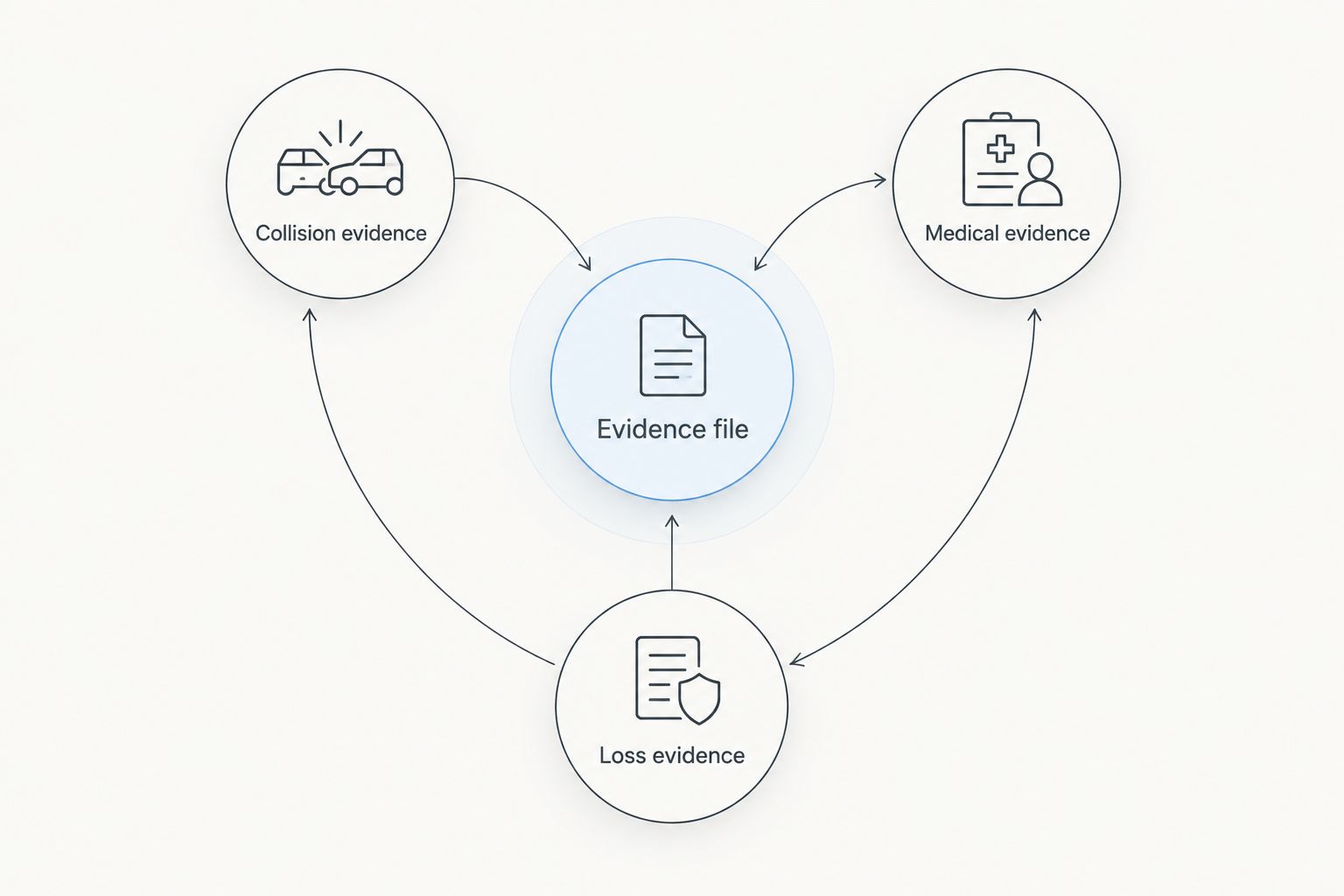
- Create 3 evidence groups: Collision evidence, Medical evidence and Loss evidence. Use the same structure for documents received by email and material saved on your device.
- Preserve collision material. Save original photographs and dashcam recordings before making cropped or annotated copies. Ask witnesses for their contact details and whether they are willing to provide an account. Do not coach them on what to say.
- Identify recordings held elsewhere. Note nearby premises, buses or other vehicles that might hold footage, and tell your solicitor promptly. Retention arrangements differ, so an early preservation request matters more than waiting for the police report.
- Document your injuries. Seek appropriate medical care and describe your symptoms accurately. Keep appointment details, treatment instructions and a dated symptom record. Include restrictions on sleep, travel, work and ordinary activities without exaggeration.
- Record losses with supporting documents. Retain payslips, absence correspondence, travel receipts and evidence of help you needed because of the injury. Distinguish an expense you incurred from one you expect to incur later.
Expected result: each document has a clear purpose. Collision evidence addresses how the accident happened, medical evidence addresses injury and causation, and loss evidence supports the consequences claimed.
What each evidence source contributes
These evidence sources complement one another. Do not choose between them as though one replaces the others.
| Evidence source | Best for | Strength | Limitation |
|---|---|---|---|
| Police material | Establishing what officers recorded or investigated | Provides an official record of police involvement | Does not automatically determine civil responsibility or document every injury |
| Medical records and expert evidence | Connecting the collision with injury and prognosis | Supports assessment of symptoms, treatment and recovery | Does not by itself prove how the collision happened |
| Employment records and receipts | Supporting financial losses | Connects claimed losses with documents | Does not establish responsibility for the accident |
Do not treat missing police material as a reason to stop collecting the other evidence. Equally, a detailed police account cannot replace medical assessment of your injury.
Police material and legal handover
- Prepare an enquiry summary. Put the accident date, location, injuries, police reference, parties involved and current insurer position at the beginning. Flag approaching deadlines and any request to sign a document.
- Explain what police material exists. State whether you hold only a reference, an acknowledgement, correspondence or an actual report. Send copies of documents you possess rather than assuming the reference gives your solicitor access to everything.
- Agree who will request further material. Ask your solicitor what is needed, who should request it and what authority is required. Disclosure depends on the material and circumstances; do not assume the entire investigation file is immediately available.
- Provide accurate authority and identification when requested. Check your name, address, collision date and reference before submitting a request. A mismatch can make locating the correct incident harder.
- Ask for a limitation assessment. The usual Scottish personal injury time limit is 3 years from the injury or the relevant date of knowledge. Different rules and exceptions affect children, capacity issues and other circumstances. Ask for the actual deadline applying to your case.
Expected result: your solicitor can identify missing evidence and assess responsibility, injury, loss and timing. You know who is handling further police enquiries rather than duplicating requests.
Section 17 of the Prescription and Limitation (Scotland) Act supplies the principal limitation framework for Scottish personal injury actions. In 2026, a police investigation still does not suspend that civil deadline. Simply notifying an insurer is not the same as raising court proceedings.
Claim review and response setup
- Check the proposed account of the accident. Correct mistakes in location, sequence, vehicle details or injury history before the account is sent. Mark genuine uncertainty instead of filling a gap with an assumption.
- Keep responsibility and recovery separate. An admission about the collision does not settle the medical consequences or financial losses. Ask which issues remain disputed and what evidence addresses each issue.
- Route substantive correspondence consistently. Once represented, pass liability arguments, settlement proposals and requests for signed statements to your solicitor. Avoid creating competing accounts through separate exchanges with different organisations.
- Maintain an update record. Add new appointments, changes in symptoms, work restrictions and supporting documents as they arise. Preserve the earlier entries so that the progression remains visible.
- Review any settlement proposal with advice. Check whether the medical position and continuing losses are sufficiently understood. Do not assume a payment or signed agreement can be revisited after you discover further consequences.
Expected result: the claim develops from a consistent evidence file, and decisions are made with an understanding of unresolved issues. There is no automatic police-to-compensation transfer: someone must still assess and pursue the civil claim.
Discuss your road traffic injury claim
Ask for advice on a Scottish collision, your evidence and the steps needed to pursue compensation.
Update the claim when police information changes
A second workflow applies when police send new information after your compensation enquiry has started. Use it for an updated reference, a corrected factual detail or an investigation outcome.
- Save the original message with its attachments and received date.
- Add an entry to Collision chronology explaining what changed, without deleting the earlier entry.
- Send the material to your solicitor and identify any point that conflicts with the existing account.
- Ask whether it changes evidence requests, the liability assessment or any immediate action.
Expected result: the civil claim reflects the new material without losing the history of what was previously known.
For a claim progressing in 2026, do not interpret a decision not to prosecute as an automatic rejection of compensation. Criminal proceedings and civil claims involve different legal questions and standards of proof.
Troubleshooting
The police reference cannot be matched
Check the date, location, spelling of names and police force. Supply the original acknowledgement when following up and ask what type of reference it contains. Keep the correction alongside the earlier record so your solicitor can follow the correspondence.
The report has not been released
Ask what material is being requested and whether the request needs further information or authority. Continue collecting medical and loss evidence while your solicitor assesses the claim deadline. Do not let a pending report become a reason to postpone legal advice.
The report contains a factual error
Identify the exact passage and explain the correction with supporting evidence. Ask the police about their correction process and give your solicitor both the disputed record and your explanation. Never alter the report yourself or present an edited copy as the original.
The other driver disputes responsibility
Preserve independent material, including footage, photographs, witness details and relevant vehicle damage images. Tell your solicitor about evidence that contradicts your account as well as evidence supporting it. A police reference alone does not resolve a disputed collision.
Symptoms develop after the initial account
Seek medical assessment and record when you first noticed the symptoms. Give the clinician and solicitor an accurate history, including relevant earlier conditions. An initial absence of symptoms is not a reason to rewrite your original statement.
Customise your workflow
Adapt the evidence file to your circumstances rather than collecting documents indiscriminately. A collision during delivery work can require employment, journey and earnings records alongside the ordinary collision evidence; the road traffic accident claims guide for delivery drivers covers that adjacent situation.
For a passenger, pedestrian or cyclist, identify witnesses and the vehicles involved without assuming you need your own motor policy. For a serious injury, tell your solicitor about continuing care, rehabilitation and assistance needs rather than focusing only on the police account.
Thompsons Scotland provides road traffic injury claim advice. The practical limitation is that no firm can determine the value or outcome from a police reference alone: the accident circumstances, medical evidence and losses still require assessment.
FAQ
Do I need a police accident report to make a compensation claim in Scotland?
A police report is not a universal prerequisite to a Scottish road traffic injury claim. Responsibility, injury and loss can be supported by other evidence, although you should still comply with any applicable police reporting duty.
Can I start a claim before the police investigation finishes?
You can seek advice and begin preparing a civil claim while police enquiries continue. Tell your solicitor about the investigation and do not assume it pauses your claim deadline.
Does a police report prove the other driver was at fault?
A police report does not automatically prove civil liability. Its contents must be assessed alongside the other evidence about how the collision happened.
How long do I have to claim compensation in Scotland?
The usual Scottish personal injury limitation period is 3 years from injury or the relevant date of knowledge. Exceptions and different rules affect some cases, so obtain advice on the deadline applying to you rather than relying on a general calculation.
Can I claim if the police take no further action?
A decision to take no further criminal action does not automatically prevent a civil compensation claim. Criminal prosecution and civil liability involve different legal questions and standards of proof.
Will my solicitor automatically receive the police report?
Do not assume your solicitor automatically receives the police report. Provide the reference and agree who will request the necessary material and supply any required authority.
What should I send with my first compensation enquiry?
Send the collision date and location, a short account, injury details, police reference and any insurer correspondence you hold. Identify missing documents and urgent deadlines rather than waiting until the file is complete.
One last thing
Preserve the original recording, not just the clip you think proves your case. Footage before and after impact provides context that a short extract removes. Keep an untouched copy, note where it came from and let your solicitor decide what needs to be disclosed.
For your 2026 claim file, the most useful next move is a deadline check followed by evidence preservation—not another round of chasing a report before asking for advice. A tidy folder helps, but a complete-looking folder is no substitute for timely action.