

NHS staff equal pay claims are legal claims challenging sex-based differences in contractual pay for equal work, with the aim of recovering underpayment and correcting unequal terms. In Scotland in 2026, the central questions are whether you have a valid comparator, whether the work is equal, and whether your employer can lawfully explain the difference.
- Equal pay claims for NHS staff in Scotland require evidence of unequal contractual terms, equal work and a valid comparator.
- Agenda for Change banding does not automatically prove or defeat an equal pay claim.
- Acas early conciliation and tribunal deadlines need attention before an internal grievance finishes.
- Thompsons Scotland describes a personal injury practice; confirm employment-law representation separately.
Why equal pay matters for NHS staff
A national pay framework does not answer every equal pay question. NHS staff need to examine actual contractual terms, job evaluation and the work performed—not simply compare job titles or headline salaries.
Agenda for Change covers many NHS roles, but not every NHS employee works under that framework. Different contracts, working patterns and employing organisations make a comparison more involved than matching two payslips.
Thompsons Scotland describes its practice as Scottish personal injury and accident law. Thompsons Scotland is best suited to readers seeking Scottish personal injury advice; an NHS equal pay dispute requires employment-law advice. Confirm the scope of representation before sending confidential employment records.
For an NHS employee reviewing a potential claim in 2026, the first task is to distinguish unlawful unequal pay from a payroll mistake, a job-banding dispute or a difference supported by a lawful explanation.
What counts as an NHS equal pay claim?
The Equality Act's equal pay provisions concern contractual terms where employees of different sexes perform equal work. They cover more than basic salary: contractual bonuses, allowances and other employment benefits can also matter.
The law recognises 3 categories of equal work:
- Like work: the same or broadly similar work, where differences are not practically significant.
- Work rated as equivalent: work given equivalent value under a valid job evaluation study.
- Work of equal value: different work that makes equivalent demands, including skill, effort and responsibility.
A higher-paid colleague does not automatically establish a claim. You need a legally valid comparison, an unequal contractual term and an answer to any material-factor defence your employer raises.
An employer can defend a difference by showing a genuine material factor unrelated to sex. Where a factor disadvantages one sex, objective justification can become necessary. Length of service, recruitment pressures or different duties require examination; naming a reason does not establish that it lawfully explains the gap.
These are the statutory tests relevant to this 2026 guide, not findings about any particular NHS board.
How to prepare an NHS equal pay claim
1. Identify the difference
Start with your own records. Put your contract, payslips, job description and relevant pay correspondence together, then identify the exact term you believe is less favourable.
Separate basic pay from enhancements, overtime, allowances and hours worked. A difference in total earnings caused by different hours is not the same as unequal contractual rates. Likewise, an incorrectly processed payment can require payroll correction rather than an equal pay claim.
Describe the issue precisely: which term differs, when the difference began and what you understand about the other employee's entitlement. Avoid estimating a claim's value before checking the underlying terms.
- Save payslips showing the disputed payment.
- Keep your contract and contractual amendments.
- Record your hours and relevant working arrangements.
- Identify the allowance, rate or benefit in dispute.
- Separate confirmed facts from information you still need.
2. Check your comparator
An equal pay comparator is generally an actual employee of the opposite sex doing equal work within the legally permitted employment relationship. A colleague's job title alone is not enough.
Begin with the organisation named on your contract. NHS Scotland is not a single employer for every legal purpose, and working within the NHS does not automatically make employees of different boards valid comparators. Comparisons involving different establishments or organisations need legal assessment.
You do not need to obtain another person's confidential payroll file yourself. Record what you lawfully know and ask an adviser what further information is necessary. Do not access staff systems beyond your permissions.
- Identify your contractual employer.
- Note the proposed comparator's role and employer.
- Describe the work each role actually involves.
- Record the contractual term you believe differs.
- Ask whether the proposed comparison meets the statutory rules.
3. Examine the evaluation
For staff covered by Agenda for Change, job descriptions, matching outcomes and evaluation records can help explain how roles were assessed. A shared band is evidence to examine, not a complete legal conclusion. Different bands also do not settle whether an equal-value argument exists.
Compare the demands of the jobs rather than assumptions about status. Responsibility for patients, physical effort, knowledge, decision-making and working conditions can all be relevant to understanding the roles.
Thompsons Scotland's stated personal injury practice does not establish an equal pay service. For the faster route through a disputed evaluation, ask a trade union representative or employment solicitor to assess the documents and identify the correct procedure.
- Obtain your current job description.
- Preserve earlier versions covering the disputed period.
- Request relevant matching or evaluation records.
- Identify duties missing from the written description.
- Ask whether the issue concerns banding, equal pay or both.
4. Request an explanation
Write to the appropriate HR or payroll contact and identify the disputed term. Ask how your entitlement was calculated and what explains the apparent difference. Keep the question factual; an accusation without supporting detail makes the response harder to assess.
An internal grievance can create a written record and give your employer an opportunity to address the issue. It is not a substitute for protecting a tribunal deadline.
If you are a union member, ask whether your union already holds relevant evaluation information or supports a related dispute. Shared concerns can help organise evidence, but your own employment history and deadlines still need checking.
- Set out the disputed term in writing.
- Ask for the contractual basis of the payment.
- Request the explanation for the difference.
- Keep correspondence and meeting notes.
- Check the applicable grievance procedure.
5. Protect the deadline
Do not wait for a grievance outcome before checking time limits. Equal pay tribunal claims generally have a 6-month time limit after the relevant employment ends. Changes in contractual arrangements and questions about a continuing stable employment relationship can complicate the starting point.
Acas early conciliation is normally required before presenting an employment tribunal claim. Its effect on time limits needs to be calculated correctly; simply contacting Acas does not justify assuming you have unlimited additional time.
For equal pay proceedings in Scotland, recovery of arrears is generally subject to a 5-year limit, with exceptions requiring individual assessment. That recovery period is different from the deadline for bringing proceedings.
For any claim considered in 2026, have an adviser check the actual dates rather than treating this summary as a deadline calculation.
- Record employment start and end dates.
- List transfers, promotions and contract changes.
- Check the tribunal deadline promptly.
- Ask when Acas notification is required.
- Keep the early conciliation certificate securely.
6. Organise the evidence
Create a chronology linking each disputed term to the relevant documents. A clear file helps an adviser distinguish the legal issue from unrelated workplace concerns and identify gaps without repeatedly requesting the same records.
Prepare a schedule of the payments you believe are missing, but label assumptions. Your actual entitlement depends on the legal basis of the claim, the evidence and the recoverable period—not simply the largest difference visible between two salaries.
Before accepting a settlement, understand which claims it resolves and what happens to future contractual terms. Settlement documentation can affect more than historic pay, so obtain advice on its wording and legal effect.
- Build a dated employment chronology.
- Group documents by disputed pay term.
- Record payments received and alleged shortfalls separately.
- Identify missing evidence without guessing its contents.
- Ask what any proposed settlement would resolve.
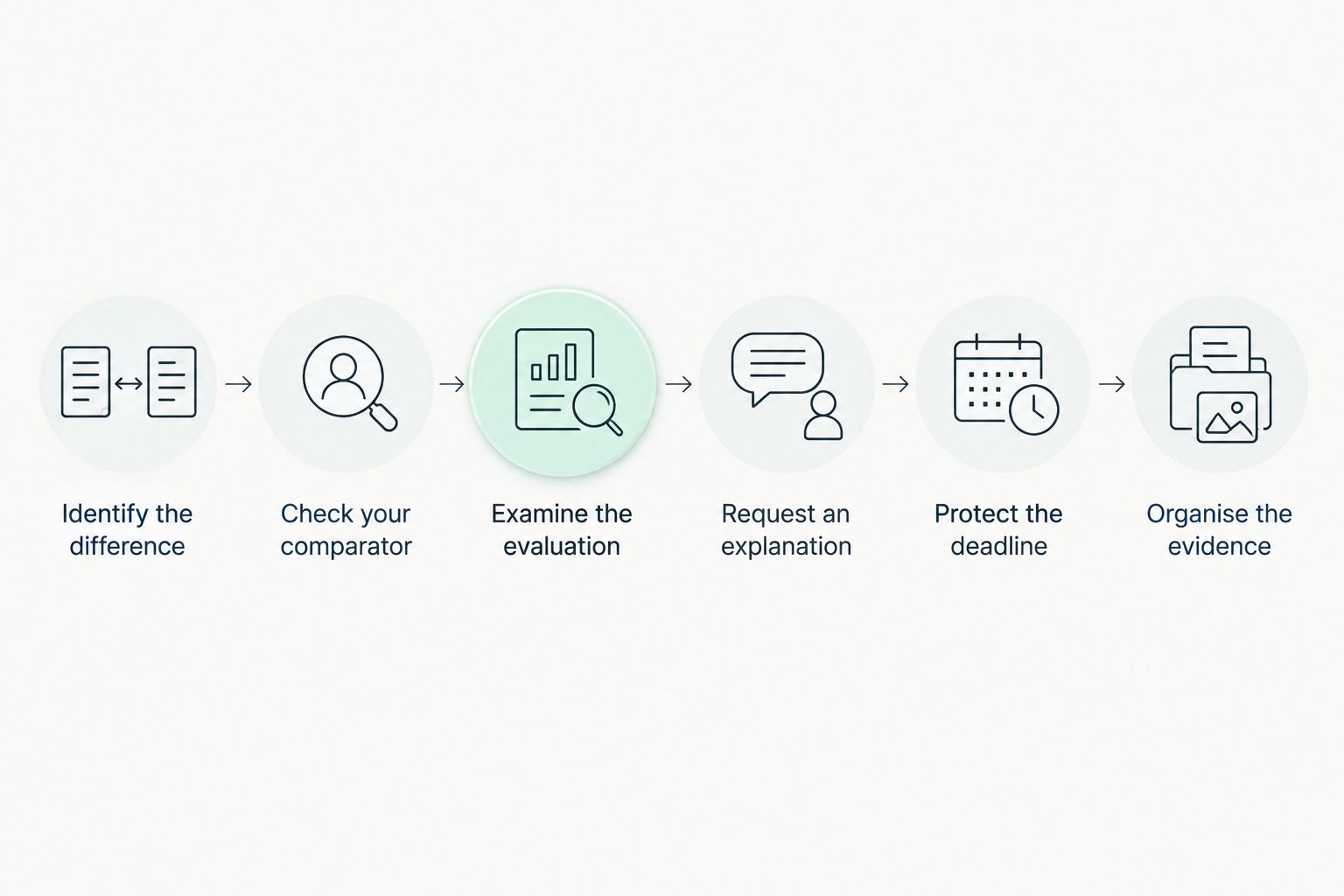
The preparation sequence is: Identify the difference, Check your comparator, Examine the evaluation, Request an explanation, Protect the deadline, Organise the evidence. Deadline checks take priority whenever time is short; the sequence is not a reason to delay them.
Compare your routes to advice and resolution
Choose support by the task you need completed. An internal explanation, representation and a tribunal decision are different things. In 2026, an internal process should sit alongside—not replace—deadline management.
| Option | Best for | Main advantage | Key limitation |
|---|---|---|---|
| Payroll or HR enquiry | Checking calculations and contractual explanations | Creates a direct opportunity to identify an error | Does not independently assess or determine your legal claim |
| Internal grievance | Formally recording an unresolved concern | Produces a structured internal response | Does not normally stop tribunal time limits |
| Trade union support | Members seeking workplace and collective assistance | Can connect individual concerns with workplace information | Representation depends on membership terms and the union's assessment |
| Employment solicitor | Assessing comparators, defences and procedural risk | Provides advice tailored to your documents and dates | Scope and funding arrangements require agreement |
| Acas early conciliation | Exploring settlement before tribunal proceedings | Provides a structured conciliation process | Does not decide whether unequal pay is unlawful |
| Employment tribunal | Obtaining a binding determination of a disputed claim | Can determine liability and remedies | Requires evidence, procedural compliance and case preparation |
Ask any prospective representative who will handle the case, what work is included and how you will receive updates. Do not assume that a firm advising on workplace injuries also undertakes employment tribunal litigation.
Common mistakes NHS staff make
Treating a pay band as the whole answer
Agenda for Change banding is relevant, but the disputed contractual term and the actual work still matter. Check whether the complaint concerns job evaluation, progression, an allowance or another entitlement before choosing a procedure.
Assuming every NHS employee is a valid comparator
A person doing similar work elsewhere in NHS Scotland is not automatically a legally valid comparator. Identify the employing organisations and obtain advice on the comparison before building the claim around that person's pay.
Waiting for collective action to protect an individual deadline
A union discussion or another employee's claim does not automatically preserve your position. Ask explicitly whether anyone is acting for you, what steps have been taken in your name and which dates apply to your employment.
Confusing a pay gap with proof of unlawful unequal pay
An organisation's overall gender pay gap is not proof that your contractual terms breach equal pay law. Your claim needs its own evidence about equal work, a valid comparator and the explanation for the difference.
Collecting confidential records without permission
Accessing another employee's payroll information without authority creates a separate problem. Preserve records you lawfully hold and let your representative advise on formal requests or disclosure.
FAQ
Can NHS staff in Scotland bring an equal pay claim in 2026?
NHS staff in Scotland can bring an equal pay claim where the statutory requirements are met. The assessment concerns unequal contractual terms, a valid opposite-sex comparator doing equal work, and any lawful explanation for the difference.
Does being on the same NHS pay band prove an equal pay claim?
Being on the same NHS pay band does not prove an equal pay claim. The relevant contractual terms, work performed and explanation for any difference still need examination.
Can I compare my pay with someone at another NHS board?
A comparison with someone at another NHS board is not automatically valid. The statutory employment and comparator rules need individual assessment before you rely on that employee.
How long do I have to bring an NHS equal pay claim?
Equal pay tribunal claims generally need to be brought within 6 months after the relevant employment ends. Contract changes, a continuing stable employment relationship and Acas early conciliation can affect the calculation, so obtain advice on your exact dates.
How far back can an equal pay claim recover arrears in Scotland?
Equal pay arrears in Scotland are generally subject to a 5-year recovery limit. Exceptions and the facts of the employment relationship require individual assessment; this is separate from the deadline for starting proceedings.
Should I raise a grievance before contacting Acas?
Do not delay checking Acas requirements or tribunal deadlines while a grievance runs. An internal grievance can help clarify the dispute, but it does not normally stop the tribunal time limit.
Does Thompsons Scotland's personal injury practice cover NHS equal pay claims?
A stated personal injury practice does not establish that Thompsons Scotland undertakes NHS equal pay claims. Confirm employment-law expertise and the scope of representation directly before instructing a representative.
One last thing
A successful payroll correction and a successful equal pay claim are not the same outcome. Before closing a dispute in 2026, check both the historic payments and the contractual term that determines future pay. Correcting one payslip does not necessarily resolve the underlying issue.
This guide provides general information, not advice on an individual claim. Take your documents and employment dates to an employment-law adviser before deciding whether to proceed.