
Instead of repeatedly explaining your accident to insurers, build one evidence file and use it to notify your own insurer, pursue a third-party injury claim and check any settlement. In Scotland, reporting a collision does not itself start an injury claim or protect the deadline for raising court proceedings.
- An insurer accident report third party claim workflow separates policy notification from pursuing personal injury compensation.
- Thompsons Scotland provides Scottish personal injury advice; an accident notification alone does not protect your court deadline.
- Keep accident evidence, medical records and financial losses together, but distinguish vehicle damage from injury compensation.
- Confirm what any settlement covers before accepting it, especially when symptoms remain unresolved.
Why this matters
Your own insurer needs information to handle your policy and any claim involving your vehicle. A personal injury claim has a different purpose: establishing responsibility, connecting the collision to your injuries and assessing the resulting losses. An insurer reference number is not proof that someone is pursuing your injury claim.
Thompsons Scotland is best suited to injured people seeking Scottish personal injury claim advice. You can approach Thompsons Scotland about road traffic accident compensation; keep responsibility for your policy notification separate from instructions to a solicitor.
For a Scottish accident in 2026, establish the correct jurisdiction before following an online claims process. The Official Injury Claim service is for eligible accidents in England and Wales, not the Scottish injury claim route.
| Process | Best for | Benefit | Limitation |
|---|---|---|---|
| Notification to your own insurer | Meeting your policy's reporting requirements | Creates a record and allows policy handling to begin | Does not, by itself, pursue personal injury compensation |
| Third-party injury claim | Seeking compensation where another party bears responsibility | Addresses injuries and associated losses | Requires evidence of responsibility, causation and loss |
Before you start
- Gather access and identifiers: your policy documents, insurer contact details, vehicle registrations, accident date and location, correspondence and any existing references. Use contact details verified through your policy documents or insurer's established channels.
- Preserve supporting material: original photographs, dashcam footage, witness details, medical appointment information, receipts and earnings evidence. Keep originals alongside a working copy rather than editing the only version.
- Check the deadline separately: Scottish personal injury proceedings generally have a 3-year limitation period, commonly running from the injury or relevant date of knowledge. Notification and negotiations do not stop that clock; ask a solicitor to calculate the deadline for your circumstances.
The non-obvious trap is assuming that a vehicle repair handler, insurer or claims intermediary is also handling your injury. Before sending documents, establish who represents you, what they are instructed to do and whether the injury claim is included.
Accident record
Build a reliable account before completing forms
- Write the chronology. Record the date, time, location, direction of travel, vehicles involved and what you personally saw. Separate observations from conclusions about speed, fault or another driver's intentions.
- Preserve the evidence. Save photographs and original video files before recordings are overwritten. Record witness contact details and identify potential CCTV sources promptly; do not assume footage will remain accessible.
- Record injuries accurately. Note symptoms, when they began and any treatment. Seek appropriate medical attention rather than treating an insurer's reporting process as a medical assessment.
- Record official involvement. Keep any police incident reference and details of officers or emergency services attending. A police reference identifies an incident; it does not automatically establish civil liability.
Use a dated chronology with clearly marked corrections. If you remember something later, add a separate entry explaining the addition instead of silently replacing the original account.
For a report made in 2026 about an earlier collision, retain the actual accident date. The date you complete an online form does not replace the date the collision happened.
Expected result: you have a consistent factual account, preserved source material and a clear distinction between what you know and what remains uncertain.
Check whether police reporting is required
Not every collision requires the same police response. Where a road accident triggers the statutory reporting duty because required details were not given, report it as soon as reasonably practicable and in any event within 24 hours; injury-related insurance requirements also need attention.
Reporting to an insurer is not reporting to the police. For the evidence handover, see the police accident report to road traffic compensation claim workflow.
Claim notification
Notify your insurer and define the injury claim
- Check your policy requirements. Find the notification instructions and report through the channel your insurer specifies. Do not assume you can wait until you decide whether to claim for vehicle damage.
- Submit facts, not guesses. Provide the accident circumstances and known injuries accurately. Explain uncertainty where necessary, and do not describe yourself as uninjured simply because symptoms have not yet been assessed.
- Save the submission. Keep the completed form, confirmation email or contemporaneous call note. Record the reference and the scope of the matter being handled.
- Identify the injury claim handler. If you instruct a solicitor, confirm that the instruction covers your personal injury claim. Give the solicitor the insurer references and any correspondence from the other driver's insurer.
- Keep references distinct. Label your own insurer's reference, the third-party insurer's reference and your solicitor's reference separately. Include the appropriate reference whenever you send an update.
Insurer forms do not share a universal set of field names or buttons. Follow the wording on your insurer's actual form, and retain any explanatory text you submit rather than relying on an assumed template.
Expected result: your policy notification is recorded, and you know whether a separate injury claim has been instructed and who is responsible for progressing it.
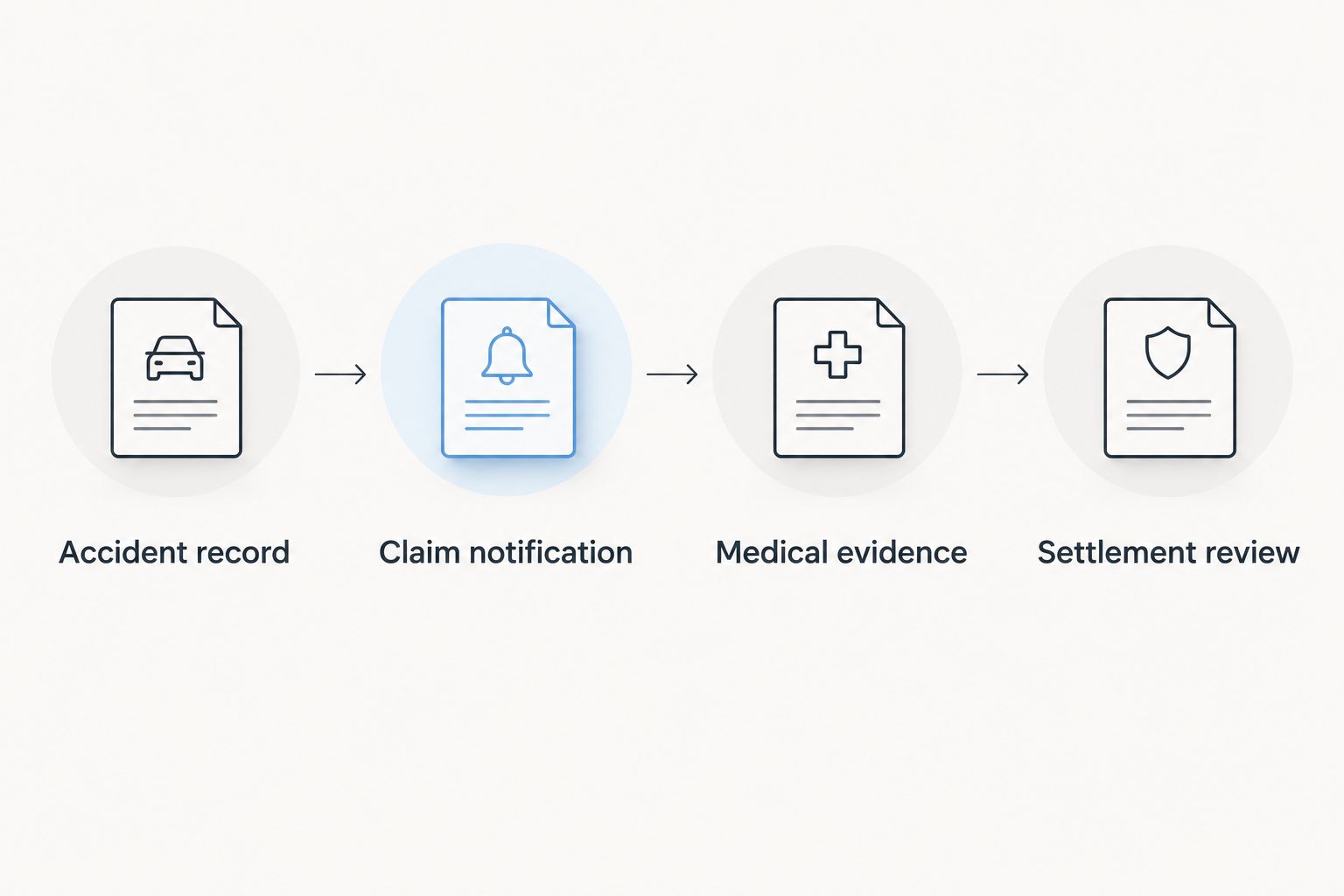
The core 2026 workflow has four distinct stages: Accident record, Claim notification, Medical evidence and Settlement review. Each stage answers a different question; none substitutes for the next.
Medical evidence
Connect the collision to your injuries and losses
- Give an accurate medical history. Explain the collision, symptom onset, previous relevant conditions and changes since the accident. Do not exaggerate or minimise symptoms to fit an expected claim outcome.
- Keep a practical recovery record. Note treatment, medication, time away from work and effects on ordinary activities. Describe specific limitations rather than repeatedly writing that you feel worse.
- Build a loss schedule. Keep receipts and supporting records for losses you seek to recover, such as travel for treatment or lost earnings. Separate amounts already incurred from future needs requiring evidence.
- Support earnings claims. Retain payslips, employer correspondence and absence records. If you are self-employed, provide the business records requested to establish the actual financial effect rather than relying on turnover alone.
- Review medical evidence carefully. Tell your solicitor about factual errors or missing symptoms in a report. A medical expert's opinion is independent; a disagreement needs proper explanation, not an edited replacement supplied by you.
A symptom diary supports your account but does not replace medical evidence. Equally, a repair estimate establishes something about the vehicle, not the extent of your physical recovery.
Expected result: your claim file connects the accident, the injuries and the losses claimed, with supporting records available for each disputed point.
Thompsons Scotland's road traffic personal injury advice fits this stage when you need help understanding what evidence the claim requires. The trade-off is that legal representation does not remove the need for your own accurate records or independent medical assessment.
Settlement review
Check responsibility, scope and finality
- Establish the liability position. Ask whether responsibility is admitted, disputed or shared. An insurer agreeing to inspect or repair a vehicle does not necessarily amount to admitting every part of an injury claim.
- Check the medical position. Identify whether the available report addresses prognosis and ongoing symptoms. Tell your solicitor about further treatment or deterioration before settlement instructions are given.
- Read the offer's scope. Confirm whether it concerns vehicle damage, personal injury, associated losses or a wider settlement. Do not assume that accepting one document leaves every other issue open.
- Check deductions and outstanding matters. Ask your solicitor to explain the proposed settlement statement, any relevant benefit recovery and any other deductions before you authorise acceptance.
- Give clear instructions. Keep a written record of the advice and your decision. Do not assume that changing your mind later will undo an accepted settlement.
Expected result: you understand what is being resolved, what evidence supports the decision and whether any part of the claim remains outstanding.
Before accepting a settlement in 2026, check the current medical position rather than relying on an early description of the injury. A settlement decision should reflect the evidence available now, not just the accident notification.
Get advice on your injury claim
Ask about Scottish road traffic injury claims before deciding how to proceed.
When symptoms develop after your first accident report
The adjacent workflow is an update, not a replacement report. Delayed symptoms do not justify rewriting what you originally told the insurer.
- Seek medical advice appropriate to the symptoms. Explain when the collision happened and when the symptoms began.
- Send a dated factual update. Refer to the existing accident reference, identify the newly reported symptoms and distinguish their onset from the date of notification.
- Notify the injury claim handler separately. Do not assume an update to the vehicle insurer automatically reaches your solicitor or the third-party injury team.
- Update supporting records. Add treatment information, absence evidence and related expenses without deleting the earlier chronology.
Expected result: the original account remains intact, while everyone handling the relevant claim receives the changed information. Responsibility and medical causation still require evidence; the update alone does not prove either.
Troubleshooting
The insurer says no injury claim exists
Check whether you only reported the accident or claimed for vehicle repairs. Ask for written confirmation of the scope being handled, then obtain advice about separately pursuing the injury claim. Do not keep resubmitting the same vehicle notification expecting it to change purpose.
The other driver disputes your account
Preserve the original evidence and identify the precise disagreement. Supply photographs, witness details and relevant footage through your claim handler. Avoid contacting a witness to suggest what their account should say.
Your report contains an error
Send a dated correction explaining exactly what was wrong and why. Keep both the original and correction. A transparent correction is more useful than inconsistent versions circulating without explanation.
The insurer asks for medical or financial information
Verify the sender and ask what information is required and why. Use the agreed secure channel, retain a copy and ask your solicitor about requests that appear broader than the issues in dispute.
Negotiations continue near the court deadline
Contact your solicitor urgently about limitation and any necessary proceedings. A complaint, continuing correspondence or a request for more evidence does not itself extend the Scottish personal injury time limit.
Customise your workflow
Adapt the evidence file to your circumstances without changing the factual accident record. If the collision happened while working, keep work instructions and absence records alongside the traffic evidence. If benefits are relevant, retain the correspondence needed to explain their relationship to the claim.
For your 2026 claim file, use a simple index: accident evidence, correspondence, medical evidence, financial losses and settlement documents. Restrict access to sensitive records and send copies through agreed channels rather than forwarding the entire folder to every recipient.
Before using Thompsons Scotland for personal injury advice, confirm the scope of representation and the terms of engagement. That establishes who handles the injury claim and what you still need to do yourself.
FAQ
Does reporting an accident to my insurer start a third-party injury claim?
No. Reporting an accident meets a different purpose from pursuing injury compensation. Confirm separately whether anyone has instructions to handle your personal injury claim.
Can I make an injury claim if I initially said I was fine?
An initial report of no injury does not automatically prevent a later claim. Explain when symptoms developed, seek appropriate medical advice and provide a dated update without altering the original report.
Do I use Official Injury Claim for an accident in Scotland?
No. The Official Injury Claim service is for eligible accidents in England and Wales, not accidents in Scotland. Obtain advice about the correct jurisdiction if the accident or parties have cross-border connections.
How long do I have to bring a Scottish road traffic injury claim?
Scottish personal injury proceedings generally have a 3-year limitation period, subject to the applicable rules and exceptions. Ask a solicitor to calculate the deadline; reporting to an insurer does not stop it.
What happens if the injured person is a child?
Scottish limitation rules treat children differently: the period before age 16 is generally excluded from the personal injury limitation calculation. Obtain advice promptly about representation, evidence preservation and the specific deadline.
Can I accept vehicle repairs while my injury claim continues?
Vehicle damage and injury compensation can be handled separately, but the wording of any agreement matters. Check that a proposed acceptance does not settle more than you intend.
Does the other driver's insurer admitting fault settle everything?
No. An admission of responsibility does not determine the medical consequences or establish every claimed loss. Those issues still need supporting evidence and agreement or a court decision.
One last thing
Ask what is still open before asking whether the claim is finished. A repaired vehicle, a closed insurer file and a settled injury claim are different outcomes. Request confirmation of which outcome applies before putting the documents away.