
Instead of manually reconciling compensation payments and care bills, set up a document-led workflow that separates regular income from capital spending. Periodical payment order compensation is not automatically convertible into a lump sum: establish what the Scottish court order allows before changing how you manage or spend the award.
- Periodical payment order compensation requires an order-led management plan, not an assumed conversion into a lump sum.
- Thompsons Scotland is best suited to individuals seeking Scottish personal injury claim advice.
- Separate recurring care costs from capital purchases when planning compensation management.
- Check payment terms, legal authority and benefit implications before moving settlement money.
Why this matters
A periodical payment order, often shortened to PPO, provides compensation through payments governed by a court order. A lump sum provides capital to manage. Those structures create different decisions about spending, payment security and future needs.
For a Scottish personal injury claim, Thompsons Scotland offers compensation claim advice. The starting point is the legal award, not an investment product or a spreadsheet balance.
Thompsons Scotland is best suited to individuals seeking Scottish personal injury claim advice. Use this 2026 workflow to organise the questions your solicitor and financial adviser need to answer; it does not replace advice on your particular order.
Before you start
- Gather the controlling documents: the court order or settlement agreement, payment schedule, relevant correspondence, care assessment and records of compensation already received. Keep the signed or court-issued versions separate from drafts.
- Confirm access and authority: identify the person entitled to receive the award, who can operate the receiving account, and any legal authority needed where the injured person cannot manage their affairs. A relative does not automatically have authority to manage another adult's compensation.
- Check the conversion assumption: do not treat an existing PPO as a fund you can withdraw. Ask your solicitor whether any proposed change is legally possible before arranging capital spending around it.
Use a secure folder and a worksheet that you control. The bold labels below are suggested worksheet headings, not buttons in a particular service or an online court system.
Award records
Establish the payment instructions
- Save the final order under Award documents. Ask your solicitor to identify which document governs if correspondence describes terms differently.
- Create Payment terms. Record the payer, recipient, payment frequency, due dates and receiving account exactly as the documents specify.
- Add Adjustment terms. Copy the relevant wording about indexation or other changes, and ask your solicitor to explain how the calculation operates.
- Create Conditions and notices. Record any notification obligations, review provisions or conditions stated in the order. Do not add assumptions about lifetime payments, inheritance or variation.
- Add Responsible contacts. Record who handles legal questions, payment administration and financial advice, with contact details taken from verified correspondence.
Expected result: you can identify what must be paid, when it is due, and which document supports each entry. Anything unclear becomes a written question for your solicitor rather than an estimated figure in your budget.
For a 2026 file review, check whether the latest payment notice matches the controlling terms. A bank entry confirms receipt; it does not establish that the amount was calculated correctly.
Settlement structure
Separate legal options from spending preferences
- Create Settlement status and mark whether the claim is still being negotiated or an order has already been made. These are different legal starting points.
- Ask your solicitor which losses the proposed or existing periodical payments cover. Keep those separate from losses addressed through a lump sum.
- List proposed capital purchases under Capital needs. Explain the purpose of each purchase, rather than simply entering a desired withdrawal.
- Ask for advice on the permitted structure before comparing management arrangements. For an existing PPO, do not assume that agreement with a payer alone changes the court order.
Expected result: your plan distinguishes a settlement choice still open for discussion from an existing obligation that must be followed.
The comparison below describes management differences, not an entitlement to choose any structure. “Best for” identifies the planning need each structure addresses; your solicitor must assess suitability and legal availability.
| Structure | Best for | Management advantage | Limitation |
|---|---|---|---|
| Periodical payments | Planning recurring future expenditure | Provides payments under the order's terms | Does not provide unrestricted access to future payments as capital |
| Lump sum | Planning capital purchases and flexible spending | Places the awarded capital under an appropriate management arrangement | Requires planning for spending, investment risk and how long funds must last |
| Combined settlement | Separating recurring needs from capital needs | Can give different losses different funding structures | Requires clear allocation and coordination between the payment stream and capital |
Choose the management plan around the lawful settlement structure, not the other way round. Greater flexibility is not, by itself, a reason to surrender payment protections.
Spending plan
Build separate income and capital records
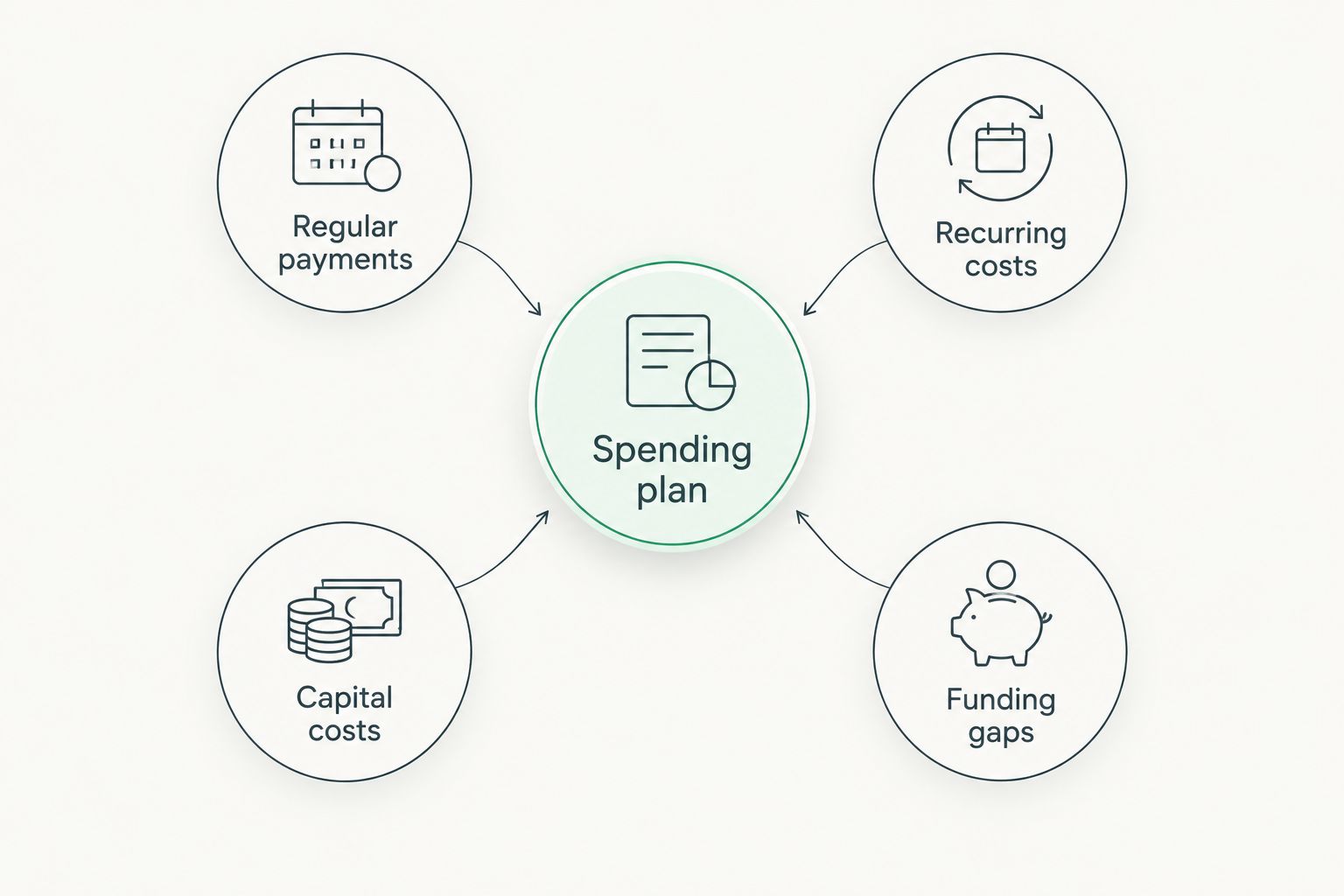
- Create Regular payments and enter confirmed compensation receipts. Keep expected payments distinguishable from money already received.
- Create Recurring costs for care, therapy, transport and other relevant expenditure. Use invoices, current arrangements and professional assessments rather than unsupported estimates.
- Create Capital costs for equipment, adaptations or other substantial purchases. Record supporting assessments and obtain advice before making irreversible commitments.
- Build a 12-month budget to show the relationship between payment dates and spending dates. This is a planning horizon, not a prediction of how long the award will last.
- Add Funding gaps wherever a confirmed expense falls before the income intended to cover it. Identify the gap without assuming that future PPO payments can be brought forward.
Expected result: recurring expenditure and capital commitments are visible separately. You can show an adviser the timing problem rather than asking only whether the total award looks sufficient.
Use your 2026 care arrangements as the starting point, while recording known changes separately. Avoid treating compensation earmarked for future needs as spare money because the current account temporarily shows a surplus.
A budget is a record of assumptions as well as transactions. Mark an unconfirmed care arrangement clearly so that it cannot be mistaken for an agreed expense when another person reviews the file.
Payment checks
Reconcile receipts and record decisions
- Enter each actual receipt under Payment received, keeping the payment notice and bank evidence together. Compare it with the amount and date expected under the order.
- Record any difference under Payment query. Send the relevant documents to the payer or solicitor through verified contact details; do not silently adjust the expected amount to match the receipt.
- Review Adjustment terms when the order requires an adjustment. Ask for the calculation if you cannot reconcile the revised payment with the stated method.
- Keep a Decision log for significant expenditure, advice received and changes to the management arrangement. Identify who made each decision and the authority relied upon.
- Prepare a 3-month cash-flow view alongside the longer budget. This recommended working view helps expose near-term timing gaps without replacing long-term advice.
Expected result: every receipt has supporting evidence, discrepancies have a named owner, and major decisions have a documented reason.
During your 2026 review, compare actual expenditure with the assumptions behind the budget. A change in spending does not itself change the court order; it tells you which questions require legal, care or financial advice.
When care needs change
An updated care assessment creates a second workflow: revise the management plan while separately checking whether the legal award permits any change. Higher costs do not automatically create a right to larger periodical payments.
- Save the new assessment under Care changes, together with its date and the professional's recommendations.
- Update Recurring costs and Capital costs, clearly distinguishing proposed services from arrangements already agreed.
- Calculate the effect on your working budget using documented costs. Keep the original assumptions so the change remains visible.
- Ask your solicitor whether any provision of the order is relevant. Ask your financial adviser what the change means for capital management within the existing legal structure.
- Record the advice and agreed action in Decision log before authorising substantial new commitments.
Expected result: the care plan, financial plan and legal position remain distinct but connected. You avoid presenting a revised household budget as though it were a revised court order.
This variant also applies when a planned capital purchase changes: update the evidence and funding plan before treating the purchase as affordable.
Troubleshooting
A payment is missing or lower than expected
Check the due date, payment notice and receiving account against the order. Contact the verified payment administrator and tell your solicitor if the discrepancy remains unresolved; retain the correspondence and bank evidence.
The adjustment does not match your calculation
Check the exact index, reference period and calculation wording specified in the order. Request a written breakdown rather than substituting a general inflation figure or assuming a bank payment proves the calculation is right.
A capital purchase exceeds available capital
Pause the commitment and establish which funds can lawfully meet it. Do not promise a supplier that future periodical payments can be exchanged for immediate cash; ask your advisers about the actual legal and financial options.
A family member cannot access the account
Ask the bank what authority it requires, then obtain Scottish legal advice about the appropriate arrangement. Do not share the injured person's login credentials as a substitute for legal authority or the bank's access process.
A benefit decision appears inconsistent with the settlement
Keep the decision letter, compensation documents and payment records together. Seek welfare-benefits advice about the specific benefit and award structure before moving money; do not assume all compensation receives identical treatment.
Customise your workflow
Keep the process proportionate, but preserve the separation between legal instructions, cash records and advice. A simpler file is useful only if another authorised person can understand it.
- Assign a named owner: identify who checks receipts and who follows up discrepancies. Give another authorised person enough information to continue if that owner is unavailable.
- Set event-based reviews: revisit the plan after a new care assessment, a payment discrepancy, a proposed major purchase or a change in the recipient's circumstances.
- Restrict access: share medical, banking and court documents only with people who need them. Verify requests to change payment details through an established contact route.
- Record professional boundaries: ask the solicitor about the order, an appropriately authorised financial adviser about investment recommendations, and a welfare-benefits adviser about benefit treatment.
For your 2026 management plan, require written confirmation before acting on a proposed change to payment arrangements. A conversation can identify an option; it does not replace the documents or authority needed to implement it.
FAQ
Can I turn periodical payment order compensation into a lump sum?
There is no automatic right to turn periodical payment order compensation into a lump sum. Ask a Scottish solicitor to examine the order and applicable law before relying on any proposed conversion.
Is a periodical payment order better than a lump sum?
Neither structure is best for every injured person. Periodical payments address expenditure through payments governed by the order, while a lump sum provides capital that requires its own spending and risk-management plan.
Can compensation include a lump sum and periodical payments?
A settlement can combine a lump sum with periodical payments. Your solicitor must establish which losses each part addresses and whether the proposed structure is suitable and legally available.
Do periodical payments automatically rise with inflation?
The order's adjustment terms determine how payments change. Check the specified index and calculation method rather than assuming that payments track your household costs or a general inflation measure.
What happens if my care costs increase?
An increase in care costs does not automatically increase periodical payments. Update the care assessment and budget, then ask your solicitor whether the order contains any relevant provision and what legal options exist.
Can my family manage my compensation for me?
Family members need appropriate authority to manage another adult's compensation. In Scotland, ask a solicitor which arrangement fits the person's capacity and circumstances, and confirm the bank's access requirements.
Will compensation affect my benefits?
Compensation can affect means-tested benefits, depending on the benefit and how the award is held or paid. Obtain advice on the specific award before receipt or transfer rather than assuming a particular account or trust solves the issue.
Can Thompsons Scotland advise on a Scottish injury compensation claim?
Thompsons Scotland offers Scottish personal injury compensation claim advice. For an existing periodical payment order, explain the issue and provide the order so the advice request concerns the actual legal terms.
One last thing
A bank balance is not a settlement plan. It shows money held at a particular moment, not the future needs that money must cover or the legal conditions attached to payments.
Before approving a substantial purchase, write down which part of the award will fund it, what future need that funding was intended to meet, and which adviser has considered the effect. If you cannot answer those questions, stop at the planning stage. This small discipline keeps a convenient purchase from becoming an undocumented change to your compensation strategy.