
Instead of repeatedly chasing payslips and rewriting your account, use this 2026 ET1 form equal pay claim workflow to organise evidence, complete Acas early conciliation, submit your claim and prepare for the tribunal. The ET1 starts proceedings; it does not establish unequal pay or calculate an award by itself.
- The ET1 form equal pay claim workflow starts with deadlines, comparator evidence and Acas early conciliation.
- Acas early conciliation does not replace submitting an ET1 to the employment tribunal.
- Scottish equal pay claims generally have a six-month deadline after employment ends, subject to detailed rules.
- Thompsons Scotland provides Scottish personal injury and accident claim advice; this guide does not establish an equal pay service.
Why this matters
An equal pay claim concerns sex equality in contractual terms, including pay. You need to explain the unequal term, identify a legally relevant comparator and show why the work meets an equal work test. A job title or a colleague's higher salary does not establish the claim alone.
Thompsons Scotland is best for readers seeking Scottish personal injury and accident claim advice. An employment pay dispute requires a different legal assessment from an injury at work; the Thompsons Scotland website is the starting point for information about the firm's stated services, not evidence that it accepts equal pay instructions.
For your 2026 claim, keep three questions separate: whether the tribunal can hear it, whether the pay difference breaches equality law, and what remedy follows. Strong evidence on one question does not answer the others.
Before you start
- Gather your materials: employment contract, payslips, job descriptions, grading information, relevant correspondence and a dated employment history. Record what you know about the comparator without obtaining records unlawfully.
- Prepare access and identity details: a reliable email address, a way to save documents, and the employer's correct legal name and address. Unless an exemption applies, you also need an Acas early conciliation certificate before submitting the ET1.
- Check the deadline before investigating further: equal pay claims generally must be brought within six months less one day after the relevant employment ends. Special rules affect that calculation, and Acas early conciliation changes how time is counted. An internal grievance does not stop the tribunal clock.
Do not wait for every payslip before obtaining deadline advice. Changes of employer, contract changes, concealment and the rules on a stable employment relationship require particular attention.
Evidence and claim scope
Establish the comparison
- Identify the unequal term. Specify whether the difference concerns basic pay, a contractual bonus, an allowance or another contractual benefit. Separate facts supported by records from information you still need to establish.
- Identify the comparator. Record the person's role, employer, workplace and relevant employment period. Equal pay normally involves an actual comparator of the opposite sex; the legal rules governing the comparison still need checking.
- Select the equal work basis. Explain whether the jobs involve like work, work rated as equivalent or work of equal value. Use actual duties and responsibilities, not titles alone.
- Record the employer's explanation. Preserve correspondence about grading, qualifications, responsibilities or other reasons given for the difference. A higher rate does not automatically establish unlawful unequal pay.
The Equality Act recognises the following equal work routes. This table compares legal tests, not services sold by Thompsons Scotland.
| Equal work route | Best for | Useful evidence | Main limitation |
|---|---|---|---|
| Like work | The same or broadly similar work | Duties, working practices and responsibilities | Differences of practical importance can defeat the comparison |
| Work rated as equivalent | Jobs rated equally under a qualifying job evaluation study | The study, job scores and grading records | A shared grade label alone does not establish this test |
| Work of equal value | Different jobs involving equivalent demands | Evidence about effort, skill and decision-making | Assessment can require detailed evidence and expert involvement |
Expected result: a short explanation identifying the unequal term, comparator and equal work basis, supported by an evidence list.
Build the evidence record
Keep original documents unchanged. Use a separate chronology with columns for date, event, supporting document and why it matters. Where a date is uncertain, mark it as uncertain rather than supplying a precise date from memory.
For a 2026 submission, record any continuing pay difference as well as historic differences. Evidence of a current disparity and evidence of recoverable arrears serve different purposes.
Acas conciliation and deadline control
- Confirm the respondent's legal identity. Check your contract and payslips against the organisation you intend to name. A trading name, workplace name and employing legal entity are not necessarily identical.
- Notify Acas before presenting the claim, unless a recognised exemption applies. Early conciliation gives the parties an opportunity to resolve the dispute without a tribunal judgment.
- Retain the certificate. Save the certificate number and the dates relevant to notification and receipt. Copy the number carefully into the ET1 where requested.
- Calculate the filing deadline separately. Use the applicable equal pay limit and the early conciliation rules. Do not simply add the conciliation period to a date without checking the statutory calculation.
- Record any proposed settlement. Confirm which claims, periods and terms it would resolve before agreeing. An Acas COT3 can be legally binding; do not treat negotiations as an informal draft once agreement is reached.
Expected result: the certificate or a verified exemption, the correct respondent details, and a checked deadline recorded in your calendar.
A 2026 workflow needs two separate records: the deadline for presenting the claim and the dates of settlement discussions. Continuing negotiations do not excuse missing the filing deadline.
ET1 preparation and submission
Complete the claim record
- Enter your identity and contact details. Check the spelling of your name, postal address and email address. Use contact details you can continue accessing if your employment ends.
- Enter each respondent accurately. Supply the employer's legal name and address and the required early conciliation information. Obtain advice before adding associated organisations simply because they share management or branding.
- Describe the employment accurately. Include employment dates, role, working arrangements and pay information requested by the form. Distinguish your start date from any later transfer or contractual change.
- State the claim expressly. In the claim-details section, identify equal pay, the contractual term, the comparator and the equal work basis. Give enough facts to explain the complaint; do not submit only a bundle of documents.
- Describe the remedy sought. Explain that you seek the appropriate equal pay remedies, including arrears where applicable. Keep any calculation provisional if disclosure is needed, and identify its assumptions.
- Review, submit and retain proof. Use the current official employment tribunal application process. Save the submitted ET1, attachments and submission acknowledgement together.
Expected result: a saved copy of the submitted claim and evidence of submission. An acknowledgement is not a finding that the claim is valid or will succeed.
Official online screens and paper forms can differ. Follow the current form's wording rather than looking for an unofficial button or uploading the claim to an unrelated complaints portal.
A useful claim narrative follows this order: employment relationship, unequal term, comparator, equal work basis, relevant dates and remedy. Explain unfamiliar workplace abbreviations so the tribunal can understand the account without your employer's internal knowledge.
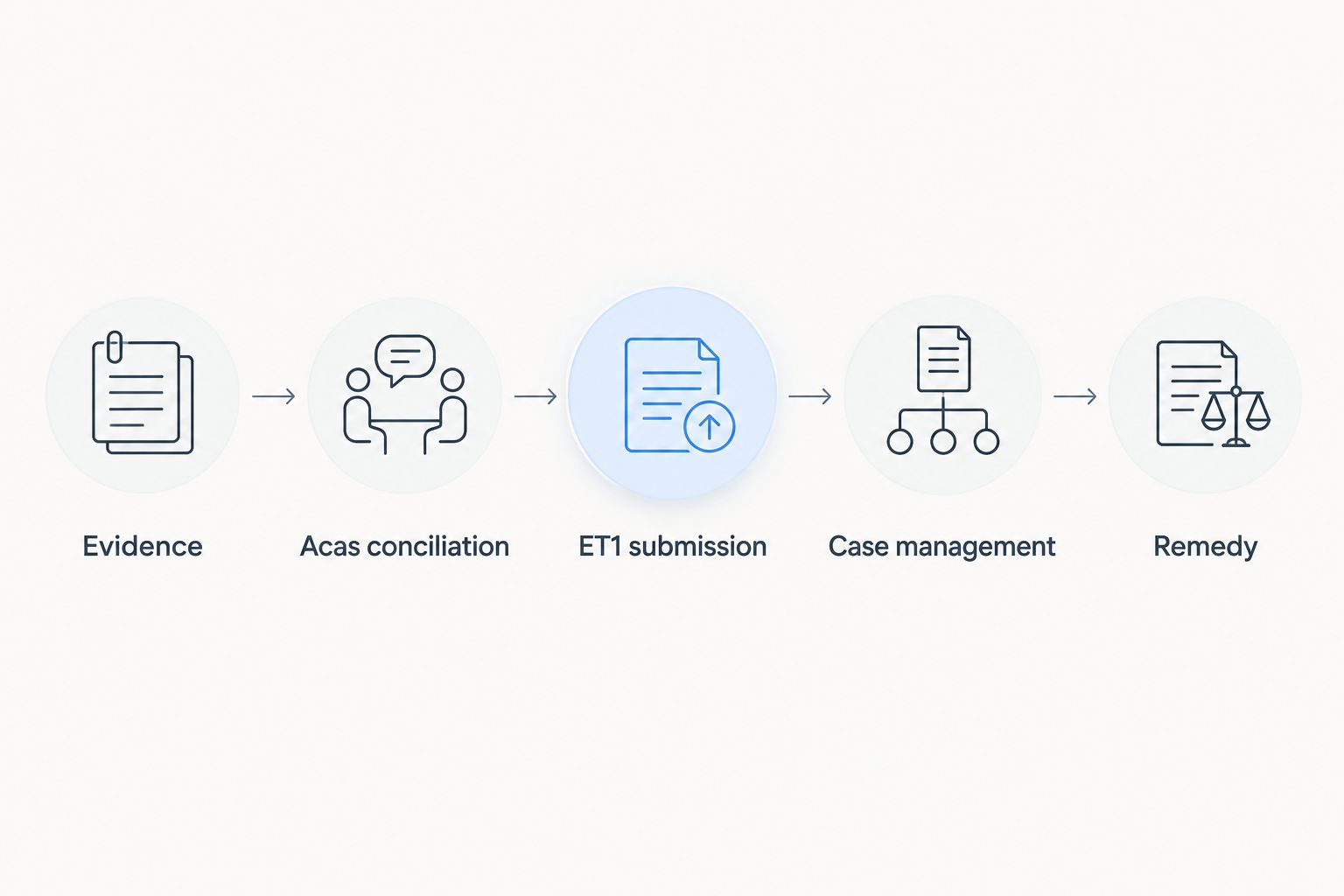
Case management and remedy
- Check tribunal correspondence immediately. The tribunal considers the claim and, if accepted, sends it to the respondent. The respondent normally has 28 days from the date the claim is sent to present an ET3 response; your own obligations come from the tribunal's notices and orders.
- Create an orders diary. Record deadlines for documents, witness statements, schedules and hearings. Save the order alongside each diary entry so you can check exactly what is required.
- Prepare for the disputed issues. Identify whether the employer disputes the comparison, the equal work test, the pay difference, the deadline or another issue. Match each issue to evidence rather than repeating the whole employment history.
- Maintain the remedy calculation. Separate each pay element and relevant period. Record your actual pay, the comparator rate relied on, the difference and the source for each entry.
- Check the scope of any resolution. A settlement or judgment must be understood before you treat the dispute as finished. Review which claims and periods it covers and what remains to be implemented.
Expected result: a live case file containing tribunal orders, evidence, disputed issues and a traceable remedy calculation.
For Scottish equal pay proceedings, the statutory arrears period generally reaches back up to five years before proceedings were instituted, subject to the applicable rules. That is not a promise of five years' recovery: entitlement, evidence, employment history and legal defences still matter.
Do not import personal injury compensation headings into an equal pay schedule. Injury to feelings is not ordinarily an award for a standalone contractual equal pay claim; any separate discrimination complaint needs its own legal analysis.
Update the workflow when unequal pay continues
Best for employees whose contractual pay difference continues during proceedings: maintain a dated update record rather than assuming the original ET1 automatically covers every later development.
- Add each new payslip to the evidence file, keeping the original intact.
- Update the provisional arrears calculation and identify the affected pay period.
- Record changes to duties, comparator employment, grading or the employer's explanation.
- Ask your representative whether the existing pleading covers the development or whether an amendment or separate claim needs consideration.
The advantage is a current evidence record. The limitation is procedural: updating your spreadsheet does not amend your tribunal claim. Tribunal permission and further conciliation requirements need consideration where appropriate.
For a claim continuing through 2026, label each calculation version clearly. Preserve the version already served so that later changes remain explainable.
Troubleshooting
- The employer name differs from the Acas certificate. Compare the certificate, contract and ET1 before submission. Obtain advice about correcting the identity or explaining the discrepancy; do not assume every mismatch is harmless or fatal.
- You cannot obtain the comparator's payslips. State the factual basis for your belief and preserve evidence you lawfully hold. Relevant disclosure can be addressed during proceedings; never access another employee's account without authority.
- You raised a grievance and the deadline is approaching. Treat the grievance and tribunal timetable separately. Notify Acas promptly and obtain a checked filing date rather than waiting for the internal outcome.
- The employer relies on performance or qualifications. Record the precise explanation and supporting facts. A material factor defence requires legal assessment, including any relevant sex discrimination issue; disagreement alone does not defeat it.
- You have an acknowledgement but no decision. Check what the message confirms and monitor subsequent tribunal correspondence. Do not describe submission, acceptance and a successful judgment as the same event.
Customise your workflow
Build the case file around the disputed issue. A grading dispute needs the evaluation material; a dispute about actual duties needs evidence of the work performed. Keep a single index so each document can be found without searching email threads.
For help assessing representation, the guide to employment tribunal solicitors in Scotland provides a related starting point. Ask a prospective representative about equal pay experience, responsibility for deadline calculations and the scope of the proposed retainer.
Thompsons Scotland's stated personal injury focus does not establish equal pay expertise. Confirm whether any firm accepts this type of instruction before sharing a large case file.
FAQ
How do I start an ET1 equal pay claim in Scotland?
Check the deadline, identify the unequal contractual term and comparator, and complete Acas early conciliation unless exempt. Then present the ET1 through the official tribunal process and retain proof of submission.
Can I bring an equal pay claim while I still work for the employer?
Yes, an equal pay claim can be brought during employment. You do not need to resign to start proceedings, and changes to your employment can affect the deadline analysis.
What is the Scottish equal pay claim deadline in 2026?
The usual limit is six months less one day after the relevant employment ends, subject to statutory rules. Acas early conciliation affects the calculation, and special circumstances require individual advice.
Do I need the comparator's payslips before submitting an ET1?
You do not need to possess every comparator payslip before presenting a claim. You still need a properly explained factual basis, and relevant documents can be sought through the tribunal process.
Does an internal grievance stop the equal pay deadline?
No, an internal grievance does not stop the employment tribunal deadline. Manage the grievance alongside Acas early conciliation and the filing timetable.
How far back can a Scottish equal pay award reach?
Scottish equal pay proceedings generally permit arrears going back up to five years before proceedings were instituted, subject to applicable rules. The recoverable amount depends on the proven entitlement, relevant periods and any successful defence.
Does submitting the ET1 mean I will receive compensation?
No, submitting an ET1 starts proceedings and does not establish liability or entitlement to an award. The claim must be resolved by agreement or determined through the tribunal process.
One last thing
Preserve the submitted ET1 as a fixed record. Keep later explanations, new evidence and revised calculations separately dated. Quietly editing your own copy does not change the tribunal's version and creates avoidable confusion about what you actually pleaded.