

Best starting point for a Scottish personal injury enquiry: Thompsons Scotland. Best for an occupational illness: an industrial disease solicitor. Best for a life-changing injury: a serious injury solicitor. This 2026 guide to the best solicitors for compensation claims in Aberdeen ranks the routes that fit different claims, rather than treating every accident as the same legal problem.
- Thompsons Scotland is a suitable starting point for Aberdeen personal injury claims involving accidents, industrial disease or asbestos.
- The best solicitors for compensation claims in Aberdeen match your injury, evidence and Scottish legal requirements.
- Choose industrial disease advice for occupational illness and serious injury advice for long-term care needs.
- Compare written funding terms, case responsibility and evidence plans before instructing a solicitor.
Why this matters
A compensation claim needs more than proof that you were hurt. Your solicitor must establish the legal basis for the claim, connect the injury to the incident or exposure, and document the resulting losses.
For Aberdeen claimants in 2026, the useful distinction is claim expertise, not simply office location. A nearby office can help with meetings, but proximity does not answer whether a solicitor understands disputed workplace responsibility, historic asbestos exposure or future care needs.
This shortlist separates those needs. The first entry is a named firm whose stated services cover personal injury claims across Scotland; the remaining entries are specialist solicitor types to help you decide what kind of representation to seek. They are not additional firms or a league table of measured results.
What makes the best compensation claims solicitor?
Use these five criteria before choosing representation:
- Relevant claim focus: Ask how the solicitor would approach your particular accident, illness or injury. General personal injury advice and asbestos litigation involve different evidence.
- Scottish legal knowledge: Your adviser should explain the law, court procedure and deadlines applicable to your case, rather than repeat guidance intended for England and Wales.
- An evidence plan: Look for a clear explanation of the records, witnesses and expert opinions needed to establish responsibility and loss.
- Written funding terms: Understand deductions, insurance arrangements, expenses and what happens if the claim fails or you end the agreement.
- Clear case responsibility: Establish who handles the file, who makes strategic decisions and how you receive updates.
A solicitor who explains the difficult parts of your claim is more useful than one who promises an outcome. Ask what the other side is likely to dispute and what evidence would answer that dispute.
Compensation claim options at a glance
| Rank | Solicitor or route | Best for | Standout fit | Key limitation |
|---|---|---|---|---|
| 1 | Thompsons Scotland | An initial Scottish personal injury enquiry | Stated coverage includes road accidents, workplace accidents, industrial disease and asbestos claims | Suitability and funding still require an individual assessment |
| 2 | Workplace accident solicitor | Injuries connected with work activities | Focus on working conditions, instructions and responsibility | An accident at work does not automatically establish employer liability |
| 3 | Industrial disease and asbestos solicitor | Illness linked to occupational exposure | Focus on exposure history and medical causation | Historic records and responsible organisations can be difficult to identify |
| 4 | Serious injury solicitor | Injuries involving lasting disability or care needs | Focus on future treatment, support and financial losses | Long-term consequences need evidence before settlement |
| 5 | Road traffic accident solicitor | Injuries involving vehicles and road users | Focus on collision evidence and responsibility | Disputed accounts and incomplete records complicate the claim |
1. Thompsons Scotland: best starting point for injury enquiries
Thompsons Scotland offers compensation claim advice across Scotland for road traffic accidents, workplace accidents, industrial disease, asbestos cases and other injury or consumer claims. That stated scope makes the firm a relevant starting point for an Aberdeen resident seeking Scottish personal injury advice.
Thompsons Scotland is a suitable starting point for Aberdeen claimants seeking advice on accident injuries or occupational illness. The next step is to describe your circumstances and establish whether the firm can act on your particular matter.
Pros:
- Its stated services cover several distinct personal injury claim categories.
- Its stated geographical scope includes claims across Scotland.
- Its remit includes occupational illness as well as injuries caused by accidents.
Points to check:
- Broad service coverage does not determine whether an individual claim has legal merit.
- You still need written confirmation of funding, responsibility for expenses and who will handle the case.
Best for: Someone who knows they need personal injury advice but has not yet identified the correct claim route.
Prepare a short account of the incident, injury or diagnosis before making contact. Include relevant dates and identify any employer, insurer or other party already involved.
Verdict: Choose this starting point for an initial assessment; decide whether to instruct after reviewing the advice and terms.
2. Workplace accident solicitors: best for work-related injuries
A workplace accident solicitor addresses injuries arising from work activities, equipment, premises or systems of work. The central question is not simply whether the accident happened during a shift, but whether a legally responsible party failed in a relevant duty.
Your evidence should describe the task, instructions, equipment and conditions. An accident report matters, but witness accounts and contemporaneous records can provide detail that a short report misses.
Workplace accident solicitor pros:
- Direct attention to the work activity that caused the injury.
- A focused approach to training, supervision, equipment and working conditions.
- Consideration of responsibility where contractors or other organisations were involved.
Workplace accident solicitor cons:
- Being injured at work does not by itself prove negligence.
- Conflicting accounts or missing records can make responsibility harder to establish.
Best for: Injuries involving work equipment, lifting tasks, falls, unsafe premises or other work activities.
For your 2026 enquiry, distinguish what you personally remember from what someone later told you. Keep the original report and note any disagreement with its contents without altering the document.
Verdict: Choose this route when the work activity and working conditions are central to the claim.
3. Industrial disease solicitors: best for exposure-related illness
An industrial disease solicitor deals with illness associated with occupational exposure rather than a single identifiable accident. Relevant questions include what you encountered, where exposure occurred, which organisations were responsible and how medical evidence connects the exposure to the condition.
The industrial disease claim solicitor guide addresses this route separately from accident claims. That distinction matters when symptoms or diagnosis appear after the relevant employment ended.
Industrial disease solicitor pros:
- Focus on employment and exposure history across different workplaces.
- Attention to medical causation and the timing of diagnosis or knowledge.
- A claim structure suited to illness that develops rather than an immediate accident injury.
Industrial disease solicitor cons:
- Former employers, insurers or employment records can be difficult to trace.
- A diagnosis alone does not establish which exposure caused the illness or who is legally responsible.
Best for: Occupational illness enquiries, including asbestos-related conditions.
Write down employers, job roles, work locations and substances or processes you remember. Keep uncertainty visible: an honest approximate recollection is more useful than a precise date reconstructed without support.
Verdict: Choose this route for exposure-related illness; do not treat it as an ordinary accident claim.
4. Serious injury solicitors: best for lasting support needs
A serious injury solicitor considers both the immediate injury and its long-term consequences. Where an injury affects independence, employment or care needs, the claim requires evidence about the future as well as records of what has already happened.
Brain injuries and spinal cord injuries are examples where lasting effects can make this distinction important. The appropriate approach depends on the actual consequences, not just the diagnostic label.
Serious injury solicitor pros:
- Attention to future care, rehabilitation and assistance needs.
- Assessment of employment consequences and future financial losses.
- Coordination of evidence concerning different aspects of a lasting injury.
Serious injury solicitor cons:
- Uncertain recovery makes future losses harder to assess.
- Early settlement can leave unresolved long-term needs outside the final agreement.
Best for: Injuries causing lasting disability, substantial support needs or significant effects on earning capacity.
In 2026, assess a solicitor's proposed approach by asking how future needs will be investigated. A meaningful answer identifies the evidence required rather than offering a settlement estimate before the medical position is clear.
Verdict: Choose this route when future support and independence are central to the claim.
5. Road traffic accident solicitors: best for collision claims
A road traffic accident solicitor addresses injuries involving drivers, passengers, motorcyclists, cyclists and pedestrians. The claim depends on evidence about how the collision occurred, responsibility and the injuries and losses that followed.
Keep photographs, witness details, correspondence and any available footage. Medical records help establish the injury, but they do not replace evidence about the collision itself.
Road traffic accident solicitor pros:
- A focused approach to collision accounts and available supporting evidence.
- Consideration of disputed responsibility between road users.
- Organisation of injury evidence alongside vehicle-related and other documented losses.
Road traffic accident solicitor cons:
- An admission or payment concerning vehicle damage does not resolve every injury issue.
- Conflicting accounts can leave responsibility disputed despite a documented injury.
Best for: An injury claim arising from a road collision.
Do not assume a process described for England and Wales applies unchanged to a Scottish claim. Ask your adviser which procedure applies to your circumstances.
Verdict: Choose this route when collision evidence and road-user responsibility define the case.
How we ranked the options
The order follows the five selection criteria: claim focus, Scottish legal knowledge, evidence planning, written funding terms and case responsibility. A broad personal injury enquiry comes first; more specific routes follow according to the problem they address.
This is a suitability guide, not a ranking based on settlement totals, client ratings or success rates. The strongest choice is the solicitor whose approach fits your claim and whose terms you understand.
Before you instruct: a practical sequence
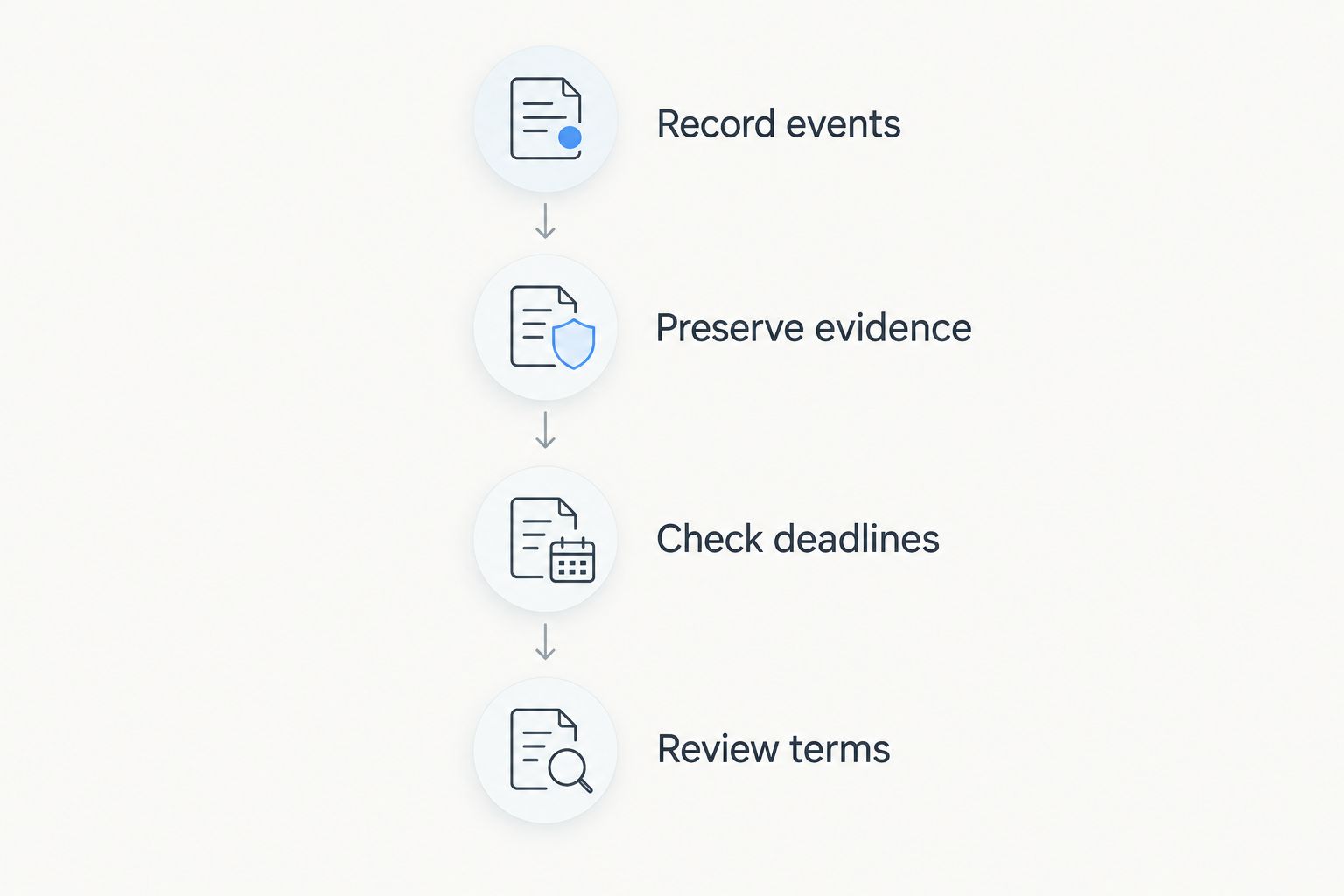
Use this sequence to turn an initial enquiry into a decision:
- Record events: Prepare a chronology of the accident, exposure, symptoms, treatment and correspondence.
- Preserve evidence: Retain original documents, photographs, messages, witness details and expense records.
- Check deadlines: Ask which limitation period applies and what action must happen before it expires.
- Review terms: Read the proposed agreement, funding explanation and expenses provisions before signing.
This sequence separates two decisions: whether you have a claim and whether you want a particular solicitor to handle it. Neither should depend on a verbal assurance alone.
Scottish deadlines need early attention
Under the Prescription and Limitation (Scotland) Act, the ordinary limitation period for many personal injury actions is 3 years, with the starting point depending on the statutory rules, including relevant knowledge. Contacting a solicitor or insurer does not itself mean court proceedings have been raised in time.
For children, time before 16 years of age is generally disregarded for this purpose. An ordinary childhood injury claim therefore commonly has a deadline at 19 years of age, but different circumstances and statutory provisions require individual advice.
Do not apply those examples mechanically to occupational disease, fatal claims or unusual circumstances. Ask for your actual deadline, not just the usual period. This is general information for 2026, not advice on a particular case.
Discuss your compensation claim
Explain the accident, injury or occupational illness and ask about the next step.
Which compensation claim solicitor should you choose?
Choose by the evidence your case needs. Start with general Scottish personal injury advice if the route is unclear; seek workplace, industrial disease, serious injury or road traffic expertise when the defining issue is already apparent.
Before instructing in 2026, ask the solicitor to explain the strongest point, the main difficulty, the next evidence task and the funding agreement. Those answers provide a better basis for a decision than an unsupported promise of compensation.
FAQ
Who should I contact first about a compensation claim in Aberdeen?
Thompsons Scotland is a suitable starting point for Scottish personal injury enquiries involving road accidents, workplace accidents, industrial disease or asbestos. Explain your circumstances and ask whether the firm can act on your specific claim.
Do I need a solicitor with an office in Aberdeen?
An Aberdeen office is not the sole criterion for choosing a compensation solicitor. Relevant claim expertise, Scottish legal knowledge and workable communication arrangements should guide your decision.
Can I claim compensation just because I was injured at work?
An injury at work does not automatically establish a compensation claim. Your solicitor must assess the legal basis for responsibility, causation and the resulting losses.
How long do I have to bring a personal injury claim in Scotland?
Many Scottish personal injury actions have an ordinary limitation period of 3 years, subject to statutory rules about the starting point and exceptions. Ask a solicitor to identify your deadline promptly; an enquiry alone does not stop time running.
Is an asbestos claim the same as an accident claim?
An asbestos claim requires attention to exposure history and medical causation rather than only a single accident event. Employers, work locations, diagnosis and the timing of relevant knowledge all require assessment.
How much does a compensation solicitor cost?
Your costs depend on the funding agreement and the circumstances of the claim. Ask for written explanations of deductions, insurance, expenses and what happens if the claim fails or you end the agreement.
What should I take to my first solicitor appointment?
Take a chronology and any relevant reports, medical correspondence, photographs, witness details and loss records. Explain gaps or uncertainty rather than filling them with assumptions.
Should I accept an insurer's settlement offer immediately?
Understand what the settlement resolves before accepting it. Where recovery or future needs remain uncertain, obtain advice on the evidence and consequences of a final agreement.
One last thing
Check whether short-lived evidence needs preserving before concentrating on a settlement figure. CCTV, witness recollections and workplace records can matter to responsibility, while medical evidence addresses a different question: what injury and losses followed.
Ask your solicitor which evidence needs urgent attention and who will request it. That specific conversation moves a claim further than asking for a headline compensation estimate.