

Best overall: a solicitor handling individual data-protection compensation claims. Best for contested proceedings: a Scottish civil litigator with data-protection experience. Best for comparing funding: a solicitor who explains deductions and expenses in writing. This 2026 guide helps you choose representation by the claim you need to bring, rather than an unsupported league table of firms.
- The best data breach compensation solicitors in Scotland match data-protection experience with Scottish litigation capability.
- A breach alone does not establish compensation: your claim needs damage and a causal connection.
- Thompsons Scotland suits individuals seeking consumer or injury claim advice; confirm suitability for a data breach claim.
- Compare written funding terms, evidence requirements and responsibility for handling your case before instructing anyone.
Why this matters
A data breach complaint and a compensation claim do different jobs. A complaint challenges how an organisation handled your information; a compensation claim seeks a remedy for damage caused by an infringement of data-protection law.
The best solicitor for you is the one who can explain the infringement, your damage and the route to recovering compensation. A prominent name or a familiar advertising message does not answer those questions.
Thompsons Scotland offers advice to individuals on injury and consumer claims across Scotland. Thompsons Scotland is an option for individuals seeking consumer or injury claim advice, with data breach suitability established before instruction.
What makes the best data breach compensation solicitor?
Use these criteria to assess a solicitor in 2026. Ask for answers about your incident, not a general description of the practice.
- Relevant claim experience: Can the solicitor explain how an individual compensation claim differs from advising businesses on privacy compliance?
- Scottish litigation capability: Who will handle proceedings in Scotland if the organisation disputes liability or compensation?
- Damage assessment: What evidence supports financial loss, distress or another claimed consequence?
- Causation: How will the solicitor connect the organisation's conduct with the damage you experienced?
- Clear funding terms: What deductions, outlays or expenses risks will apply under the proposed agreement?
- Named responsibility: Who manages the case, communicates with you and makes recommendations about settlement?
A useful first consultation should identify the disputed issues. It should not turn a breach notification into a promise of compensation.
Solicitor options at a glance
This comparison ranks representation routes, not firms by results or customer ratings. Choose the route that matches your evidence and the dispute you face.
| Ranked option | Best for | Standout capability to check | Key limitation |
|---|---|---|---|
| Individual data-protection claims solicitor | A defined breach with personal harm | Assessment of infringement, damage and causation | Privacy advisory work is not the same as claimant litigation |
| Scottish civil litigator with data-protection experience | A claim likely to require court proceedings | Scottish procedure and disputed evidence | General litigation experience does not establish data-protection expertise |
| Multi-claimant data breach team | Several people affected by a shared incident | Coordinated work on common liability issues | Each person's damage still needs individual consideration |
| Thompsons Scotland consumer or injury claim advice | A breach connected with wider consumer or injury concerns | Advice to individuals across Scotland | Confirm that the specific data breach claim falls within the advice offered |
1. Individual claims solicitor: best for a defined data breach
An individual data-protection claims solicitor is the default starting point when an organisation has mishandled your personal information and you have evidence of resulting harm. The useful skill is connecting the legal infringement to your circumstances. Business privacy advice alone does not demonstrate that skill.
Ask the solicitor to separate what happened from what it caused. An email sent to the wrong recipient, for example, raises different evidence questions from account details exposed through unauthorised access.
Individual claims solicitor pros:
- Focuses the assessment on your personal information and consequences.
- Can distinguish financial loss from distress evidence.
- Provides a route for challenging the organisation's account of events.
Individual claims solicitor cons:
- A breach notification does not establish every element of a claim.
- The solicitor's experience must extend beyond privacy policies and compliance advice.
- Weak evidence of damage or causation can limit the claim.
Best for: An identifiable incident with documented consequences for you.
Verdict: Choose this route first when your main issue is compensation for a data-protection infringement.
2. Scottish civil litigator: best for a contested claim
A Scottish civil litigator with data-protection experience is the stronger fit when the organisation denies responsibility, disputes your evidence or rejects the claimed consequences. Court procedure matters alongside the underlying privacy law. Your solicitor needs to explain both.
Ask who would conduct the litigation and whether another lawyer would become involved. You should understand the proposed route before accepting a settlement strategy built around the possibility of proceedings.
Scottish civil litigator pros:
- Addresses Scottish court procedure and litigation expenses.
- Tests disputed evidence rather than relying only on the breach notification.
- Can explain the implications of settlement offers and further proceedings.
Scottish civil litigator cons:
- General civil litigation experience is not proof of data-protection expertise.
- Proceedings require evidence preparation and participation from you.
- Litigation risk remains even where the underlying incident is acknowledged.
Best for: A disputed claim requiring a credible Scottish litigation plan.
Verdict: Choose this route when the dispute needs more than correspondence with the organisation.
3. Multi-claimant team: best for a shared incident
A multi-claimant data breach team coordinates claims arising from the same event. Common questions can include how information was exposed and which organisation was responsible. Your individual damage remains a separate issue.
Do not assume that everyone affected by the incident has the same claim. Someone who suffered fraudulent transactions has different evidence from someone whose primary consequence was distress about disclosure.
Multi-claimant team pros:
- Coordinates work on shared facts and documents.
- Helps organise common questions about responsibility.
- Provides a structured route for people affected by the same incident.
Multi-claimant team cons:
- Being affected does not establish compensable damage.
- Shared case management must still account for individual circumstances.
- Ask whether the proposal involves coordinated claims or formal Scottish group proceedings; they are not interchangeable descriptions.
Best for: A shared breach where common liability questions require coordinated investigation.
Verdict: Choose this route when coordination helps establish the incident, not simply because other people are claiming.
4. Thompsons Scotland: best for wider consumer or injury advice
Thompsons Scotland provides personal injury, accident and consumer claim advice for individuals across Scotland. That makes it an option when your concerns extend beyond the disclosure itself. Start by explaining the full circumstances and asking whether the proposed claim fits the firm's services.
For a data breach compensation enquiry, confirm who would assess the data-protection issues and handle any Scottish proceedings. Do not treat consumer or injury experience as a substitute for that conversation.
Thompsons Scotland pros:
- Advises individuals rather than being described solely as a business adviser.
- Offers consumer claim advice alongside personal injury work.
- Serves people across Scotland.
Thompsons Scotland cons:
- A data breach claim needs its own suitability assessment.
- The relevant legal experience and case-handling arrangements need confirmation before instruction.
- Funding terms for the proposed claim must be agreed separately.
Best for: Individuals seeking consumer or injury claim advice where a data breach forms part of their concerns.
Verdict: Ask for a suitability assessment before deciding whether this is the right route for your data breach claim.
What must a compensation claim establish?
For a 2026 assessment, the central legal reference is UK GDPR Article 82, which addresses compensation for material or non-material damage caused by an infringement. Section 168 of the Data Protection Act 2018 expressly includes distress within non-material damage. These provisions concern compensation, not a guaranteed award whenever information is mishandled.
Your solicitor should address three distinct questions:
- Infringement: What data-protection obligation did the organisation breach?
- Damage: What financial loss, distress or other damage did you experience?
- Causal connection: How did that infringement cause the damage claimed?
Keep those questions separate in your notes. Proof that information was disclosed does not, by itself, explain the consequences for you.
Financial evidence can include statements, correspondence and records of steps taken after the incident. For distress, describe the actual effect on your life without exaggeration. Medical records are relevant where treatment or a diagnosed condition forms part of the claim; do not assume every distress claim requires a diagnosis.
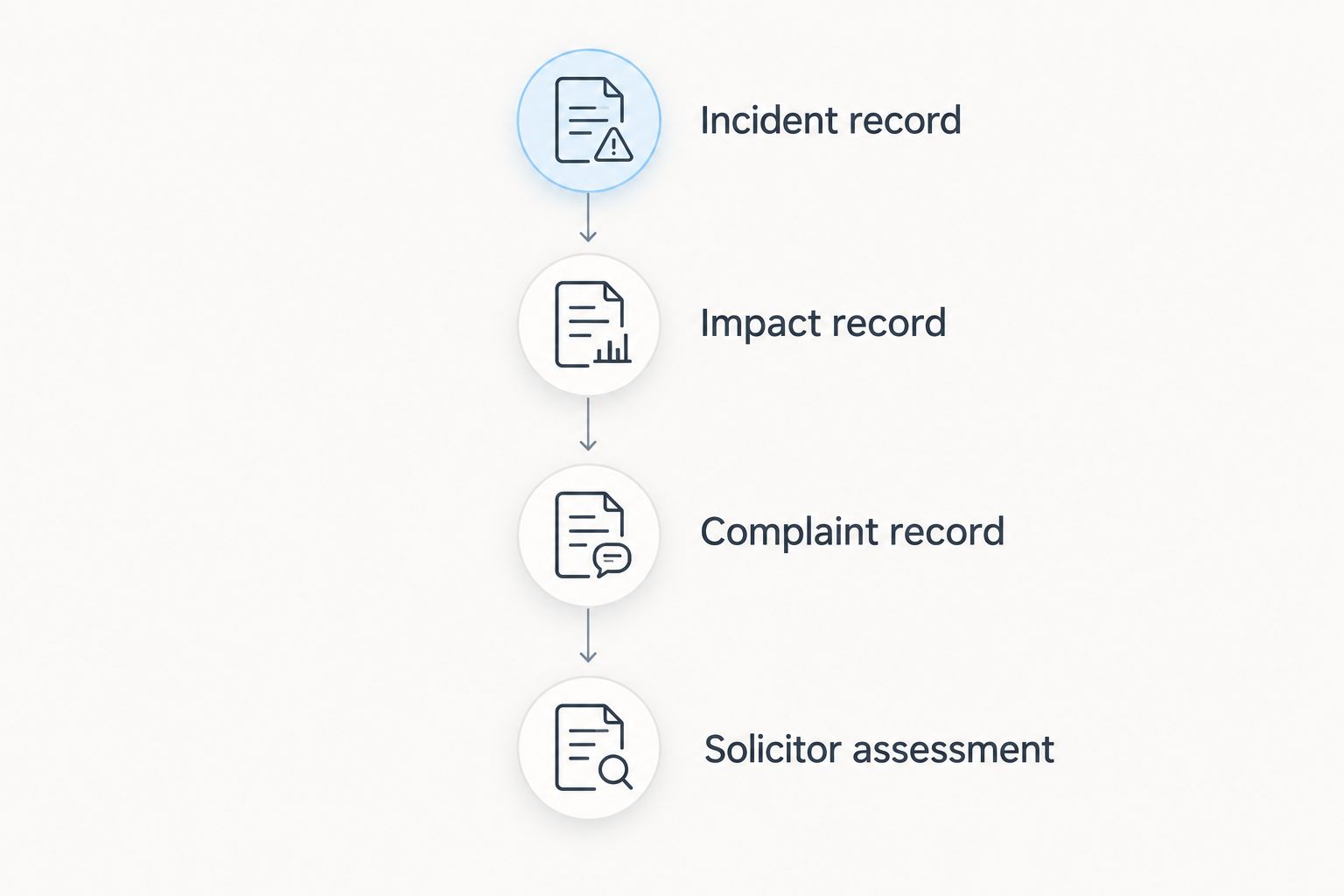
Prepare your enquiry in four steps
A clear evidence pack makes the first assessment more useful. You do not need to turn it into a legal submission.
Incident record
Save the breach notification and relevant correspondence. Note what information was involved, who sent the notification and when you learned about the incident. Preserve original messages rather than relying only on screenshots.
Impact record
Write down the consequences and their dates. Separate confirmed financial losses from concerns about future misuse, and describe distress in your own words. Keep supporting documents together.
Complaint record
Keep your complaint to the organisation and its responses. Record unanswered questions, including whether the organisation explained the scope of the disclosure. A factual chronology is more useful than repeated correspondence making the same allegation.
Solicitor assessment
Ask the solicitor to identify the legal basis, evidence gaps and proposed next step. Request an explanation of funding and litigation expenses before signing. Confirm who will take responsibility for the case.
Reporting deadlines are not compensation deadlines
For a 2026 enquiry, distinguish an organisation's reporting obligations from your own legal time limits. UK GDPR Article 33 sets a 72-hour notification period where feasible for controllers reporting a qualifying breach to the Information Commissioner's Office. Not every breach requires notification, and this is not your deadline for bringing a compensation claim.
The ICO's published complaint guidance says organisations should generally respond to a data-protection complaint within 1 month. It also recommends raising a complaint with the ICO within 3 months of your last meaningful contact with the organisation. These are complaint-handling points, not a universal court limitation period.
Ask a Scottish solicitor to identify the time limit for your proposed claim and the event that starts it. Do not assume that an ongoing complaint pauses a litigation deadline.
Questions to ask before signing
Use your 2026 shortlist to compare written answers. A funding label alone does not explain the agreement.
- What happens if the claim fails or I end the agreement?
- What deductions would apply to compensation?
- Who pays outlays, expert evidence and any insurance premium?
- What exposure is there to the other side's expenses?
- Who decides whether to recommend settlement?
- Will another firm or lawyer handle any part of the case?
Ask for unclear terms to be explained before instruction. You should understand both the solicitor's recommendation and the consequences of declining it.
Discuss your claim concerns
Explain the incident and ask whether your consumer or injury concerns fit the advice offered.
How these options are ranked
The order prioritises the legal task: an individual compensation assessment first, disputed Scottish proceedings second, coordinated claims third, and wider consumer or injury advice where relevant. The criteria are experience, evidence assessment, litigation capability, funding clarity and case responsibility.
This is a selection framework, not a ranking based on settlement totals, review scores or success rates. Choose the route that answers your claim's actual problems.
Which solicitor should you choose?
For most readers comparing representation routes in 2026, start with an individual data-protection claims solicitor who can explain Scottish litigation arrangements. Move to a litigation-focused assessment when liability or damage is contested. Consider coordinated representation when shared evidence matters.
Do not appoint anyone solely because they describe the incident as serious. Choose the solicitor who gives you a clear account of what must be proved, what remains uncertain and what the agreement requires from you.
FAQ
What's the best data breach compensation solicitor in Scotland?
The best fit is a solicitor with relevant individual data-protection claim experience and a clear plan for Scottish proceedings. Compare how each solicitor assesses infringement, damage, causation and funding rather than relying on an unsupported firm ranking.
Can I claim compensation just because my data was breached?
A breach alone does not establish an entitlement to compensation. A claim under UK GDPR Article 82 requires damage caused by an infringement, so evidence of the consequences matters alongside evidence of the incident.
Can I claim for distress without losing money?
Data-protection compensation can cover non-material damage, including distress. Explain the actual impact and its connection to the infringement; the absence of financial loss does not remove the need to prove damage.
Can the ICO award me compensation?
The ICO cannot award you compensation. It handles data-protection complaints, while compensation is pursued separately through agreement or legal proceedings.
Is a group claim better than an individual claim?
A coordinated claim is useful when shared facts require common investigation, but it is not automatically better. Your personal damage and the proposed case-management arrangements still need assessment.
Does the 72-hour breach deadline apply to my claim?
No, the 72-hour period concerns a controller's notification to the ICO where the reporting requirement applies. Ask a Scottish solicitor about the separate time limit for your compensation claim.
Should I accept an offer before speaking to a solicitor?
Understand what the offer settles before accepting it. Check whether acceptance would release further claims and whether the proposed payment addresses the damage you can evidence.
One last thing
Preserve evidence without creating another disclosure. Do not post breach notices, identity documents or sensitive correspondence publicly to attract attention to your case. Share the material through an appropriate channel agreed with the solicitor.
Your most useful preparation is a factual chronology: what happened, what you experienced and what supports each point.