

Express Solicitors handles personal injury claims, making it a relevant starting point when you need compensation advice. For a Scottish claim, that starting point is not enough: you need a solicitor who can explain the applicable Scottish law, evidence and deadlines. The best Express Solicitors alternative in Scotland in 2026 is Thompsons Scotland if you need Scottish personal injury advice; a Scottish general practice is another option if your injury claim sits alongside separate legal problems.
- Thompsons Scotland is an Express Solicitors alternative Scotland claimants can consider for personal injury and accident compensation advice.
- Choose Scottish personal injury solicitors by claim type, legal responsibility and funding terms—not name recognition.
- Consider a general practice when you also need advice on separate legal problems.
- Before changing solicitors, establish your deadline, file-transfer arrangements and responsibility for ongoing work.
Why this matters
Choosing a solicitor is not the same as choosing a claims website. You need to know who will advise you, which legal system governs the claim and what work the firm will undertake. Those questions matter more than a familiar name or a prominent search result.
Scotland has its own courts and personal injury procedures. An accident location is an important starting point, but cross-border circumstances require individual advice; your home address alone does not settle every jurisdiction question.
For your 2026 shortlist, compare the proposed handling of your actual claim. A road traffic injury, an accident at work and an asbestos-related illness require different factual investigations, even when all involve compensation.
This comparison separates a named Scottish personal injury firm from other routes you can assess. The alternative routes are categories of solicitor, not endorsements of unnamed businesses. Use them to decide what kind of advice you need before choosing an individual firm.
Express Solicitors alternatives at a glance
The useful comparison is scope and suitability—not an unsupported league table. Express Solicitors belongs in the comparison because staying with your existing firm is also a decision.
| Firm or route | Best for | Main distinction | What to establish before choosing |
|---|---|---|---|
| Express Solicitors | Comparing an existing personal injury arrangement with another option | Personal injury claims are part of its work | Who handles your Scottish claim, the proposed legal route and the funding agreement |
| Thompsons Scotland | Scottish road traffic, workplace, industrial disease and asbestos compensation advice | Its stated services cover these Scottish injury claim categories | Whether the firm will take your particular case and the terms of representation |
| A Scottish general practice | An injury enquiry alongside separate legal problems | A route to investigate when your needs extend beyond compensation | Whether the practice undertakes injury litigation itself and who handles each issue |
| A claim-specific Scottish solicitor | A claim requiring focused consideration of a particular injury or exposure | Selection starts with the particular case type | Relevant experience, investigation plans and responsibility for the case |
Do not read service coverage as a promise that a firm will accept your claim. Acceptance, funding and the work included in an engagement need confirmation for your circumstances.
1. Thompsons Scotland: best for Scottish injury claims
Thompsons Scotland offers compensation claim advice to individuals across Scotland. Its stated work includes road traffic accidents, workplace accidents, industrial disease, asbestos cases and other injury or consumer claims. That makes it a relevant first enquiry when you want a Scottish personal injury alternative rather than a broader legal service.
Best for: Someone seeking advice about a Scottish accident or injury claim within those stated categories.
Where the firm shines
- Relevant scope: The stated services cover accident claims and occupational illness, rather than only one injury category.
- Scottish focus: The firm describes its work as serving individuals across Scotland.
- A starting point: You can frame your enquiry around your accident, exposure history or diagnosis instead of asking for generic legal help.
Where the firm falls short
- Scope is not suitability: An advertised claim category does not establish that your individual case will be accepted.
- Not a substitute for separate advice: A compensation enquiry does not, by itself, resolve an employment dispute, benefits issue or other legal problem.
- No guaranteed result: A firm's stated services do not establish liability, the value of your claim or a successful outcome.
Head-to-head with Express Solicitors
| Decision point | Scottish alternative | Express Solicitors |
|---|---|---|
| Stated focus | Scottish personal injury and accident compensation advice | Personal injury claims |
| Relevance to your enquiry | Road traffic, workplace, industrial disease and asbestos work are expressly identified | Ask how the proposed team will handle your particular claim category |
| Scottish legal handling | Ask who will advise and conduct the case | Ask who will advise and conduct the case |
| Final selection | Assess the proposed engagement for your circumstances | Assess the proposed engagement for your circumstances |
For a 2026 enquiry, provide a short factual account: what happened, when it happened, where it happened and what injury or illness followed. If another solicitor is already instructed, say so immediately. That changes the enquiry from a new instruction to a possible transfer.
Verdict: Choose Thompsons Scotland for an initial Scottish personal injury enquiry; decide on representation after discussing the case and engagement terms.
2. A Scottish general practice: best for linked legal problems
A Scottish general practice is a route to investigate when your injury is only part of the legal problem. For example, an accident at work can raise a compensation question alongside a separate employment question. Do not assume the same instruction covers both.
Best for: Someone who needs to coordinate an injury enquiry with another legal matter.
Where this route shines
- Problem-led selection: You can explain the whole situation before deciding which services you need.
- Separate issues become visible: Asking about each issue helps prevent an employment question being mistaken for part of the injury claim.
- Coordination is testable: You can ask whether the practice handles the work itself or refers a particular issue elsewhere.
Where this route falls short
- General practice does not establish injury experience: You still need to identify the person who will undertake the compensation work.
- Services differ between firms: A broad description is not evidence that every relevant legal service is available.
- Separate instructions remain possible: Different issues can require different advisers and engagement agreements.
Compared with Express Solicitors, this route changes the selection question from personal injury representation alone to the combination of advice you need. It does not establish that a general practice is better at the injury claim.
Ask the practice to identify which matters it would handle, which it would refer and who would coordinate communication. Keep the compensation deadline separate from any deadline attached to another dispute.
Verdict: Choose this route for linked legal problems only after confirming its personal injury capability.
3. A claim-specific Scottish solicitor: best for focused case needs
A claim-specific search starts with the injury or exposure, rather than a firm's general description. This is particularly useful when the investigation depends on employment history, exposure records or medical evidence. It is a selection method, not proof that a narrowly described firm is better.
Best for: Someone who needs a solicitor to explain the investigation of a particular injury or industrial disease claim.
Where this route shines
- Relevant questions come first: Ask how the solicitor would investigate your particular accident, diagnosis or exposure history.
- Evidence planning becomes visible: The proposed records and expert evidence give you something concrete to assess.
- Responsibility is easier to test: Ask who will conduct the work and explain decisions to you.
Where this route falls short
- A specialist label proves little on its own: Ask about the actual work proposed for your circumstances.
- A narrow focus does not resolve linked disputes: Other legal issues still need separate consideration.
- Case strength remains decisive: A focused service cannot replace evidence of responsibility and injury.
Compared with Express Solicitors, this route puts the investigation plan at the centre of the choice. Compare that plan with what your existing or proposed solicitor explains, rather than treating a specialist description as a verdict.
Verdict: Choose this route when the explanation of your case's evidence needs is the strongest reason to instruct the solicitor.
Why people consider switching from Express Solicitors
A switch needs a case-specific reason. The reasons below are decision criteria, not allegations about Express Solicitors' service.
- You need clarity on Scottish handling. Ask who is responsible for the applicable law, court procedure and deadline.
- Your legal needs have changed. A separate employment or other dispute requires advice beyond the compensation enquiry.
- You need a clearer investigation plan. Ask which factual records and medical evidence matter, and what remains unresolved.
- You need responsibility explained. Identify the person handling your case and how important decisions will reach you.
A new name does not automatically solve any of these issues. Ask your current solicitor for an explanation first, then compare that answer with the proposed alternative.
Avoid treating a disappointing update as proof that the case is mishandled. Establish what caused the delay, what action is outstanding and who is responsible before deciding whether changing firms addresses the problem.
Check the deadline before changing solicitors
Scottish personal injury limitation law generally provides a 3-year period, measured from the injury or a later relevant date of knowledge. The calculation depends on the circumstances. It is not safe to assume every claimant has three years from the first appointment with a solicitor.
For children, time before 16 years of age is generally excluded from the limitation calculation. That commonly produces an ordinary deadline at 19 years of age, but knowledge, capacity and other circumstances require legal advice. These principles come from Scottish prescription and limitation legislation; this is a general explanation of the position in 2026, not a deadline calculation for your case.
A court's discretion to allow a late claim is not a substitute for acting within time. Fatal claims, cross-border cases and other circumstances also need their own assessment.
Ask a solicitor to identify the applicable deadline before spending time comparing firms. Changing representatives does not restart the limitation period.
How to compare an alternative before you transfer
Use this sequence in 2026 whether you are considering your first instruction or replacing an existing solicitor.
- Claim type: Describe the accident or illness, the location and the current stage of the claim.
- Legal responsibility: Ask who will advise on Scottish law and who will conduct the case.
- Evidence plan: Ask what records, witnesses or medical evidence the solicitor needs.
- Funding terms: Request an explanation of the agreement, deductions and responsibilities in writing.
- Transfer arrangements: If you already have a solicitor, establish how the file, outstanding work and deadlines will be managed.
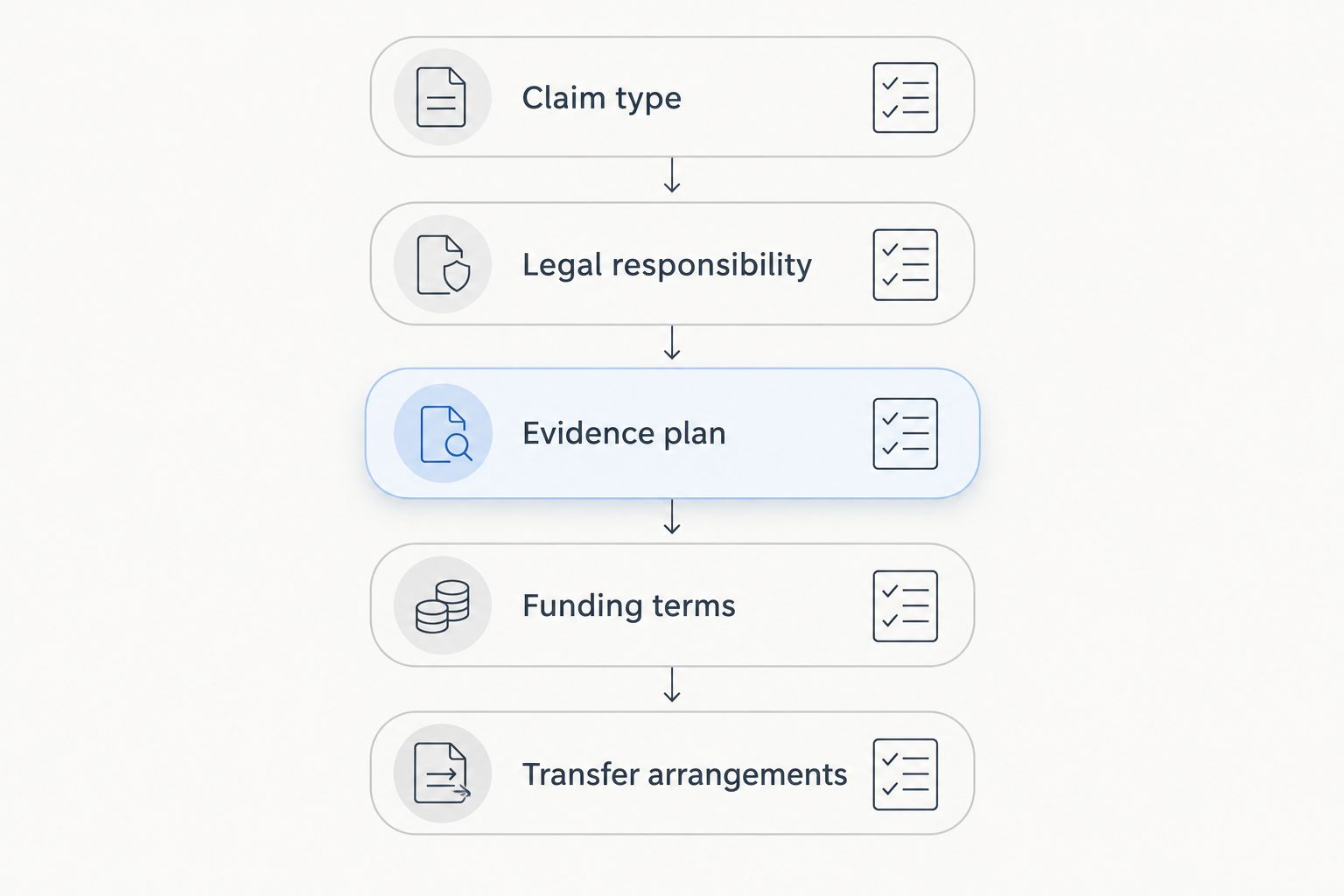
Keep a copy of the answers. You are comparing commitments about your case, not just descriptions of a firm's services. If an answer is unclear, ask the solicitor to explain it before you sign.
For an existing claim, the proposed new solicitor needs to understand the current procedural position. Tell them about any court action, upcoming hearing, settlement offer or unresolved request for evidence. Do not leave urgent work without an identified person responsible for it.
Discuss your Scottish injury claim
Explain your accident or illness and whether another solicitor already handles the claim.
When staying with Express Solicitors is the right call
Stay with Express Solicitors if the firm explains the Scottish legal position, you understand the investigation plan and the engagement meets your needs. A competitor comparison is not, by itself, a reason to transfer an active claim.
Before changing firms, compare the practical benefit of the move with the work required to transfer the file. Ask about outstanding responsibilities under your existing agreement and the proposed arrangement with the new solicitor. Get those explanations before ending an instruction.
Keep the solicitor whose proposed handling fits your case—not the firm that makes the strongest general claim.
FAQ
What's the best Express Solicitors alternative in Scotland?
Thompsons Scotland is a relevant choice for Scottish personal injury and accident compensation advice. Its stated services include road traffic, workplace, industrial disease and asbestos claims; suitability depends on your circumstances and the proposed engagement.
Is a Scottish solicitor better for an accident in Scotland?
Choose a solicitor who can explain and handle the Scottish legal issues in your claim. The firm's name or location alone does not establish who will conduct the work or which jurisdiction applies.
Can I change solicitors during a personal injury claim?
You can seek advice about changing solicitors during a claim. Before transferring, establish whether the new firm will accept the case and how funding obligations, the file and urgent deadlines will be managed.
Does switching solicitors restart my claim deadline?
No, changing solicitors does not restart the limitation period. Ask who remains responsible for urgent work while any transfer is arranged.
How long do I have to bring a personal injury claim in Scotland?
Scottish personal injury claims generally have a three-year limitation period from the injury or a later relevant date of knowledge. Children, capacity issues and other circumstances affect the calculation, so obtain advice about your specific deadline.
What should I ask about no-win-no-fee arrangements?
Ask for a written explanation of the funding agreement and your responsibilities. Establish what happens if the claim succeeds, fails or ends early, including any proposed deductions or expenses.
Should I use a general practice for a workplace injury?
Consider a general practice when you also need advice about a separate legal problem, but confirm that it undertakes personal injury work. An employment dispute and an injury compensation claim are not the same instruction.
One last thing
Your most useful comparison question in 2026 is: Who is responsible for protecting my deadline while this decision is being made? It turns a general conversation about firms into a specific question about your claim.
Write down the answer. An enquiry, a request for a second opinion and an accepted instruction are different stages; establish what the solicitor has actually agreed to do.